

Short video ads are defined as paid video content under 60 seconds designed to deliver a brand message within the natural flow of a viewer's session. They consistently outperform longer formats because they match how people actually consume media today: in fragmented bursts, across multiple screens, with limited patience for anything that doesn't earn attention immediately. Research confirms that video drives over 80% of online traffic, and short formats capture the largest share of that engagement. Platforms like Instagram Reels and YouTube Shorts have built entire advertising ecosystems around this reality, and brands like Copper Compression have seen measurable sales lifts by committing to short-form creative. Understanding why short video ads perform better is no longer optional for brand marketers. It's the foundation of a competitive 2026 ad strategy.
Why short video ads perform better than longer formats
The answer starts in the first five seconds. Short video ads succeed because they are built around the mechanics of bottom-up attention, the involuntary, stimulus-driven response that fires before a viewer consciously decides to watch. A fast visual cut, a bold on-screen statement, or an unexpected sound triggers that response instantly. Longer ads often bury their hook in a narrative setup that viewers never reach.
Fragmented media consumption patterns reinforce this advantage. Most people encounter ads during micro-moments: a 90-second scroll between meetings, a quick check of Instagram Reels while waiting in line, a YouTube Shorts session on a commute. These sessions are short by nature, and ads that respect that rhythm earn attention while interruptive formats lose it. Native, contextual placement within these sessions produces a 16% click-through rate, compared to far lower rates for forced pre-roll or interruptive formats.

Short videos also benefit from what researchers call contextual receptivity. When an ad fits the format and pacing of the surrounding content, viewers lower their psychological resistance. A 15-second vertical video on Instagram Reels feels native. A repurposed 60-second horizontal TV spot does not. That distinction drives measurable differences in engagement and recall.
Pro Tip: Design your short video ad to feel like the content surrounding it. If your audience is watching fast-cut UGC-style clips, your ad should match that energy, not interrupt it.
Key behavioral signals that short video ads exploit:
- Viewers decide within 1.4 seconds whether to keep watching or scroll past
- Mobile-first consumption favors vertical formats that fill the screen without requiring rotation
- Short sessions reward ads that deliver value or intrigue before the viewer's attention shifts
- Repeated exposure in voluntary engagement contexts builds recall without viewer fatigue
What creative elements maximize short video ad effectiveness
Creative structure is where short video ad effectiveness is won or lost. The research is specific and the margins are significant.
-
Lead with brand and message in the first five seconds. A Meta and Toluna study found that showing your brand and core message within the first five seconds increases purchase intent 1.7x. Most brands still bury their product reveal at the 10-second mark, which means a large share of viewers never see it.
-
Use format-native elements like emojis and on-screen text. The same Meta and Toluna research shows that using emojis native to the platform lifts purchase intent 2.5x. These elements signal to viewers that the content belongs in their feed, not in a TV commercial break.
-
Cap brand presence at 25% of total duration. Capping brand or product screen time at roughly 25% of the video's duration improves purchase intent 4.8x compared to ads that keep the product on screen throughout. Less is genuinely more here.
-
Shoot and edit in vertical 9:16 format with fast cuts. Winning short-form ads use cuts every 1.5 to 2.5 seconds and a UGC-style aesthetic over polished cinematic production. Native-style videos outperform polished 30-second brand films by two to three times on hook rate.
-
Open with a visual or audio hook in the first two seconds. The hook rate, defined as the percentage of viewers who watch past the first few seconds, is the single most predictive metric for short video ad performance. At 1.4 seconds, the scroll decision is already made.
Pro Tip: Test two versions of every short video ad: one that opens with the product on screen and one that opens with a problem or emotion. The product-first version often wins on direct response, while the emotion-first version wins on brand recall. Run both and let the data decide.
The short video ads vs long ads debate often centers on production quality, but the data points in the opposite direction. Authenticity and format fit outperform polish every time on short-form platforms. A brand like Black & Decker can generate stronger engagement with a 15-second demonstration clip shot vertically than with a broadcast-quality 60-second spot repurposed for mobile.
How does platform choice influence short video ad performance?
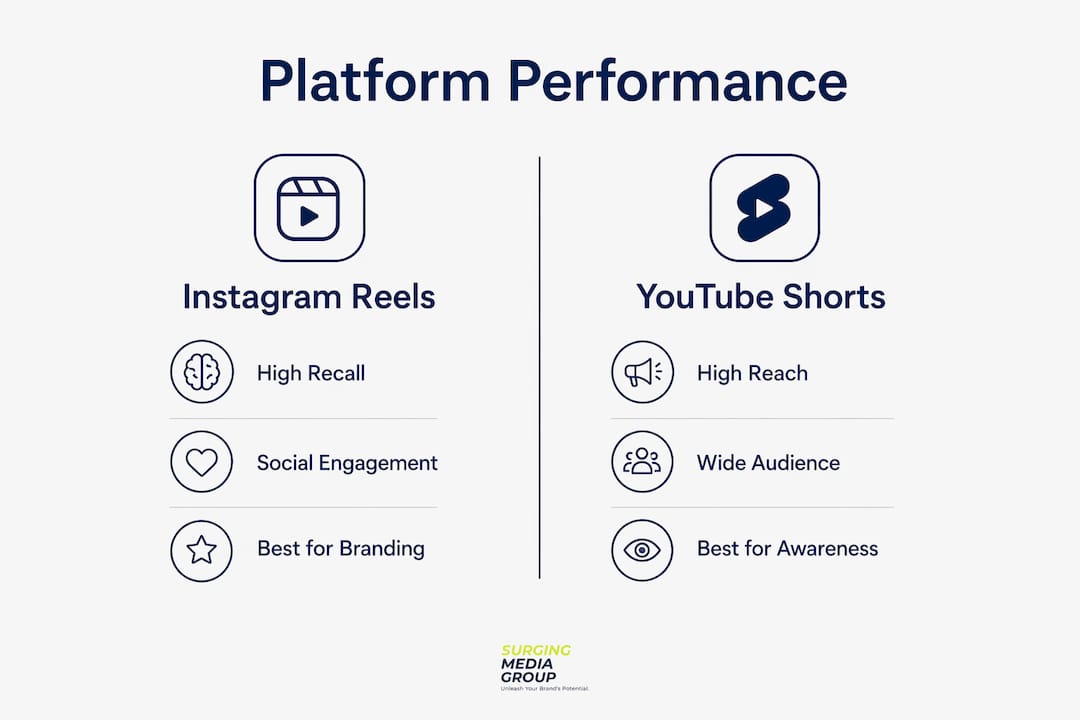
Platform context shapes how viewers receive and remember your ad. Instagram Reels and YouTube Shorts are the two dominant short-form platforms for paid advertising, but they do not perform identically.
| Platform | Brand recall strength | Key advantage | Best use case |
|---|---|---|---|
| Instagram Reels | Higher | Social interactivity, shares, comments | Brand recall, direct response, purchase intent |
| YouTube Shorts | Moderate | Search intent context, longer session depth | Awareness, product education, retargeting |
| Publisher vertical video | High engagement | Premium editorial context, CPM efficiency | Reach extension, contextual targeting |
Research comparing Instagram Reels and YouTube Shorts found that Instagram drives stronger brand recall due to higher engagement intensity and social interactivity. The first three seconds are critical on both platforms, but the social layer on Instagram, including likes, shares, and comment visibility, amplifies the memory signal. YouTube Shorts benefits from search intent context, making it more effective for product education and retargeting sequences.
Publisher-side vertical video is an underutilized channel worth your attention. Time-limited vertical video drives 2.5 times higher engagement compared to standard formats, and nine in ten US consumers are open to short vertical clips. Publishers charge CPM premiums of 25 to 40% for this format, which reflects genuine performance lift rather than inventory scarcity.
The practical implication is that you should not run the same creative across all platforms and expect uniform results. Testing platform-native delivery is the only way to understand where your specific audience responds. A streaming ad placement strategy that accounts for platform context will consistently outperform a one-size-fits-all approach.
What are the trade-offs of short video ads on memory and learning?
Short video ads are not without cognitive costs, and understanding those costs makes you a sharper media planner. Neuroscience research published in Communications Psychology found that fragmented short videos impair memory accuracy and reduce neural synchrony compared to longer continuous video. Participants exposed to short-form content showed higher forgetting rates and reduced activation in brain structures responsible for memory retrieval.
A separate study in npj Science of Learning confirmed that short videos disrupt semantic processing and cognitive control, reducing the brain's ability to integrate information across a session. This matters for brand marketers because it means a single short video ad, no matter how well crafted, may not be sufficient for complex product messaging or high-consideration purchases.
"Marketers should use short videos for fast answers and reserve longer videos for in-depth explanations due to the cognitive costs of fragmented consumption." — Neurocognitive research synthesis
The strategic response is not to abandon short video. It is to build a portfolio. Use short videos to capture attention, trigger recognition, and drive immediate response. Use longer assets, whether a 2-minute product demo or a 90-second testimonial, for the conversion stage of the funnel where deeper understanding matters. Brands that treat short video as the only tool in the kit leave conversion on the table.
One advanced technique worth adopting: serial short videos that each answer a single micro-question in sequence. Rather than cramming a product's full value proposition into 15 seconds, you create a series of 10 to 15-second clips that each address one objection or benefit. This approach captures the attention advantages of short format while mitigating the memory disruption that comes from fragmented, isolated viewing. The impact of short video marketing compounds when the creative strategy accounts for how memory actually works.
Key takeaways
Short video ads perform better because they align with how viewers actually consume media, but their effectiveness depends entirely on creative structure, platform fit, and strategic placement within a broader content mix.
| Point | Details |
|---|---|
| Hook within 1.4 seconds | Viewers make the scroll decision before two seconds; your opening frame is your entire pitch. |
| Brand visibility drives intent | Showing brand in the first five seconds increases purchase intent 1.7x, per Meta and Toluna research. |
| Platform context determines recall | Instagram Reels outperforms YouTube Shorts for brand recall due to social interactivity. |
| Native format beats polish | Vertical 9:16 UGC-style ads outperform cinematic 30-second spots by two to three times on hook rate. |
| Balance short with long assets | Short video captures attention; longer content handles complex messaging and conversion depth. |
What I've learned from years of building short video ad campaigns
I've watched brands make the same mistake repeatedly: they take a 60-second TV spot, chop the last 45 seconds off, and call it a short video ad. The result is a video that opens with a slow brand logo reveal and a voiceover that assumes the viewer is already invested. They are not. They never were.
The brands that win with short-form creative treat it as a distinct discipline, not a trimmed-down version of something else. Every frame has to earn its place. The first two seconds are not setup. They are the entire argument. I've seen 12-second clips from brands like Copper Compression generate stronger direct-response results than polished 45-second productions, not because they were cheaper to make, but because they were built with the viewer's micro-moment in mind.
My honest advice: stop thinking about short video ads as a format constraint and start thinking about them as a creative philosophy. Respect the scroll. Respect the session. Build for the platform, not for the boardroom presentation. And invest in creative variation testing as a standard part of your production process, not an afterthought. The brands that iterate fastest on short-form creative are the ones pulling ahead in 2026.
— Sergio
How Surgingmedia helps brands build short video ads that convert

Surgingmedia specializes in producing short-form video ads built for performance, not just aesthetics. Every project starts with a direct-response framework: fast hooks, native vertical formats, and creative structures proven to drive purchase intent on Instagram Reels, YouTube Shorts, and publisher placements. The team handles concept development, scripting, production, and performance analytics end to end, so your creative is tested and optimized before significant media spend goes behind it. Whether you are scaling a single product or building a multi-platform campaign, Surgingmedia's production process is designed to generate high-converting video content that fits the 2026 short-form ad environment. Brands like Black & Decker and Copper Compression have used this approach to drive measurable sales lifts across paid social and streaming channels.
FAQ
Why do short video ads outperform longer video formats?
Short video ads match the fragmented, micro-moment nature of modern media consumption, capturing attention within 1.4 seconds and fitting natively into platform session flows. Longer formats require sustained viewer investment that most ad placements cannot guarantee.
How long should a short video ad be for best results?
Most high-performing short video ads run between 10 and 30 seconds, with the core brand message delivered in the first five seconds. Formats under 15 seconds work best for awareness and direct response on Instagram Reels and YouTube Shorts.
Does Instagram Reels or YouTube Shorts perform better for brand recall?
Research shows Instagram Reels drives stronger brand recall than YouTube Shorts due to higher social interactivity, including shares and comments that reinforce memory. YouTube Shorts performs better for search-intent contexts and product education sequences.
Can short video ads hurt brand memory?
Neuroscience research confirms that fragmented short video exposure can reduce memory accuracy and neural synchrony compared to longer continuous content. The solution is pairing short video ads for attention and response with longer assets for complex messaging and conversion depth.
What is the most important creative element in a short video ad?
The hook in the first two seconds is the single most critical element, determining whether viewers scroll past or keep watching. Showing your brand or product within the first five seconds, combined with format-native elements like vertical framing and on-screen text, produces the strongest purchase intent results.