

Streaming ad placement shapes whether your video ads get seen, felt, and acted on — or skipped without a second thought. As connected TV and on-demand video continue pulling audiences away from traditional broadcast, brand marketers and business owners need to understand what is streaming ad placement and how it differs from simply "running a video ad." This guide breaks down how streaming ads work, the placement formats that matter most in 2026, how to plan smarter campaigns, and what the platforms and data are actually telling us about where attention lives.
Table of Contents
- Key takeaways
- What is streaming ad placement and how it works
- Types of streaming ad placements and their strategic uses
- Benefits and challenges of streaming ad placement
- How to plan and optimize your streaming ad placements
- My perspective on where streaming ad placement is heading
- How Surgingmedia helps you get streaming right
- FAQ
Key takeaways
| Point | Details |
|---|---|
| Placement determines context | Whether your ad runs before, during, or after content changes how receptive viewers are to your message. |
| SSAI shapes viewer experience | Server-side ad insertion delivers ads as part of a continuous stream, reducing buffering and improving engagement. |
| Interactive formats convert | Pause ads and shoppable placements turn passive viewing moments into active conversion opportunities. |
| Platform mix matters | YouTube, Amazon Prime Video, and Hulu dominate marketer budgets, but each serves different audience behaviors. |
| Verification is non-negotiable | Without confirming sound-on, in-view playback, you cannot accurately measure streaming ad campaign performance. |
What is streaming ad placement and how it works
At its core, streaming ad placement refers to where and when a video ad appears relative to streaming content. That sounds simple. But the "where and when" carries enormous strategic weight.
There are two primary categories every marketer needs to understand:
- In-stream ads appear inside a video player, integrated directly within the content experience. These include pre-roll (before the show starts), mid-roll (during playback), and post-roll (after the content ends).
- Out-stream ads appear outside the video player environment, typically embedded in article pages or social feeds, auto-playing as users scroll past them.
The distinction matters because audience context is completely different. Someone actively watching a show on Hulu is in a lean-back, high-focus state. Someone scrolling through a news article is skimming. Streaming ads reach viewers already engaged with content, which is why in-stream placements consistently outperform out-stream in brand recall and response rates.
How the technology actually delivers your ad
The mechanism behind the scenes is worth knowing. Server-side ad insertion (SSAI) stitches ads directly into the video stream before it reaches the viewer's device, creating one seamless, continuous playback experience. This is different from client-side ad insertion, where the device fetches the ad separately, often creating a brief buffering moment or visible transition. SSAI removes that friction and significantly reduces ad-blocker interference since the ad is part of the stream itself.
Here is a quick comparison of the core placement formats:
| Format | When it plays | Primary use case | Skippable? |
|---|---|---|---|
| Pre-roll | Before content | Brand awareness, product launches | Often after 5 seconds |
| Mid-roll | During content | Engagement, storytelling | Platform-dependent |
| Post-roll | After content | Direct response, retargeting | Usually yes |
| Pause ad | When viewer pauses | Interactive engagement, conversion | N/A (non-intrusive) |
| Out-stream | Outside video player | Reach expansion, awareness | Yes |
Understanding these formats is foundational. But knowing when to deploy each one, and on which platform, is where strategy begins.
Types of streaming ad placements and their strategic uses
Pre-roll ads grab attention at the highest-intent moment in the viewing session. The viewer has committed to watching something, so your ad lands when focus is sharpest. These work especially well for brand awareness campaigns and product launches where you need quick, memorable impressions in 6 to 30 seconds.

Mid-roll placements carry a different energy. The viewer is already invested in the content, which creates a captive moment that rewards longer, story-driven creative. If your brand has something worth saying, mid-roll gives you space to say it. Post-roll placements, meanwhile, are underused. By the time the content ends, intent signals are high for viewers who sat through the whole thing. These are ideal for direct-response messaging and retargeting.
Then there are the formats that are reshaping how brands think about streaming media advertising entirely.
Interactive and pause ads
Pause ads on Prime Video appear the moment a viewer hits pause, occupying the screen in a non-intrusive overlay. What makes them extraordinary is the data behind them: 81% of viewers pause to avoid missing content, and 51% act on pause ads. That combination of high attention and behavioral trigger is rare in advertising. CTAs are designed specifically for remote control interaction, offering options like "Add to Cart" or "Send to Email," which means the conversion path is native to the device the viewer is already holding.
Shoppable ads go a step further, embedding purchase functionality directly inside the video player. A viewer sees a product featured in an ad, clicks with their remote or mobile device, and completes a transaction without leaving the content environment. For brands selling consumer products, this format collapses the funnel in ways that traditional TV simply cannot replicate.
Platform distribution across streaming
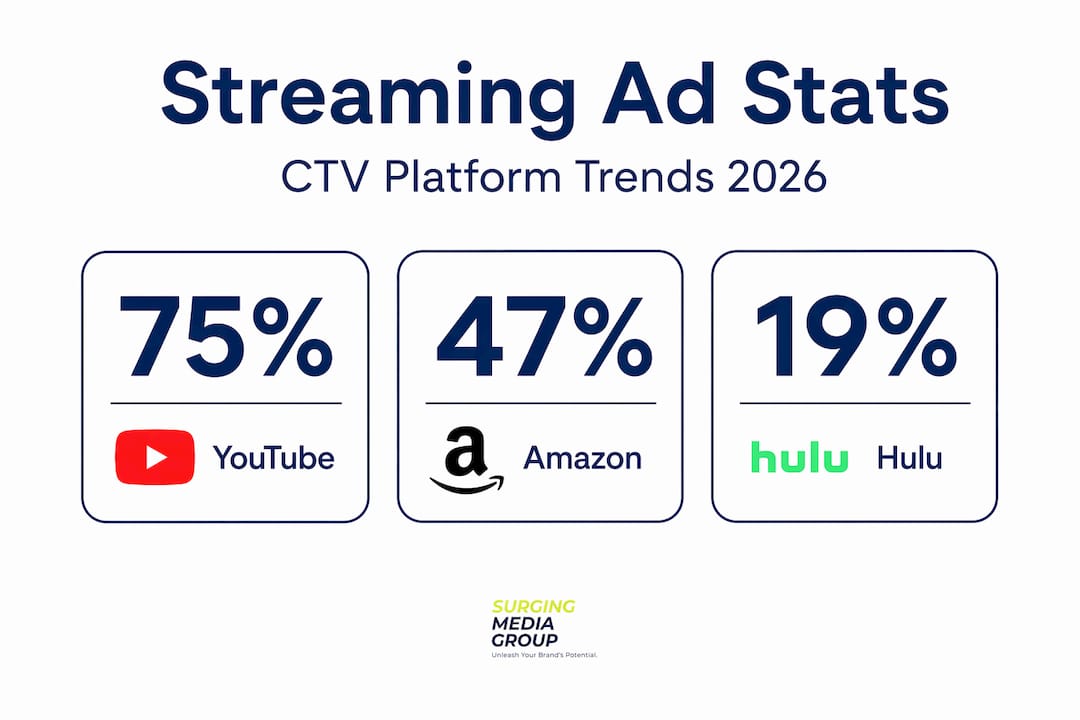
Budget allocation across CTV platforms in 2026 tells a clear story: 75% of marketers place ads on YouTube, 47% on Amazon Prime Video, and 43% on both Hulu and Paramount+. YouTube took the largest share of overall budget. Each platform attracts different viewer behaviors. YouTube skews toward active search-driven viewing and shorter formats. Amazon Prime Video audiences are in lean-back mode with high purchase intent baked into the ecosystem. Hulu captures a broad demographic across scripted content and live sports.
Pro Tip: Match your placement type to the platform's viewing behavior, not just its reach numbers. A 90-second story-driven mid-roll will land very differently on YouTube than on Prime Video, where viewers are settled in for longer sessions.
Understanding types of video ads and their platform fit is what separates a campaign that performs from one that just runs.
Benefits and challenges of streaming ad placement
The appeal of streaming ad placement for brand marketers comes down to three things: precision, measurability, and context.
Traditional TV buys are broad. You pay for a time slot and hope your demographic is watching. Streaming flips that model. You reach specific audiences based on viewing history, purchase behavior, household income, and content preferences. That specificity means less waste and a tighter feedback loop between spend and outcome.
Here are the core benefits that set streaming apart:
- Audience targeting precision: Reach viewers by interest, behavior, or device, not just by daypart or channel.
- Performance measurement: Track completions, click-throughs, and conversions at the individual placement level rather than relying on panel-based ratings.
- High-engagement context: Viewers actively watching video content are significantly more receptive to ads woven into that experience versus ads encountered while scrolling.
- Interactive conversion paths: Formats like pause ads and shoppable placements create direct response opportunities within the content environment.
- Cross-device reach: Serve ads across smart TVs, mobile, desktop, and tablets through unified campaign management.
Where the challenges live
Measurement in streaming is more complex than it appears. Without placement verification, you cannot confirm that your ad ran in the intended context. An ad marked as "delivered" may have played with sound off, in a background tab, or alongside content that conflicts with your brand values. That gap between "served" and "seen" is where campaign budgets quietly bleed out.
The IAB's standards for in-stream ads specify that true in-stream placements should play with sound on by default and appear as the primary content focus. Not every platform or publisher honors this consistently. As a marketer, you need verification tools that confirm playback state, not just impression delivery.
Pro Tip: Before committing budget to any streaming placement, ask your platform or DSP partner specifically how they define and verify in-stream delivery. Sound-on, full-screen, primary-content-focus placements are the standard you should hold them to.
How to plan and optimize your streaming ad placements
Planning a streaming ad campaign that actually performs requires more than picking a platform and uploading a video. Here is how to approach it with intention:
-
Define your objective first. Are you building brand awareness, driving product consideration, or converting ready buyers? Your objective determines which placement types you prioritize. Awareness campaigns lean into pre-roll and high-reach out-stream. Direct response campaigns belong in mid-roll, post-roll, and interactive formats.
-
Map your audience to platforms. Use what you know about your buyers. High-income households skew toward connected TV platforms with premium content. Younger demographics remain heavily concentrated on YouTube. Shoppers with active purchase intent are often best reached through Amazon's ecosystem. Check your audience targeting strategy against the platform's actual user composition before committing budget.
-
Allocate budget by platform strength, not just reach. The platform budget data shows YouTube commanding the largest overall share, but that does not mean it is right for every brand. A brand selling premium kitchenware may find Prime Video's environment produces higher returns at lower reach because the audience context matches purchase behavior more closely.
-
Design creative for the specific placement. A pre-roll ad needs to earn attention in the first three seconds. A mid-roll ad can build a narrative. A pause ad needs to be visually compelling with a single, remote-friendly CTA. Repurposing the same 30-second spot across every format is one of the most common budget killers in streaming campaigns.
-
Implement placement verification from day one. Work with your DSP or measurement partner to confirm sound-on, in-view delivery for every placement. Set up conversion tracking that ties impression data to downstream actions like site visits, add-to-carts, or purchases.
-
Review and rotate creative regularly. Streaming audiences on premium platforms often see the same ads repeatedly. Frequency caps protect viewer experience, but strong creative rotation keeps your brand fresh. Track completion rates by placement type. A drop in completion signals either a creative issue or a placement mismatch.
These best practices for ad placement do not require a massive team. What they require is intentionality at each stage of the planning process.
My perspective on where streaming ad placement is heading
I've spent years watching the distance between television advertising and digital performance marketing collapse. What's happening in streaming right now is the most interesting version of that convergence I've seen.
Here's what I've learned: most brands underinvest in creative differentiation by placement type and overinvest in platform coverage. They spread budget across YouTube, Hulu, and Prime Video, run the same asset everywhere, and then wonder why results are inconsistent. The placement itself is only half the equation. The creative has to be built for that placement moment.
What I find genuinely underused is the post-roll format. It has a reputation as an afterthought, but viewers who sit through an entire piece of content are self-selecting. They finished the show. They are in a different headspace than someone who just pressed play. A sharp direct-response message in post-roll, tied to something specific about the content they just watched, can outperform a flashier pre-roll by a significant margin.
The platforms are also maturing fast. Interactive formats like pause ads and shoppable placements were novelties two years ago. Now brands like Copper Compression and others in the performance space are treating them as primary conversion mechanisms, not experiments. The video assets that drive performance in 2026 are built with specific placements in mind from the first line of the script.
My honest take: if you are not yet thinking about streaming ad placement as a creative brief and not just a media buy, you are leaving real revenue on the table.
— Sergio
How Surgingmedia helps you get streaming right
If this guide clarified the mechanics of streaming ad placement, the next question is whether your video creative is actually built to perform within these placements. Most brands have a content gap they don't realize exists until campaign results come back flat.
Surgingmedia specializes in producing video content that sells across every major streaming format, from 6-second pre-roll bumpers to interactive pause ads and shoppable CTV spots. Every project is built on direct-response principles, meaning the creative is designed not just to look good but to convert at each specific placement moment. Whether you are scaling an existing campaign or building your first streaming ad strategy from scratch, the Surgingmedia team can help you match the right creative to the right placement and measure what actually works. Reach out to start building your streaming campaign.
FAQ
What is streaming ad placement in simple terms?
Streaming ad placement refers to where and when video ads appear within or around streaming video content, including before, during, or after shows on platforms like YouTube, Hulu, or Amazon Prime Video.
What are the main types of streaming ad placements?
The primary types include pre-roll, mid-roll, post-roll, pause ads, and out-stream ads. Each serves a different marketing objective and audience engagement moment.
How do streaming ads work technically?
Most streaming ads are delivered using server-side ad insertion (SSAI), which stitches the ad into the video stream before it reaches the viewer's device, creating seamless playback without buffering interruptions.
Why does placement verification matter for streaming ads?
Without verification, advertisers cannot confirm their ads ran with sound on and in the intended context. Unverified placements make it impossible to accurately measure campaign performance or ensure brand safety.
Which platforms should brands prioritize for streaming ad placement?
In 2026, YouTube captures the largest share of marketer budgets at 75%, followed by Amazon Prime Video at 47% and Hulu at 43%. The right platform depends on your audience's behavior and your campaign objective.