

Most direct-response marketers have run the same experiment: pour budget into a video campaign, watch the view counts climb, then open the attribution report and find almost nothing tied to revenue. The disconnect is not a creative failure. It is a structural one. A well-built brand storytelling video strategy changes that equation by connecting narrative-driven content to real demand signals, tracked in ways that actually reflect how buyers behave. This guide walks you through the full arc, from diagnosing what your current video marketing strategy is missing to building, distributing, and measuring brand narrative video that earns both attention and bottom-line results.
Table of Contents
- Understanding the problem: why typical video strategies fall short
- Preparing your brand storytelling video strategy: key elements and tools
- Executing brand storytelling videos for direct-response marketing
- Verifying your brand storytelling video strategy's impact
- Why brand storytelling videos are your secret weapon in direct marketing
- Get professional support for your brand storytelling video strategy
- Frequently asked questions
Key Takeaways
| Point | Details |
|---|---|
| Measure beyond clicks | Focus on branded search lift and on-site engagement to truly assess brand storytelling video impact. |
| Use modular story systems | Create flexible video assets that can be adapted across platforms without repetition. |
| Optimize video placement | Place videos on relevant high-intent pages for better play rates and conversion support. |
| Combine channels | Leverage YouTube for reach and owned sites for conversion to maximize ROI. |
| Prioritize storytelling | Engage audiences emotionally to drive trust, consideration, and purchase intent. |
Understanding the problem: why typical video strategies fall short
The most common gap I see in direct-response video marketing strategy is not budget or production quality. It is attribution. Most teams measure what is easy to measure: impressions, views, click-through rates. Those numbers feel good in a report, but they rarely capture what storytelling in marketing actually does to buyer behavior.
Last-click attribution undercredits top-funnel storytelling, specifically by missing YouTube's measurable impact on branded search lift. In practice, this means your video campaign drives real demand, people search your brand name, visit your site, and convert, but the video never gets credit because no one clicked directly from it to a purchase page.
There are a few other structural problems worth naming:
- View-only optimization: Teams that optimize purely for social views are measuring reach, not intent. A video with 500,000 views on a social platform may generate less measurable ROI than a 15-second product story embedded on a high-converting landing page.
- Placement blind spots: Many brands treat all video placements as equal. They are not. Videos placed on video asset performance pages, like product detail pages or category landing pages, regularly outperform passive social views because the audience is already in a buying mindset.
- No demand signal tracking: When marketers skip branded search monitoring and holdout measurement, they lose the clearest evidence that storytelling is working.
The result is a cycle where storytelling video gets underfunded because it cannot prove its value under a measurement model that was never designed for it.
Preparing your brand storytelling video strategy: key elements and tools
Before a single frame is shot, the preparation work determines whether your brand storytelling video strategy produces demand or just content. The brands that get this right build from audience insight outward, not from a creative brief inward.
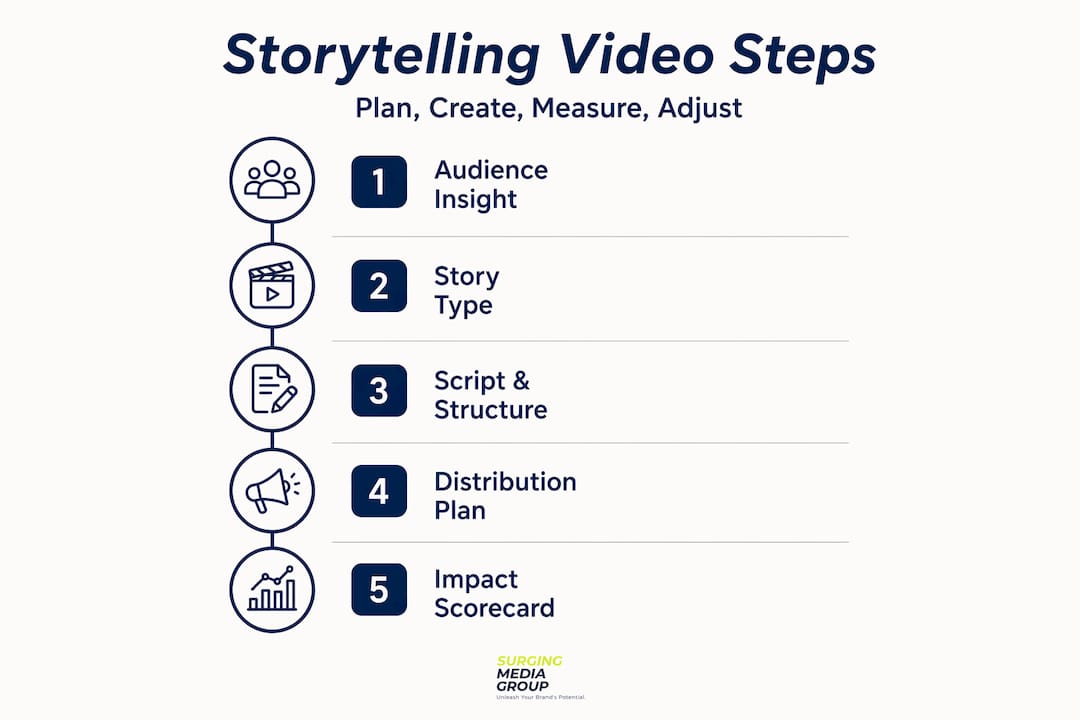
Start with a genuine understanding of your customer. Not demographics alone, but motivations. What problem are they aware of? What language do they use when describing it? What makes them distrust a brand in your category? Those answers shape every story decision. Effective storytelling videos communicate purpose, values, and impact to build trust and emotional connection, and that only works when the story reflects something true about your audience's experience.
Next, choose the right story type for your goal:
| Story type | Best for | Primary emotion triggered |
|---|---|---|
| Founder story | New brand awareness | Trust, relatability |
| Customer journey | Mid-funnel consideration | Empathy, social proof |
| Brand values | Long-term loyalty | Belonging, identity |
| Problem-solution | Direct response, conversion | Relief, urgency |
Each story type has a different job to do in the funnel. Mixing them without intention creates confusing messaging. Pick one per campaign phase and build from there.
I rely on a simple story spine framework to structure the narrative: setup (who is the character and what do they want), conflict (what is standing in the way), and resolution (how the brand provides a path forward). This three-part arc works whether the video is 30 seconds or 10 minutes. It also makes it easier to produce modular edits later, because each section can stand alone as a shorter asset for video asset strategy across platforms.

Pro Tip: Before finalizing any script, read it out loud and ask: would a real customer say any of these lines? If the answer is no, the script is still in marketing language, not human language. Rewrite until it sounds like a person, not a brand.
Finally, map your distribution plan before production, not after. Where the video will live should influence how it is shot, how long it runs, and what call to action is appropriate. A homepage video, a YouTube pre-roll, and a TikTok reel are three different formats that serve three different audience moments.
Executing brand storytelling videos for direct-response marketing
Execution is where strategy either holds or breaks apart. The mechanics of producing engaging video content for direct response follow a clear sequence, and skipping steps early usually means expensive reshoots or underperforming assets later.
Here is how I approach it:
- Open with proof, not polish. The first five seconds of any brand narrative video must earn trust. A real customer face, a specific claim backed by evidence, or a situation the viewer instantly recognizes works better than a cinematic logo reveal. Credibility cues in the opening reduce skip rates significantly.
- Build your modular story system. Shoot your core long-form story with short-form segments deliberately planned in. A 90-second brand story should be editable into a 30-second social version and a 15-second retargeting cut without losing coherence. This approach multiplies your asset output without multiplying your production budget.
- Distribute for intent. YouTube excels at attention, relevance, and trust, influencing purchase decisions more than social platforms. Use YouTube for broader reach and trust-building. Then drive that warmed audience to owned pages where conversion-focused video content closes the loop.
- Optimize placement by context. A product detail page calls for a concise, feature-forward story. A brand values video fits the About page or a retargeting sequence. Mismatched placement kills engagement regardless of how good the creative is.
- Test hooks systematically. Create two or three different video openings for the same core story and run them as separate ad variations. Opening performance often varies by 40% or more, and finding the right hook early saves wasted spend at scale.
- Track beyond the platform dashboard. Social platform metrics reflect what happened on the platform. Real performance lives in your branded search data, site engagement rates, and downstream conversion behavior.
Here is a reference table for video length by placement:
| Placement | Recommended length | Primary goal |
|---|---|---|
| Social media pre-roll | 6-15 seconds | Awareness, recall |
| YouTube in-stream | 30-90 seconds | Consideration, trust |
| Homepage | 60-120 seconds | Brand introduction |
| Product/landing page | 30-90 seconds | Conversion |
| Email or retargeting | 15-30 seconds | Re-engagement |
Homepage videos have a 24% play rate and long videos over 60 minutes reach a 52% play rate, which speaks to how deeply engaged audiences become when they find content that genuinely matches their intent. For ecommerce, this signals real opportunity in owned placements that most brands leave underdeveloped.
Pro Tip: When embedding video on video production services pages or product pages, always use a video platform that tracks individual viewer behavior, like chapters watched and drop-off points. That data tells you exactly where your story loses people, and it is far more useful than aggregate view counts.
Verifying your brand storytelling video strategy's impact
Verification is where most brand storytelling video strategies either earn their budget for next year or get cut. The problem is that standard reporting was built for direct-response channels where the click is the conversion step. Storytelling lives upstream of the click, so you need a different measurement approach.
Here is what actually works:
- Branded search lift: Track your brand name search volume before, during, and after a storytelling campaign. YouTube campaigns can drive 30 to 50% increases in branded search volume, and last-click attribution misses all of it. If your branded search rises while a campaign runs, the story is working.
- Holdout testing: Split your audience so one group receives the storytelling video campaign and another does not. Compare conversion rates, average order value, and return visits between the two groups. This is the cleanest proof of storytelling's demand impact.
- On-site engagement depth: Website videos on homepage and landing pages yield better ROI than social engagement metrics alone. Watch time on owned pages, scroll depth after video views, and subsequent page visits tell a richer story than platform-level data.
- Returning visitor rate: Storytelling builds brand recall. Track whether audiences who viewed your brand narrative video return to your site at higher rates than audiences who only saw performance ads.
- Internal communication: Share verified results in language your finance and leadership teams understand. Not "we got 2 million impressions" but "branded search volume increased 34% during the campaign, and direct site sessions rose 18%." That framing earns future budget.
Pro Tip: Build a simple scorecard that combines branded search lift, holdout conversion difference, and on-site video engagement into a single monthly summary. It takes 30 minutes to assemble and becomes your most persuasive tool for justifying storytelling investment to skeptics.
Why brand storytelling videos are your secret weapon in direct marketing
Here is what I genuinely believe after years of working inside brand video campaigns: the marketers who treat storytelling as a "brand awareness luxury" are leaving measurable revenue on the table. Storytelling is not soft. It is structural.
Story-driven video content is more engaging, scalable, and effective across the funnel than hard-sell formats, and the measurement frameworks now exist to prove it. The argument that storytelling cannot be held accountable was always a failure of measurement design, not a failure of the medium.
What makes this a genuine competitive edge right now is that most brands still run their video programs in silos: performance videos for conversion, brand videos for awareness, social videos for engagement. The brands pulling ahead treat their story as one modular world, where every asset shares characters, language, and visual identity. That consistency compounds over time. Each new touchpoint reinforces the last, building the kind of recognition that makes every other marketing dollar more efficient. The importance of video assets as a connective tissue across your funnel cannot be overstated.
The other shift worth naming is consumer expectation. Audiences have spent years watching streaming content, YouTube documentaries, and creator-led storytelling. They recognize when a brand is genuinely trying to communicate something versus running a disguised sales pitch. Earning attention now requires the same respect for narrative that good entertainment demands. That is a higher bar, but it is also an enormous filter. Most brands will not clear it, which means those that do earn a level of trust that performs across every channel.
Get professional support for your brand storytelling video strategy
Building a brand storytelling video strategy that actually moves demand metrics takes more than a good creative idea. It takes production expertise, distribution planning, and a measurement framework built from the start, not bolted on at the end.
At Surging Media, we produce narrative-driven video content specifically designed to perform in direct-response environments. From scripting and production through platform distribution and performance reporting, we handle the full process so your brand story reaches the right audience and earns measurable results. Our work with brands like Copper Compression and Black & Decker shows what happens when creative storytelling and direct-response discipline are built into the same production process. If you are ready to build video content that earns its budget, explore our video production services or reach out to the Surging Media team to get started.
Frequently asked questions
What is a brand storytelling video strategy in direct-response marketing?
It is a planned approach to create and distribute videos that tell your brand's story to build emotional connections and measurable demand that supports direct-response goals. Brand storytelling videos communicate mission, values, and personality to build trust and emotional connection with your target audience.
How can I measure the impact of brand storytelling videos beyond views?
Track branded search lift, conduct holdout tests, and analyze on-site engagement, since last-click attribution consistently underestimates storytelling's top-funnel impact. YouTube campaigns can boost branded search volume by 30 to 50%, and that lift is almost entirely invisible in standard attribution reports.
Should I focus on social media or owned website for brand story videos?
Combine both: social media delivers reach and engagement while owned website videos on the homepage or landing pages offer higher play rates and better ROI. Owned website videos on the homepage bring better ROI than social engagement metrics alone.
How can I make brand storytelling videos effective for ecommerce?
Create modular story assets reflecting characters and situations your customers recognize, then distribute them deliberately across each stage of your marketing funnel. Treat your brand story as a modular "world" to create multiple short-form assets across the funnel without feeling repetitive.
What are common mistakes to avoid when producing brand storytelling videos?
Avoid optimizing only for social views, skipping demand impact measurement, and ignoring context-appropriate video length and placement for each funnel stage. Owned placements often drive better ROI with higher play rates than social-only distribution strategies.