

Pouring money into video ads without precise targeting is like racing with the wrong fuel — you burn through budget fast and finish nowhere near the podium. For e-commerce brands and Amazon sellers, the gap between a campaign that converts and one that drains spend often comes down to how well you've matched your message to the right viewer at exactly the right moment. This guide walks you through every layer of video ad targeting, from building audience profiles to launching campaigns and measuring what actually moves the needle, so your creative investment pays off in real revenue.
Table of Contents
- Core targeting methods for video ads: What works and why
- Preparing your audience profile: Research, segmentation, and platform specifics
- Building and launching targeted video ad campaigns: Practical workflow
- Verifying campaign impact: Metrics, benchmarks, and troubleshooting
- A fresh perspective: Why context beats pure audience targeting
- Unlock higher conversions with expert video production
- Frequently asked questions
Key Takeaways
| Point | Details |
|---|---|
| Target context matters | Contextual targeting can significantly boost engagement and CTR for video ads. |
| Segment for platforms | Different ad platforms require tailored segmentation to maximize results and reach. |
| Creative refresh is critical | Refreshing video creatives every week prevents ad fatigue and sustains conversions. |
| Benchmark performance | Track CTR, CPM, and completion rates to compare against industry standards and improve effectiveness. |
| Leverage professional services | Partnering with expert video producers helps scale campaigns and optimize for conversion. |
Core targeting methods for video ads: What works and why
With an understanding of why video ad targeting matters, let's break down the main methods you can use and how each impacts e-commerce results.
Video ad targeting isn't a single dial you turn up or down. It's a set of interlocking systems, each with its own logic and performance profile. Knowing which method fits your campaign goal is the first step toward spending smarter.
The four main targeting methods:
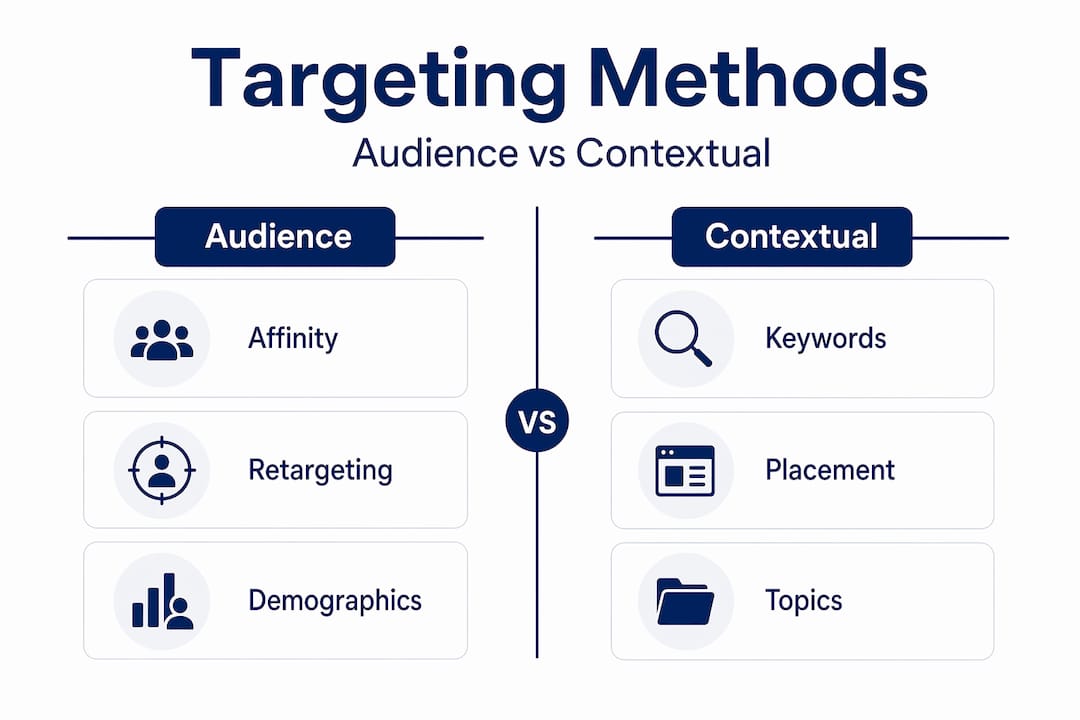
- Audience targeting groups viewers by affinity segments, interests, and demographics. Google Ads Video campaigns use affinity audiences, demographics, topics, keywords, and placements to reach the right viewers, making this method ideal for top-of-funnel brand awareness.
- Contextual targeting places your ad alongside content that matches your product's theme. It reads the page or video environment in real time, not just the viewer's history. Contextual targeting on YouTube boosts CTR up to 55% and view rates from 31.9% to 47%, outperforming pure audience targeting in many e-commerce tests.
- Keyword targeting is especially powerful on Amazon Sponsored Brands Video (SBV) and Google Video campaigns. You bid on search terms that signal purchase intent, placing your video directly in front of shoppers actively looking for solutions.
- Programmatic targeting layers both audience and contextual signals simultaneously. Programmatic systems evaluate real-time demographic and behavioral signals alongside contextual data through demand-side platforms (DSPs), enabling dynamic, auction-based placements at scale.
| Targeting method | Best for | Typical CTR range | Platform fit |
|---|---|---|---|
| Audience (affinity) | Brand awareness | 0.3% to 0.8% | YouTube, CTV, Google |
| Contextual | Mid-funnel engagement | 0.6% to 1.4% | YouTube, Display |
| Keyword | Purchase intent | 1.0% to 2.5% | Amazon SBV, Google |
| Programmatic | Scaled retargeting | 0.5% to 1.8% | DSPs, CTV, OTT |
Pro Tip: Don't default to a single method. Layering keyword targeting with contextual signals on Amazon SBV consistently outperforms either approach used alone, especially for products with strong visual storytelling potential.
Preparing your audience profile: Research, segmentation, and platform specifics
Once you know the targeting methods, the next step is preparing an audience profile tailored to your brand and platform.
An audience profile isn't a persona document that collects dust in a shared folder. It's a living, actionable map of who your buyers are, where they spend time, and what content surrounds them when they're most receptive to your message. Building it correctly changes everything downstream.
Step-by-step audience profiling for e-commerce:
- Pull first-party data first. Review your customer purchase history, email list demographics, and on-site behavior. These signals are more reliable than any platform estimate.
- Segment by intent stage. Separate cold audiences (no prior brand contact) from warm audiences (website visitors, product page viewers) and hot audiences (cart abandoners, past purchasers).
- Map segments to platforms. Amazon SDV (Streaming TV Ads) and SBV serve different purposes. Amazon SDV targets audiences for retargeting viewers of your products or conquesting competitors, while SBV uses keyword targeting to capture active search intent.
- Apply income and interest filters. Broad demographic filters waste impressions. A well-documented CTV case study showed that targeting women aged 28 to 55 with household incomes above $75,000 and home decor interests drove 41% revenue growth for an e-commerce brand, illustrating how precise segmentation translates directly to revenue.
- Build lookalike audiences from your best buyers. Most platforms let you upload a customer list and find viewers who share behavioral and demographic traits with your top converters.
| Platform | Primary targeting lever | Retargeting capability | Best use case |
|---|---|---|---|
| Amazon SBV | Keywords, ASINs | Product page viewers | Active shoppers |
| Amazon SDV | Demographics, interests | Cart abandoners | Brand awareness + retargeting |
| YouTube | Affinity, contextual | Site visitors via Google Ads | Funnel-wide coverage |
| CTV/OTT | Demographics, income | Household retargeting | Premium reach, high completion |
Pro Tip: On Amazon, conquesting competitor ASINs through SDV can be a fast route to trial for new product launches. Layer it with retargeting for viewers who've already seen your SBV ads to create a sequential narrative experience.
Building and launching targeted video ad campaigns: Practical workflow
Now that your audience profile is set, let's walk step-by-step through launching video ads that reach and convert the right viewers.

Execution is where strategy becomes revenue. The workflow below applies across platforms, though the specific controls differ. Treat it as a production checklist, not a loose set of suggestions.
Campaign launch workflow:
- Define your campaign objective clearly. Awareness, consideration, and conversion campaigns require different bidding strategies and creative formats. Mixing objectives in a single campaign dilutes performance data.
- Set your targeting layers before uploading creative. On Google and YouTube, build your audience segments, keyword lists, and topic exclusions before the campaign goes live. Retroactive targeting changes reset the algorithm's learning period.
- Match creative length to platform behavior. Six-second bumper ads work for retargeting on YouTube. Fifteen to thirty-second skippable ads suit mid-funnel storytelling. CTV pre-roll ads perform best at fifteen to thirty seconds, where CTV CPM averages $14 to $18.50 with 78% completion rates, and YouTube skippable CPV averages $0.024 broadly, dropping to $0.019 for retail and e-commerce.
- Launch with at least three creative variants. A/B testing from day one gives you actionable data within the first week. Vary the hook (first three seconds), the call-to-action, and the visual framing rather than making wholesale changes.
- Monitor video ad creative rotation actively. Platforms favor creatives that generate early engagement signals, so a strong variant can dominate quickly. Rotate underperformers out fast.
- Schedule your refresh cycle. Amazon video ads CTR benchmarks show that campaigns performing above 1.5% CTR are considered good, with optimized campaigns exceeding 2.0%. Creatives should be refreshed every 7 to 14 days to maintain those levels and combat creative fatigue before it erodes your ROAS.
- Review spend pacing daily in the first two weeks. Budget front-loading is common on new campaigns. Adjust delivery settings if you're burning through daily budgets before peak shopping hours.
The discipline here is sequential. Brands that skip audience validation before launch often find themselves optimizing a campaign that was structurally flawed from the start. Build the foundation right, and the optimization phase becomes refinement rather than rescue.
Verifying campaign impact: Metrics, benchmarks, and troubleshooting
With campaigns live and optimized, it's critical to measure success and know how to fix issues before budgets are wasted.
Numbers without context are noise. The benchmarks below give you a calibrated baseline so you know whether your campaign is performing, underperforming, or hiding a problem that will compound over time.
| Platform | CTR benchmark | CPM range | Completion rate | Target ROAS |
|---|---|---|---|---|
| Amazon SBV | 1.5% to 2.0%+ | $8 to $15 | 60% to 75% | 3x to 6x |
| YouTube skippable | 0.5% to 1.5% | $6 to $12 | 40% to 65% | 2x to 4x |
| CTV/OTT | 0.1% to 0.4% | $20 to $40 (avg $25) | 90% to 97% | 3x to 5x |
| Google Video | 0.4% to 1.2% | $5 to $10 | 45% to 70% | 2x to 4x |
CTV benchmarks show CPM averaging $25 with completion rates reaching 90% to 97% and a recommended frequency of 3 to 5 impressions per household before diminishing returns set in.
Diagnosing underperformance:
- CTR below benchmark: Usually a creative issue, not a targeting issue. The right audience is seeing the ad but not responding. Recut the first three seconds of your video.
- High view rate, low conversion: Targeting is working but the landing page or product listing isn't closing the sale. Audit your Amazon detail page or landing page for alignment with the ad's promise.
- Declining CTR week over week: Classic creative fatigue signal. Weekly refresh cycles are critical for sustained ROAS across video platforms. Introduce new hooks and visual angles before the drop becomes a cliff.
- High CPM with low impressions: Audience segment is too narrow. Broaden targeting or add contextual layers to increase available inventory.
"The biggest mistake I see e-commerce brands make is treating a video campaign as a set-and-forget asset. The creative that converts in week one rarely converts in week four. Optimizing video ad performance is an ongoing discipline, not a launch-day decision."
Actionable troubleshooting steps:
- Pull a placement report weekly to identify low-performing placements and exclude them
- Segment performance data by device type since CTV, mobile, and desktop often show dramatically different completion and conversion rates
- Compare creative variants by first-quartile view rate, not just overall CTR, to identify where viewers are dropping off
A fresh perspective: Why context beats pure audience targeting
After covering the practical steps, it's important to step back and challenge common assumptions in the industry.
Here's something I've seen repeatedly across campaigns for brands of all sizes: the instinct to narrow targeting as tightly as possible often backfires. The logic feels sound. Smaller audience, higher relevance, better results. But in practice, hyper-narrow audience targeting creates a different problem. You exhaust your segment fast, frequency climbs before you expect it, and performance collapses while you're still convinced the targeting is correct.
Contextual targeting operates on a different principle. It doesn't ask who the viewer is. It asks what they're watching right now, and whether that moment makes them receptive to your message. A viewer watching a kitchen organization video on YouTube is in a completely different mental state than the same viewer checking sports scores. Contextual targeting on YouTube captures that receptivity, which is why it drives CTR lifts up to 55% and view rate improvements that pure audience targeting simply can't match.
The post-cookie landscape accelerates this shift. As third-party data becomes less reliable, the brands that have built contextual targeting expertise are positioned to maintain performance while competitors scramble. This isn't a future trend. It's happening now, and the e-commerce brands I've worked with that leaned into video targeting strategies rooted in contextual logic consistently outperform those chasing ever-smaller audience segments.
The conventional wisdom says precision targeting equals better results. My experience says precision targeting plus contextual alignment equals better results. The "plus" is doing more work than most marketers realize. Don't abandon audience data. Layer it with context, and you'll find a targeting combination that's both efficient and durable.
Unlock higher conversions with expert video production
Having learned what works in targeting and creative, here's how you can leverage professional help for maximum impact.
Targeting strategy only performs as well as the creative it carries. A precisely targeted campaign built around a weak video is still a weak campaign. The brands that consistently win on Amazon, YouTube, and CTV share one trait: their video content was built with conversion in mind from the first frame.
At Surging Media, our video production services are engineered around direct-response principles, meaning every script, every visual choice, and every call-to-action is designed to move viewers toward a purchase decision. We've helped brands like Copper Compression and Black & Decker scale their video presence with creative refresh cycles that sustain performance week after week. Whether you need Amazon product videos, CTV pre-roll, or social reels, our video production solutions give your targeting strategy the creative firepower it deserves. Reach out to explore how we can build a campaign that converts.
Frequently asked questions
How do I choose between audience and contextual targeting for my video ads?
Contextual targeting often boosts CTR and view rates significantly, especially when combined with audience data. Contextual targeting on YouTube drives CTR lifts up to 55%, so test both methods but lean toward contextual signals for e-commerce campaigns where purchase intent is tied to content environment.
What's a good CTR for Amazon video ads?
Above 1.5% is considered solid performance for Amazon video ads. Optimized campaigns should aim for over 2.0% CTR, which signals strong creative and targeting alignment.
How often should I refresh my video ad creatives?
Refresh creatives every 7 to 14 days to prevent ad fatigue and maintain conversion rates. Frequent creative updates are essential for sustaining ROAS across video platforms, particularly on Amazon and YouTube.
What are typical costs and completion rates for YouTube and CTV ads in e-commerce?
YouTube skippable CPV averages $0.024 broadly and drops to $0.019 for retail and e-commerce. CTV CPM ranges from $20 to $40 with an average of $25 and completion rates between 90% and 97%, making it one of the highest-engagement formats available.
How does creative fatigue impact video ad performance?
Creative fatigue causes CTR and ROAS to decline sharply when the same video runs too long without variation. Weekly creative refreshes are critical for sustained performance, particularly on platforms where frequency caps are less restrictive.