

Digital video ad spending is projected to surpass $80 billion in 2026, growing nearly 20% faster than the total ad market. That number alone signals something fundamental has shifted. Clients aren't spending more on video out of enthusiasm or trend-chasing. They're spending more because video is delivering measurable returns that justify the investment. Understanding why video increases client ad spend means looking at performance data, attribution advances, platform migration, and the operational reality of creative production at scale.
Table of Contents
- Key Takeaways
- Why video increases client ad spend through performance
- Attribution advances that make video's value visible
- Budget migration: where the money is actually moving
- Creative strategy and the compounding cost of iteration
- Practical steps to justify and grow video budgets
- My take on the real reason video budgets keep growing
- How Surgingmedia helps brands build video that earns bigger budgets
- FAQ
Key Takeaways
| Point | Details |
|---|---|
| Video lifts conversion rates | Product video on landing pages builds purchase confidence and directly improves return on ad spend. |
| Attribution reveals true revenue influence | CRM-level attribution shows video drives pipeline impact far beyond what last-click models report. |
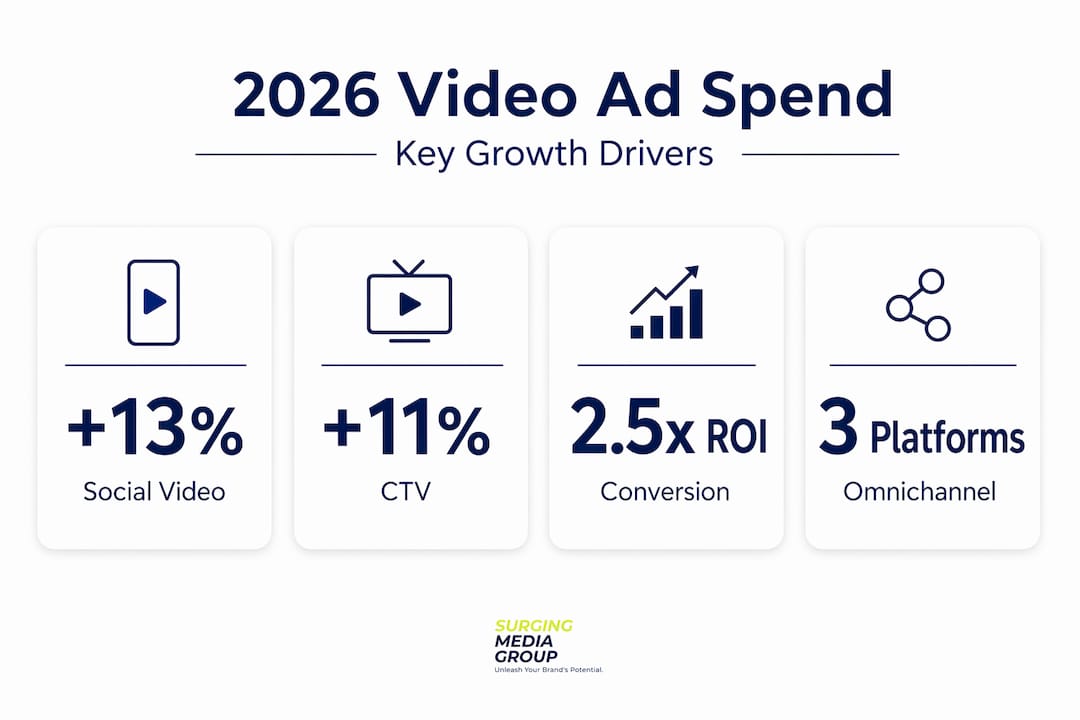
| Social video is outpacing other formats | Social video ad spend grew 13% in 2026, commanding over 50% of some client budgets. |
| Creative iteration expands budgets organically | Ongoing variant testing raises total video spend independent of media cost increases. |
| Measurement clarity unlocks bigger budgets | Connecting video consumption to revenue metrics like pipeline contribution and CAC makes the case for increased investment. |
Why video increases client ad spend through performance
The most direct reason clients commit more dollars to video is simple: it works harder than most other formats at the moment of decision. When a prospect lands on a product page and sees a video demonstrating how a product solves their specific problem, the psychological barrier to purchase drops. Adobe notes that video answers the question "Will this work for me?" in a way static copy and images rarely can.
That performance lift compounds at the account level. When video on a landing page improves conversion rates, every dollar spent driving traffic to that page generates more revenue. The return on ad spend goes up without touching the media buy. At that point, scaling the video investment becomes a rational, defensible choice rather than a creative preference.
Here's how video produces measurable performance gains across the funnel:
- Landing page conversion: Product demonstrations reduce hesitation at the bottom of the funnel, where purchase intent is highest and conversion gains matter most.
- Trust building: Video testimonials and real-world use cases make brand claims credible in a way that text alone cannot replicate.
- Time on page and engagement: Viewers who watch product videos spend significantly longer engaging with a page, signaling intent signals that retargeting systems can act on.
- Email and paid social click-through rates: Campaigns featuring video consistently outperform static creative in click-through benchmarks, improving media efficiency.
The video advertising benefits extend beyond any single channel. Brands that integrate video across touchpoints see a compounding effect: awareness built through video at the top of the funnel primes audiences to convert faster when they encounter direct-response ads lower in the funnel.
Pro Tip: Before presenting a case for increased video budget, document the baseline conversion rate on key landing pages. A controlled before-and-after comparison with video added is the single most persuasive data point you can put in front of a client.
Attribution advances that make video's value visible
For years, video's influence on revenue was chronically underreported. Last-click attribution models assigned credit to the final touchpoint before purchase, which meant video views, brand explainers, and product walktches received zero credit even when they drove the purchase decision. Clients would look at campaign reports, see video with no conversions attributed, and cut the budget. It was a measurement problem masquerading as a performance problem.
"Video's true value is revealed when marketers adopt attribution frameworks that show revenue influence beyond simple view metrics." This shift from vanity metrics to revenue-focused measurement is what's fueling sustained increases in client video investment.
The fix is viewer-level CRM attribution. When a prospect watches a product video and later converts through a paid search ad three weeks later, CRM-integrated attribution captures that video view as an assist. Wistia's pipeline attribution connects video engagement data directly to revenue outcomes, showing which videos correlate with closed deals and which pipeline stages see the highest video engagement.
The operational impact of getting attribution right is significant:
- Clients who previously cut video budgets after seeing poor last-click data often reinstate and expand those budgets once attribution shows assisted revenue.
- Video content identified as a pipeline accelerator gets designated as a protected budget line item, insulated from cuts during optimization reviews.
- Video investments working harder than standard metrics suggested becomes visible, creating a data-driven case for scaling production.
IAB CEO David Cohen frames this shift as a demand for performance accountability. Marketers are no longer accepting view counts as proof of value. They want revenue influence, pipeline contribution, and cost-per-acquisition data. When video delivers those numbers, the budget conversation changes entirely.
Budget migration: where the money is actually moving
Understanding the structural shifts underneath the headline growth numbers tells a more specific story. Social video ad spend growth is outpacing connected TV in 2026, growing at 13% versus CTV's 11%. For many advertisers, social video now commands more than half of the entire video budget.
| Format | 2026 Growth Rate | Key Driver |
|---|---|---|
| Social video (YouTube, Meta, TikTok) | 13% YoY | Targeting precision, lower production barriers, measurable performance |
| Connected TV (CTV/streaming) | 11% YoY | Premium inventory, household reach, brand safety |
| Linear TV | Declining | Audience fragmentation, limited attribution capability |
The reasons social video is pulling budget away from linear TV and even CTV come down to three factors. First, targeting. Social platforms offer audience segmentation at a granularity that broadcast television cannot approach. Second, cost efficiency. The barriers to producing effective social video have dropped sharply as AI-powered creative tools make iteration faster and less expensive. Third, feedback loops. Social video campaigns generate performance data within hours, enabling rapid optimization that linear schedules cannot match.
Brands aren't abandoning CTV. They're reallocating proportional budget from linear television to social video first, and from CTV second, concentrating investment where performance data is richest and iteration is fastest.
Pro Tip: When advising clients on budget reallocation, frame the shift from linear to social video not as a cost-cutting move but as a precision upgrade. The same dollar reaches a more qualified audience and produces measurable conversion data. That framing resonates with CMOs focused on accountability.
Creative strategy and the compounding cost of iteration
Here's a dynamic that often surprises clients when they first commit to video at scale. The initial production investment is the visible cost. The ongoing cost of keeping video creative fresh and effective is what actually drives budgets higher over time.

Creative fatigue is real and it's fast. An ad that performs well in week one will see declining engagement by week four if the creative remains static. The antidote is variants: multiple cuts of the same core concept, different hooks, different calls to action, different product angles. Sustaining engagement requires continual creative iteration, and that iteration has a production cost that accumulates as a distinct line item in video budgets.
Here's how the cycle typically unfolds:
- Launch phase: A brand produces two to three video variants, launches them, and identifies a top performer within two to three weeks.
- Optimization phase: The top performer gets scaled with additional spend, while new variants testing different hooks or formats go into production.
- Fatigue management phase: Frequency caps are hit, performance drops, and new creative is required to sustain ROAS targets.
- Scale phase: As the brand grows its video program, the number of active variants required to cover multiple audiences and platforms expands the creative budget independent of any media cost increase.
Brands like Copper Compression, which Surgingmedia has worked with directly, discover this cycle early. Starting with a tight slate of four to six variants, they find the production cadence needs to accelerate as their paid social spend grows. The creative budget and the media budget become linked. You cannot scale one without scaling the other.
This is why client investment in video content tends to compound over time rather than plateau. Effective video programs require a steady production pipeline, and that pipeline represents a meaningful portion of total ad spend.
Practical steps to justify and grow video budgets
If you're building the case for increased video investment or advising a client on how to allocate a growing video budget, the framework matters as much as the creative. Data without structure doesn't persuade. Here's how to build a defensible approach:
- Establish a measurement framework first. Before producing new video, define the metrics that will prove value: pipeline contribution, assisted conversions, cost per acquisition, and lifetime value of video-converted customers. Moving beyond vanity metrics to track video's impact on business KPIs is what earns sustained budget.
- Integrate CRM and UTM tracking. Every video view should be trackable to a named prospect or customer segment where possible. UTM parameters on video landing pages and CRM-integrated hosting platforms make attribution defensible rather than theoretical.
- Allocate for creative operations separately from media spend. Build a line item for ongoing video production. Treating creative as a one-time cost leads to fatigue-driven performance drops that make video look ineffective when the real issue is insufficient creative refresh.
- Leverage audience targeting strategies on social platforms. Social video's targeting capability is most valuable when the creative is built to speak to specific segments. Personalized video outperforms generic cuts on platforms that reward relevance with lower CPMs.
Pro Tip: Present video budget recommendations in terms of revenue outcomes, not production deliverables. "This investment supports X assisted conversions at a $Y cost per acquisition" lands differently in a boardroom than "We'll produce four videos this quarter."
My take on the real reason video budgets keep growing
I've watched video budgets grow for the better part of two decades, and the pattern I keep coming back to is this: the most durable increases happen after attribution systems get fixed, not after a particularly great creative campaign. A brand launches a video that wins an award, gets strong view numbers, and then the budget gets cut because finance sees no conversion data tied to it. That's not a creative failure. That's a measurement failure.
What I've learned is that the sequence matters enormously. Install the attribution infrastructure first. Connect your video hosting to your CRM. Tag your content with UTM parameters that survive the customer journey. Then, when the data comes back showing that video-assisted deals close 30% faster or carry a 20% higher average order value, the budget discussion is no longer a negotiation. It becomes a math problem with an obvious answer.
The other thing I'd caution against is over-investing in production volume before you understand what your audience actually responds to. I've seen brands produce 20 video variants in the first quarter, spend the year's creative budget in three months, and then have nothing to iterate with when performance starts to fade. Start tight. Test relentlessly. Scale what works. The brands that sustain video budget growth over time treat creative like a portfolio, not a campaign.
The video marketing ROI argument ultimately wins when you can point to revenue data, not view counts. Every client I've seen reduce their video spend has done so because they were looking at the wrong numbers.
— Sergio
How Surgingmedia helps brands build video that earns bigger budgets

At Surgingmedia, we've built our entire practice around one idea: video that can prove its value in revenue terms. Whether you're producing DRTV infomercials, Amazon product videos, or social media reels for platforms like Meta and YouTube, the creative strategy has to start with measurable performance goals. We work with brands from concept through distribution, integrating performance analytics so your video investment is always traceable to business outcomes. If you're ready to build a video production strategy that justifies growing client ad budgets quarter over quarter, the work starts with the right production partner. Surgingmedia brings the storytelling and the accountability together.
FAQ
Why does video increase client ad spend more than other formats?
Video improves conversion rates, builds purchase confidence, and generates attribution data that justifies budget expansion. When clients can see revenue influence tied directly to video campaigns, scaling investment becomes a rational decision rather than a creative preference.
What attribution method best captures video's revenue impact?
Viewer-level CRM attribution, which connects video engagement to pipeline stages and closed deals, captures video's true influence. Last-click models chronically underreport video's contribution, leading to premature budget cuts.
How does social video compare to CTV for ad spend growth in 2026?
Social video ad spend is growing at 13% compared to CTV's 11% in 2026, with some advertisers allocating more than half their video budget to social platforms due to superior targeting and real-time performance data.
Why do video budgets tend to grow over time rather than stabilize?
Creative fatigue requires continual variant production to sustain performance, which expands the creative budget as a line item independent of media cost increases. Brands that scale paid social spend find they must scale video production in parallel to maintain ROAS targets.
What metrics should marketers use to justify higher video budgets?
Adobe recommends tracking pipeline contribution, cost per acquisition, and lifetime value of video-converted customers rather than view counts or impressions, as revenue-focused metrics make the budget case far more persuasive to finance and executive stakeholders.