

Most marketing managers assume video is a "nice-to-have" layer on top of their static creative strategy. That assumption is quietly draining ad budgets. In Performance Max campaigns, video assets increase performance by enabling video inventory access and deliver 12% more conversions compared to auto-generated alternatives. Video is not decoration. It is the engine driving modern paid performance, and the brands that treat it as such are pulling ahead in every metric that matters.
Table of Contents
- How video assets outperform static creatives
- The mechanics: Why video engages and converts
- The role of creative diversity: Feed the algorithm, fuel results
- Strategic application: When to use video, static, or both
- What most brand marketers miss about video ad success
- Unlock high-converting video assets for your brand
- Frequently asked questions
Key Takeaways
| Point | Details |
|---|---|
| Video outperforms static | Video ads drive higher engagement, lower costs, and more conversions than static images. |
| Diversity boosts results | Ad accounts with more varied video assets see lower CPAs and faster algorithm learning. |
| Strategic application matters | Use video for awareness and education, static for retargeting, and a mix for best funnel coverage. |
| Creative quality is key | Custom, well-produced videos beat auto-generated content for brand control and performance. |
| Leverage data for optimization | Video asset engagement metrics empower more precise, automated ad optimization. |
How video assets outperform static creatives
After previewing the tangible difference video makes, let's dive into the actual numbers behind video vs. static ad assets. The data is striking, and it challenges the instinct many teams have to default to static images because they are faster and cheaper to produce.
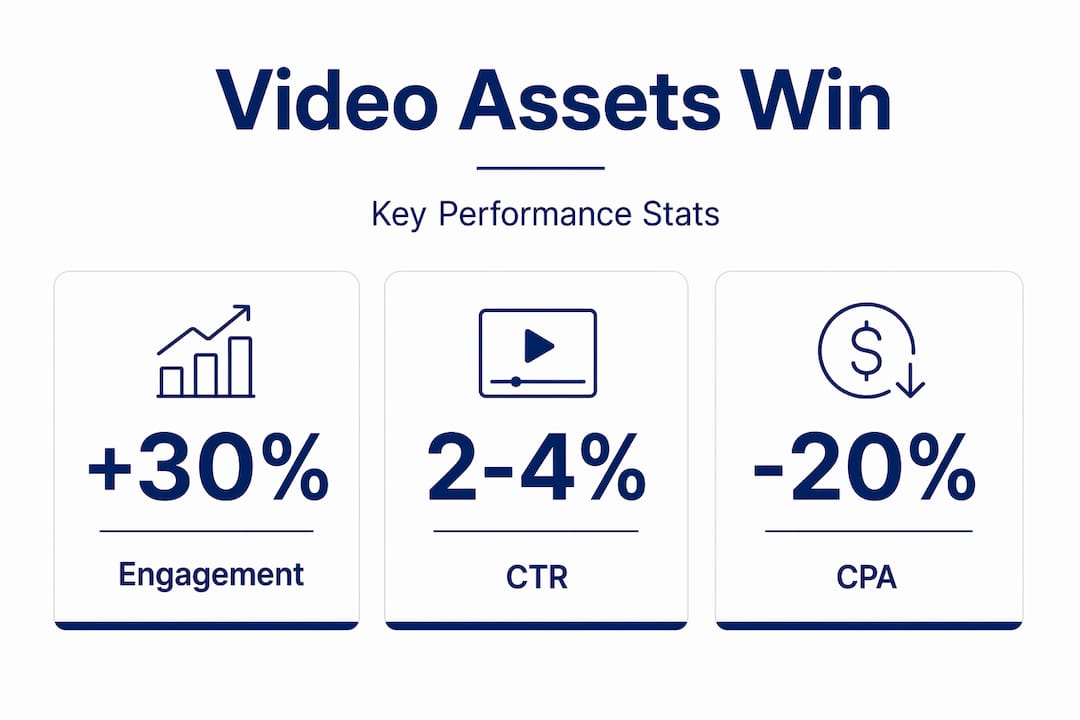
Video ads consistently outperform static creatives across the metrics that matter most. Standard video delivers a click-through rate (CTR) of 1.5 to 2.5%, while static images land between 0.9 and 1.2%. The cost-per-acquisition (CPA) index for video sits at 75 to 85 against a baseline of 100 for static, meaning you are paying less to acquire each customer. User-generated content (UGC) video pushes performance even further, reaching CTRs of 2.0 to 3.5% and a CPA index as low as 60 to 75.
On Meta, short-form vertical video drives 20 to 30% higher engagement than other formats, with CTRs ranging from 2% to 4.7% for 9:16 placements. Return on ad spend (ROAS) for direct-to-consumer cold traffic sits between 1.8x and 5.0x when video is the lead creative. These are not marginal improvements. They represent a structural advantage.
Here is a direct comparison across key performance indicators:
| Metric | Static image ads | Standard video ads | UGC video ads |
|---|---|---|---|
| CTR | 0.9 to 1.2% | 1.5 to 2.5% | 2.0 to 3.5% |
| CPA index | 100 (baseline) | 75 to 85 | 60 to 75 |
| Engagement lift | Baseline | Up to 30% higher | Up to 50% higher |
| Cold traffic ROAS | 1.2 to 2.5x | 1.8 to 5.0x | 2.5 to 5.5x |
A few additional patterns worth noting:
- Vertical video dominates mobile placements, where the majority of paid social impressions now occur.
- UGC video effectiveness is especially strong for cold audiences who have never encountered your brand.
- Polished brand video tends to perform better in retargeting and lower-funnel contexts where trust has already been established.
- Shorter videos (6 to 15 seconds) often outperform longer formats in awareness campaigns, while 30 to 60 second videos work well for education and conversion.
"The question is no longer whether video outperforms static. The question is whether you are producing enough of the right video to stay competitive."
The brands winning on paid media right now are not necessarily spending more. They are spending smarter, with video assets built specifically for each placement and audience segment.
The mechanics: Why video engages and converts
Understanding performance numbers is only half the story. The real edge of video lies in how it engages people and algorithms simultaneously. These two audiences, the human viewer and the platform AI, both respond to video in ways that static images simply cannot replicate.
Video engages multiple senses at once. Motion captures the eye before the conscious mind processes what it is seeing. Sound triggers emotional responses and memory encoding. Story arcs, even in a 15-second ad, create tension and resolution that keep viewers watching. Autoplay on platforms like Meta, YouTube, and TikTok means your video starts working before the viewer makes any conscious decision to engage. That first moment of motion is your hook, and it is worth everything.

The metrics that matter most for video engagement are hook rate and hold rate. Hook rate measures the percentage of viewers who watch past the first three seconds. A strong hook rate exceeds 30%. Hold rate measures how many viewers watch past 25% of the video's total length. A healthy hold rate clears 25%. These engagement signals feed directly into platform AI systems, giving algorithms richer data to optimize placements and find lookalike audiences who are more likely to convert.
This is where video creates a compounding advantage. Static images generate click or no-click signals. Video generates layered behavioral data: did they watch three seconds? Did they watch halfway? Did they replay it? Did they click after watching 80%? Each of these signals tells the algorithm something specific about audience intent, and the algorithm uses that information to sharpen targeting over time.
YouTube and Google video placements show a cost-per-click of just $0.18, the lowest across Google's ad network, with a conversion rate of 1.12%. That low CPC reflects how efficiently video inventory can be accessed when creative quality is high. It also supports awareness and assisted conversions, meaning video warms audiences who later convert through search or direct channels.
Key mechanics that make video convert:
- Pattern interruption: Motion breaks the scroll reflex and forces attention.
- Emotional narrative: Even brief story arcs build connection and brand recall.
- Social proof integration: Testimonials and real-use footage build trust faster than copy alone.
- Clear calls to action: Video allows you to verbally and visually reinforce the next step simultaneously.
Pro Tip: Test your hook in the first three seconds relentlessly. Swap out the opening frame, the first line of audio, and the visual treatment before you change anything else. Hook rate improvements alone can lift overall campaign performance by 20 to 40%.
The role of creative diversity: Feed the algorithm, fuel results
Now that you understand the "why," let's cover the "how." What creative strategies actually move the needle when you are managing paid campaigns at scale?
The single most underrated lever in video advertising is creative diversity. Most brands produce one or two video assets, find a winner, and run it until performance collapses. That collapse is creative fatigue, and it is entirely predictable. Algorithms on platforms like Google's Performance Max and Meta's Advantage+ are designed to learn and optimize, but they need material to work with.
Providing 10 or more creative variants leads to 15 to 20% lower CPAs compared to campaigns running fewer assets. The algorithm tests variations, identifies what resonates with different audience segments, and allocates budget accordingly. When you give it only two or three assets, it exhausts its options quickly and performance plateaus or declines.
Here is what a healthy creative volume strategy looks like by campaign type:
| Campaign type | Minimum video assets | Recommended variants | Refresh cadence |
|---|---|---|---|
| Awareness/prospecting | 5 | 8 to 10 | Every 4 to 6 weeks |
| Consideration/education | 4 | 6 to 8 | Every 6 to 8 weeks |
| Retargeting | 3 | 4 to 6 | Every 8 to 10 weeks |
| Full-funnel (PMax/Advantage+) | 8 | 12 to 15 | Every 3 to 5 weeks |
Building creative diversity does not mean starting from scratch every time. The most efficient approach involves systematic variation across a few key dimensions:
- Hook variation: Test three to five different opening scenes or opening lines for the same core message.
- Format variation: Produce the same concept in 9:16 vertical, 1:1 square, and 16:9 horizontal to serve different placements.
- Tone variation: Try one emotionally driven version and one benefit-focused, direct-response version of the same product story.
- Talent variation: Swap between brand spokesperson, UGC creator, and animated or text-overlay versions to reach different audience sensibilities.
- Length variation: Produce a 6-second bumper, a 15-second version, and a 30-second version from the same shoot.
Pro Tip: When building your high-converting video production pipeline, plan for creative families rather than individual assets. A single shoot day, structured correctly, can yield 15 to 20 distinct video variants that feed your algorithm for months.
This approach to creative volume is what separates brands that scale efficiently from those that constantly chase the next "big idea" and burn budget in the process.
Strategic application: When to use video, static, or both
Putting all the above together, here is how leading marketers approach asset mix by campaign strategy. The answer is not always "use video for everything." It is about matching the asset type to the audience's state of mind and their position in your funnel.
Static ads outperform video in retargeting by as much as 40% in conversion rate, particularly for audiences who have already visited your site or engaged with your content. At that stage, the viewer does not need to be educated or emotionally warmed. They need a clean, direct reminder with a compelling offer. A strong product image and a clear discount or urgency message often converts better than a 30-second video in that context.
Video is essential for prospecting, education, and complex product demonstrations. Cold audiences need context. They need to understand what your product does, why it matters to them, and why they should trust your brand. Video delivers all three simultaneously in a way static images cannot. The tradeoff is production cost and the time required to build creative volume, which is why a hybrid strategy by funnel stage is the most cost-efficient path.
Supplying custom videos rather than relying on auto-generated assets in Performance Max campaigns gives you control over brand presentation and message consistency. Auto-generated videos can look generic and may not reflect your brand's voice or visual identity. Custom assets also allow you to test specific hooks in the first three seconds before committing to a full production run.
A practical framework for asset selection by funnel stage:
- Top of funnel (cold awareness): Lead with UGC video or emotionally driven brand video. Prioritize 9:16 vertical format for mobile placements.
- Middle of funnel (consideration): Use educational video that demonstrates the product in use, addresses objections, and builds credibility through testimonials.
- Bottom of funnel (retargeting and conversion): Shift to static images with strong offers, or short 6-second video reminders with a direct call to action.
- Full-funnel campaigns (PMax, Advantage+): Supply both video and static assets, with at least 8 to 10 video variants to give the algorithm maximum flexibility.
Pro Tip: Track the stages of video vs. static use in your own account by segmenting performance data by placement and audience temperature. You will likely find that video dominates top-funnel CPAs while static holds its own in retargeting, validating the hybrid approach.
The brands that resist choosing one format over the other and instead build systems for both are the ones that sustain performance across full campaign cycles.
What most brand marketers miss about video ad success
All this evidence brings us to an uncomfortable truth many marketers ignore. The problem is rarely budget. It is rarely even creative quality in the traditional sense. The real gap is creative strategy, specifically the failure to treat video assets as a system rather than a series of one-off productions.
I have seen brands invest heavily in a single, beautifully produced hero video and then watch it fatigue within three weeks. The video was excellent. The strategy around it was not. One asset, no matter how well crafted, cannot carry a campaign indefinitely. Audiences see it, process it, and move past it. The algorithm exhausts it. Performance drops. The team scrambles to produce something new, often under pressure and without a clear framework.
The temptation to find the "winning" video and ride it is deeply human. It feels efficient. But in paid media, that instinct works against you. Algorithms and audiences both respond best to a steady flow of fresh, varied assets. The brands I have watched scale most effectively treat creative production like a content calendar, not a one-time project.
What actually drives sustained video ad success is simpler than most teams realize. Test hooks first, always. Iterate on small creative elements before rebuilding from scratch. Align asset type to funnel stage with discipline. And invest in overcoming video ad fatigue proactively, before performance signals force a reactive scramble.
UGC, in particular, is one of the most underutilized tools in brand advertising. It is authentic, cost-effective to produce at volume, and extraordinarily effective with cold audiences. Brands that weave UGC into their creative rotation alongside polished brand content consistently outperform those that rely on one style alone.
The marketers who win are not the ones with the biggest production budgets. They are the ones who build creative systems, stay curious about what is working, and never stop testing.
Unlock high-converting video assets for your brand
Looking to put this into action and see real improvement in your ad accounts? The gap between knowing what works and having the creative infrastructure to execute it is where most brands stall.
At Surging Media, we build video assets for high-performing ads grounded in direct-response principles, from UGC and testimonial-driven content to polished brand storytelling and performance-focused reels. Our end-to-end production process covers concept, scripting, filming, and performance analytics, so every asset we create is built to convert, not just to look good. Whether you are scaling a DTC brand or managing campaigns for a national retailer, our team brings the creative volume and strategic framework your algorithm needs to thrive. We also offer nationwide video production for brands ready to build at scale.
Frequently asked questions
What is the ideal number of video assets for an ad campaign?
For optimal algorithm learning and results, provide at least 5 to 10 unique video assets per campaign. Campaigns with 10+ creatives see 15 to 20% lower CPAs compared to those running fewer variants.
Are video ads more effective than static image ads?
Yes, video ads typically drive higher CTR, lower CPA, and stronger ROAS than static image ads, especially in prospecting. Video CTR ranges from 1.5 to 2.5% compared to 0.9 to 1.2% for static, with a significantly lower CPA index.
When should you use static image ads?
Static images work best for retargeting, low-budget testing, or simple product offers. Static ads deliver 40% higher conversions in retargeting scenarios where audiences already know your brand.
What makes UGC videos effective for advertising?
UGC videos are highly effective for cold traffic because they feel authentic and relatable rather than polished and promotional. UGC drives 4x higher CTR than brand-produced content when targeting cold audiences who have not yet encountered your brand.
How do video ads help algorithmic optimization?
Video ads give platform AI systems layered behavioral data that static images cannot provide. Hook rates above 30% and hold rates above 25% signal strong creative quality, enabling algorithms to optimize placements and audience targeting with far greater precision.