

Global CTV advertising is defined as the delivery of targeted video ads through internet-connected television devices, including smart TVs, streaming sticks, and game consoles, to audiences across multiple countries using programmatic technology and data-driven targeting. Platforms like Roku, Netflix (ad-supported tier), and Amazon Prime Video with ads have made this format the fastest-growing segment in digital media. Unlike traditional broadcast, global CTV advertising combines the emotional power of the big screen with the precision of digital attribution. For brand strategists planning international campaigns in 2026, understanding how this channel works is no longer optional. It is the foundation of any serious cross-border video strategy.
What is global CTV advertising and how does it work?
CTV advertising uses internet-enabled TVs such as smart TVs, streaming sticks, and game consoles to deliver video ads programmatically. The term "Connected TV" refers to the device, while "OTT" (Over-the-Top) refers to the content delivery method. Global CTV advertising layers international audience data on top of that device infrastructure to reach viewers in specific markets, demographics, and behavioral segments simultaneously.

The mechanics rely on programmatic real-time bidding, using standards like OpenRTB and server-side ad insertion to deliver measurable ads without interrupting the viewing experience. When a viewer launches a streaming app, an auction fires in milliseconds. The winning advertiser's creative appears before or during content, served directly into the stream rather than inserted by a cable operator.
Audience data powering these auctions comes from several sources:
- IP address targeting: Identifies household location and enables geographic precision across countries
- Device IDs: Allows frequency capping and cross-device sequencing between CTV, mobile, and desktop
- First-party data: Brands can upload customer lists to match against streaming platform audiences on Roku, Amazon, or Peacock
- Contextual signals: Content genre, language, and viewing time inform targeting without relying on cookies
Privacy compliance varies significantly by region. Campaigns running across the European Union must align with GDPR consent frameworks, while U.S. campaigns navigate CCPA and platform-specific data policies. CPMs for CTV typically range from $20 to $40 per thousand impressions, averaging around $25 for many U.S. campaigns in 2026. That premium over social video reflects the lean-back, full-screen environment and the quality of the audience signal.
Pro Tip: When launching a global CTV campaign, segment your audience by country before setting bids. CPM floors and inventory availability differ dramatically between the U.S., U.K., Germany, and Australia, and a single global line item will overspend in cheap markets while starving high-value ones.
How does CTV compare to traditional TV and OTT advertising?
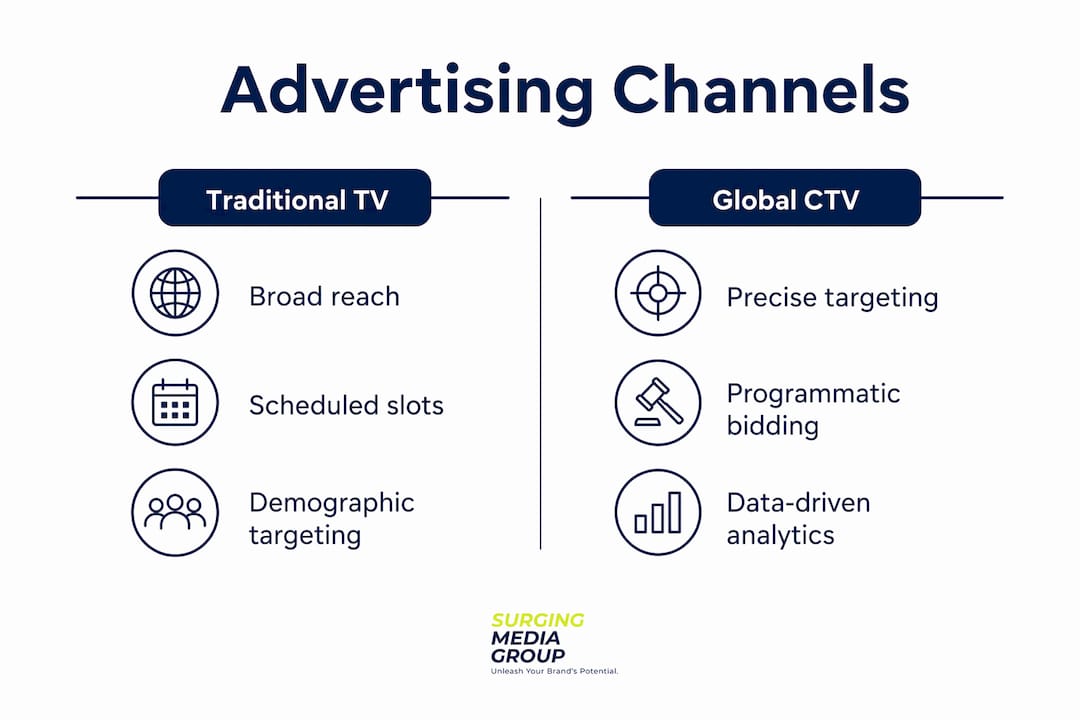
The distinction matters because budget allocation decisions often hinge on it. Traditional linear TV sells broad, schedule-based placements. A brand buying a prime-time slot on a national network reaches everyone watching at that moment, regardless of relevance. There is no retargeting, no frequency control, and no post-campaign attribution beyond panel-based estimates.
CTV flips that model. Placements are bought against audience profiles, not time slots. A fitness brand can reach adults aged 25 to 44 who have visited its website in the last 30 days, watching a health documentary on a Samsung smart TV in Chicago at 9 p.m. on a Tuesday. That specificity is structurally impossible in linear TV.
| Feature | Linear TV | OTT | Global CTV |
|---|---|---|---|
| Targeting precision | Broad demographics | Content-level | Household and behavioral |
| Buying model | Upfront/direct | Programmatic or direct | Programmatic real-time bidding |
| Measurement | Panel estimates | Platform metrics | Cross-device attribution |
| Geographic reach | National/regional | Global (platform dependent) | Global with local precision |
| Ad format flexibility | Fixed spots | Pre-roll, mid-roll | Interactive, sequential, shoppable |
OTT sits between the two. It describes any video content delivered over the internet, whether watched on a phone, laptop, or TV screen. CTV is the subset of OTT consumed specifically on television screens. This distinction matters for creative strategy: a 30-second spot designed for a 65-inch screen does not always translate to a mobile feed. Global CTV advertising, as a discipline, focuses on the television screen experience while integrating with broader paid video advertising frameworks that span all screens.
The benefits of CTV advertising over linear TV are measurable and documented. Programmatic CTV represents a shift from manual, long-term commitments to real-time automated bidding based on rich audience data. That shift gives brand strategists the ability to pause, optimize, and redirect spend mid-flight, something a network upfront deal never allows.
How CTV evolved into a full-funnel marketing channel
CTV advertising began as a brand awareness play. Marketers used it to reach cord-cutters who had abandoned linear TV, replicating the reach of broadcast with slightly better targeting. That era is over. The channel now operates across every stage of the purchase funnel, and the brands winning with it treat it accordingly.
Here is how a full-funnel CTV strategy sequences across the buyer journey:
- Awareness: Run 30-second brand films to broad, interest-based segments on platforms like Hulu or Peacock. Optimize for completed views and reach.
- Consideration: Retarget viewers who completed the awareness ad with a 15-second product-focused spot. Use device ID matching to follow them from the TV screen to mobile.
- Conversion: Serve a 6-second direct-response spot with a QR code or interactive overlay to viewers who have engaged with the consideration creative. Optimize for CPA or ROAS.
- Retention: Use first-party customer data to suppress existing buyers from acquisition campaigns and serve loyalty-focused creative to high-value segments.
Interactive overlays drive 14% higher viewer attention and a 19% lift for brand assets. Beyond attention, 29% of app installs in a large sample were assisted by CTV impressions, confirming the channel's role in driving measurable downstream action. These numbers matter because they reframe CTV from a "top of funnel only" medium to a genuine performance driver.
CTV advertising has evolved into a performance-driven medium optimizing for CPA, CPI, and ROAS using AI and cross-screen attribution. Measurement has kept pace. Multi-touch attribution, media mix modeling, and incrementality testing now give marketers a clearer picture of CTV's contribution across devices. Still, 71% of marketers miss full-funnel integration opportunities by treating CTV as a standalone channel rather than synchronizing it with mobile and desktop retargeting.
Creative asset diversity is the operational requirement that most teams underestimate. Using 6-second, 15-second, and 30-second spots with variable hooks and calls to action improves campaign performance across funnel stages. A single hero ad cannot do all of that work. You need a content architecture, not a single film.
What global streaming ad trends are shaping CTV in 2026?
The CTV space in 2026 is defined by consolidation, AI adoption, and persistent measurement friction. Each trend reshapes how brand strategists plan and execute campaigns.
- Platform consolidation: Disney plans a Hulu and Disney+ merger by 2026, while Paramount plans a Paramount+ and Max merger pending regulatory approval. Consolidation reduces fragmentation, giving marketers fewer buying relationships and more unified audience graphs. That simplifies targeting but also concentrates pricing power with fewer platforms.
- AI-driven optimization: AI adoption in CTV is growing, though many marketers still approach it cautiously. Future innovation centers on AI-driven audience targeting and contextual intelligence, particularly for international markets where first-party data is sparse. Agencies using AI for campaign optimization report meaningful gains in outcome-based performance.
- Walled garden friction: Amazon, Roku, and Netflix each operate closed data ecosystems. Measuring reach and frequency across all three simultaneously requires third-party identity solutions or clean room partnerships, neither of which is plug-and-play for most marketing teams.
- Measurement fragmentation: Netflix Standard sees 26% of marketers measuring success by click-through rates, Amazon Prime Video 18%, with impressions and watch time leading overall. The lack of a universal metric standard means campaign comparisons across platforms require manual normalization.
- CPM pressure: Streaming platforms face advertiser pressure to lower CPMs as inventory supply grows. That benefits buyers in the short term but signals a maturing market where creative quality and audience precision matter more than cheap reach.
Understanding these global streaming ad trends is not background reading. It is the strategic context that determines where your budget goes and how you measure success.
Key takeaways
Global CTV advertising works best when treated as a data-driven, full-funnel channel that integrates programmatic precision, diverse creative assets, and cross-device measurement to reach international audiences at scale.
| Point | Details |
|---|---|
| CTV defined | Internet-connected TV devices deliver programmatic video ads with household-level targeting precision. |
| Full-funnel integration | Synchronizing CTV with mobile and desktop retargeting improves conversion rates and closes the 71% opportunity gap. |
| Creative architecture | Campaigns need 6s, 15s, and 30s asset variations to serve different funnel stages effectively. |
| Measurement evolution | Attribution now spans CPA, ROAS, and incrementality testing, moving well beyond impressions. |
| 2026 market context | Platform consolidation and AI adoption are reshaping targeting and measurement for global campaigns. |
Why most CTV strategies underperform, and what actually fixes them
I have watched brand after brand treat CTV like a digital billboard. They produce one strong 30-second spot, push it to a broad audience segment, and then wonder why the ROAS looks thin compared to paid social. The problem is not the channel. The problem is the creative and measurement strategy wrapped around it.
The brands I have seen succeed with global CTV advertising share one habit: they build a content architecture before they build a media plan. They know which creative serves awareness, which serves retargeting, and which is designed to close. They also know that CTV must be integrated with other digital channels as part of a connected audience architecture, not run as a siloed TV buy with a digital label on it.
Budget size matters more than most teams admit. Insufficient spend prevents statistical significance, limiting the targeting and measurement models that make CTV worth the premium CPM. I have seen campaigns with $15,000 monthly budgets trying to optimize for CPA across three countries. The data volume simply is not there. If you cannot commit enough budget to generate meaningful signal, you are better off concentrating spend in one market and one funnel stage until you have a proven model to scale.
My honest recommendation: start with audience targeting strategies that are tightly defined, measure incrementality from the first campaign, and build your creative library before you scale. The channel rewards preparation. It punishes improvisation.
— Sergio
How Surgingmedia helps brands win with CTV advertising

Surgingmedia produces CTV-optimized video assets built for performance, not just production value. Every spot we create is engineered around direct-response principles, from the opening frame to the call to action, so your creative works as hard as your media buy. Whether you need a full suite of 6-second, 15-second, and 30-second variations for a global campaign or a single high-converting spot for a U.S. launch, our team handles concept, scripting, production, and localization for international markets. Brands like Copper Compression and Black & Decker have used our video production services to scale across streaming platforms with measurable results. If your CTV creative is not converting, we can fix that.
FAQ
What is global CTV advertising in simple terms?
Global CTV advertising is the practice of delivering targeted video ads through internet-connected TV devices, such as smart TVs and streaming sticks, to audiences in multiple countries using programmatic technology. It combines the scale of television with the precision of digital targeting.
How does CTV advertising differ from regular TV ads?
CTV advertising uses real-time programmatic bidding and audience data to target specific households, while traditional linear TV sells broad time-slot placements with no post-campaign attribution. CTV also allows mid-flight optimization, frequency capping, and cross-device retargeting.
What metrics should I use to measure CTV campaign success?
The right metrics depend on your funnel stage. Awareness campaigns prioritize completed views and reach; performance campaigns optimize for CPA, ROAS, or app installs. Incrementality testing is the most reliable method for measuring CTV's true contribution to conversions.
What budget do I need to run an effective global CTV campaign?
There is no universal floor, but campaigns with insufficient spend cannot generate the data volume needed for meaningful optimization. Concentrate budget in one market and one funnel stage first, prove the model, then scale across regions and platforms.
Which platforms are most important for global CTV advertising?
Roku, Amazon Prime Video with ads, Netflix (ad-supported tier), Hulu, and Peacock dominate U.S. inventory. For international reach, platforms like Samsung Ads, LG Channels, and regional AVOD services extend coverage into European and Asia-Pacific markets.