

Paid video advertising is not simply placing a video in front of an audience and waiting. It is a data-driven, format-specific system where brands pay to distribute video content across digital platforms to reach precisely defined audiences, with measurable outcomes tied to awareness, engagement, and revenue. Most marketers understand the concept at a surface level, but few have mapped the full strategic picture: the format choices, the buying mechanics, the creative variables, and the measurement frameworks that separate campaigns that perform from those that just run. U.S. digital video ad spend is set to exceed $80 billion in 2026, a number that reflects real market confidence. This guide breaks down how it all works.
Table of Contents
- Key takeaways
- Paid video advertising formats and platforms
- How paid video advertising works
- Strategic benefits of paid video advertising
- Cost considerations and budgeting
- Trends and best practices in 2026
- My perspective on where paid video is heading
- How Surgingmedia helps brands win with paid video
- FAQ
Key takeaways
| Point | Details |
|---|---|
| Multiple formats exist | CTV, social video, rewarded ads, and pre-roll each serve distinct audience moments and campaign goals. |
| Targeting drives results | Paid video ads work through precise audience segmentation, bidding models, and optimization against specific KPIs. |
| Attention metrics matter more | Campaigns optimized for attention deliver nearly triple the business impact compared to viewability alone. |
| Costs vary widely | CTV CPMs range from $25 to $50 while YouTube CPVs can be as low as $0.01, so budget allocation must match format purpose. |
| Creative quality is non-negotiable | Script quality, pacing, and format-specific length are the primary levers that determine whether paid video ads convert. |
Paid video advertising formats and platforms
The format you choose is not just an aesthetic decision. It determines where your message appears, how long a viewer engages, what you pay, and what outcome is realistic. Understanding the format landscape is where strategic clarity begins.
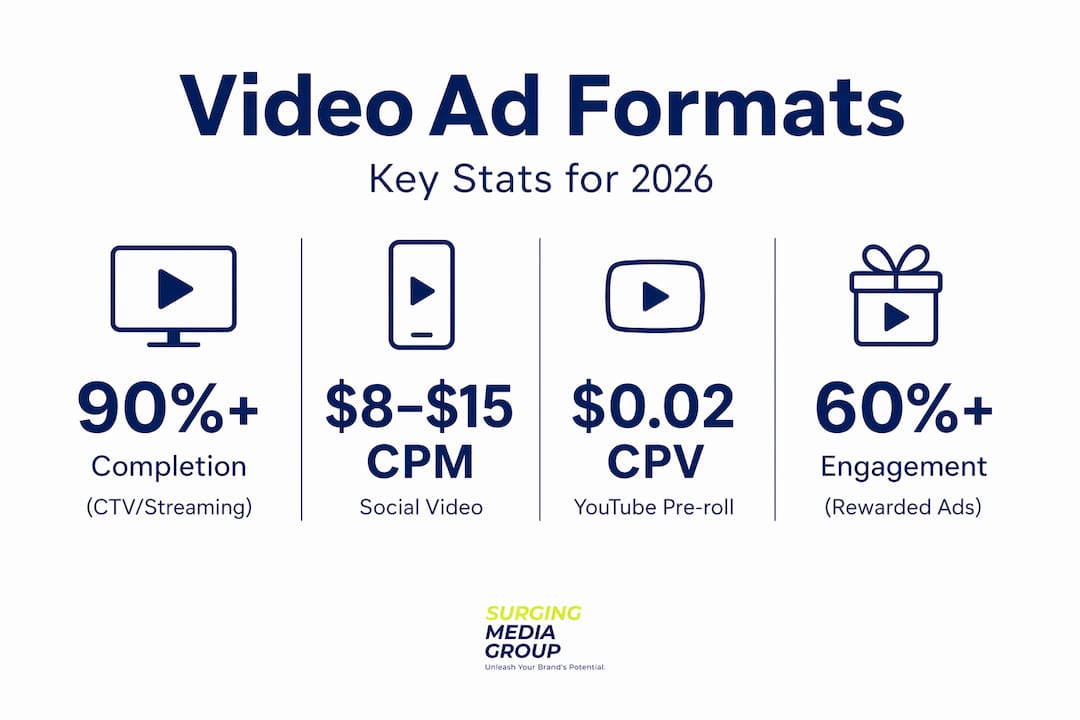
Connected TV (CTV) ads run on streaming platforms like Hulu, Peacock, and Paramount+. They command CTV CPMs between $25 and $50 and deliver near-perfect completion rates because viewers cannot skip them mid-episode. They are ideal for brand awareness campaigns with high production value.
Social video, including Instagram Reels, TikTok, and YouTube Shorts, operates at lower costs with CPMs often landing between $8 and $15 on Instagram. These formats reward speed. You have seconds to earn attention, and the creative must feel native to the feed rather than imported from a broadcast mindset.

Pre-roll and in-stream ads on platforms like YouTube use a cost-per-view (CPV) model. YouTube TrueView CPVs typically range from $0.01 to $0.05, making them highly efficient for reaching large audiences. The skip-after-five-seconds mechanic forces your creative team to front-load the hook.
Rewarded video ads run primarily inside mobile apps and games, offering users an in-app reward in exchange for watching a full video. These carry eCPMs between $10 and $50 with some of the highest completion rates in the industry.
| Format | Avg. Cost | Completion Rate | Best Use Case |
|---|---|---|---|
| CTV / Streaming | $25–$50 CPM | 90–95% | Brand awareness, storytelling |
| Instagram Reels | $8–$15 CPM | 60–75% | Product discovery, retargeting |
| YouTube TrueView | $0.01–$0.05 CPV | Variable | Broad reach, demo targeting |
| Rewarded Video | $10–$50 eCPM | 95%+ | App engagement, monetization |
| TikTok In-Feed | $10–$30 CPM | 65–80% | Gen Z reach, UGC-style creative |
Pro Tip: Match your format choice to the viewer's context. A 30-second brand film works on CTV where viewers lean back and commit. That same 30-second cut will bleed money on TikTok where the first two seconds decide everything.
How paid video advertising works
The mechanics behind a paid video campaign involve three interconnected layers: who sees the ad, how you pay for those impressions, and what you measure to know if it worked.
-
Audience targeting is where every campaign begins. Platforms give you access to demographic filters, behavioral signals, purchase intent data, lookalike audiences, and first-party customer lists. On Meta, you can layer interest targeting on top of a custom audience built from your CRM. On programmatic platforms, you can target by contextual placement, device type, or even viewing history.
-
Buying methods vary by platform and scale. Programmatic buying through demand-side platforms (DSPs) uses real-time bidding to win impressions at the lowest possible price. Direct buys with publishers or streaming platforms give you guaranteed placements and audience certainty but at a fixed premium. Most seasoned buyers blend both approaches.
-
Performance measurement has evolved well beyond click-through rate. The metrics that matter in 2026 include hook rate (the percentage of viewers who watch past the first three seconds), viewability, completion rate, cost per acquisition, and attention score. Campaigns optimized for attention deliver nearly triple the impact of those optimized for viewability alone. That gap is enormous, and most brand managers are still leaving that performance on the table.
-
Attribution and optimization close the loop. Once your campaign is live, the data tells you which creatives drive completions, which placements convert, and where budget should shift. This is not a set-it-and-forget-it medium. It rewards active management.
Pro Tip: Integrate cross-screen attribution from day one. 69% of CTV viewers use second screens while watching streaming content, and 31% actively search for products they see on TV. A CTV exposure that connects to a mobile retargeting sequence is far more powerful than either touchpoint alone.
Strategic benefits of paid video advertising
The case for paid video ads is not just philosophical. The data, the formats, and the audience behavior all point to a medium that consistently outperforms static alternatives when executed with intention.
Brand awareness is the most obvious benefit, but it undersells what video actually does. A well-crafted narrative video does not just inform. It creates an emotional association that static banners cannot replicate. When Surgingmedia produced campaign-ready video content for brands like Copper Compression, the goal was always to make the viewer feel something about the product before they ever clicked a link.
Beyond awareness, the engagement and conversion advantages are well-documented:
- UGC-style video ads achieve CTRs of 2.0–3.5% with a meaningfully lower cost per acquisition than polished brand films, particularly for cold audiences.
- Rewarded video ads generate approximately 40% of app revenue for developers who rely on them, demonstrating that this format is not a niche experiment. It is a primary revenue engine.
- Social video ad spend is projected to reach $31.9 billion in 2026, a 13% year-over-year increase, outpacing CTV growth for the first time.
"Video advertising at its best is not an interruption. It is a story that happens to carry a commercial message, and the audience chooses to stay because the story earns their attention." — Surgingmedia production philosophy
The benefits of paid video also compound over time. Audiences who engage with your video ads are warmer prospects for every downstream touchpoint. A viewer who watched 75% of your product video on YouTube is a fundamentally different retargeting audience than someone who bounced off a display banner.
Cost considerations and budgeting
Understanding the cost of video advertising means thinking in layers: format costs, platform minimums, creative production, and the hidden cost of poor creative that wastes every dollar spent on media.
Here is a practical breakdown of what you can expect across formats:
- CTV campaigns typically require higher minimum budgets, often $5,000 or more per month, to reach meaningful scale. The premium CPMs are justified by the environment and completion rates.
- Social video is more accessible. You can test paid video ads on Meta or TikTok with daily budgets starting at $20 to $50, though meaningful statistical signals require at least $500 to $1,000 in spend per creative variant.
- YouTube TrueView campaigns can technically start at low daily budgets, but the platform rewards consistency. Budget too thin and the algorithm never exits the learning phase.
- Rewarded video requires working through an ad network or DSP. eCPMs are strong, but inventory access and setup can demand more technical lift upfront.
| Budget Tier | Recommended Formats | Monthly Spend Range |
|---|---|---|
| Entry-level testing | Social video, YouTube | $1,000–$5,000 |
| Mid-tier campaigns | Social + YouTube + programmatic | $5,000–$25,000 |
| Full-funnel investment | CTV + social + retargeting | $25,000+ |
One underappreciated reality: creative spend should represent at least 30% of your total video ad budget. Marketers who pour money into media placement while cutting corners on production end up with an expensive microphone pointed at a weak message.
Pro Tip: Before scaling, test three to five distinct creative concepts at $200 to $500 each. Let performance data, not internal preference, decide which creative gets the larger budget. This approach consistently produces better ROI than launching one polished video at full spend.
Trends and best practices in 2026
The paid video space in 2026 is moving faster than most campaign planning cycles allow for. The brands staying ahead are the ones adapting their creative workflows, their measurement approaches, and their platform mix simultaneously.
Several shifts are reshaping the space right now:
- AI-driven media buying is accelerating rapidly. Two-thirds of media buyers are adopting agentic AI in their workflows, automating bidding decisions and creative rotation based on real-time attention signals.
- Platform-specific creative is no longer optional. Optimal video lengths vary significantly by platform: Meta feed ads perform best at 15 to 30 seconds, TikTok peaks at 21 to 34 seconds, and Stories or Reels need to land the message in 5 to 15 seconds. One video cut does not serve all placements.
- UGC and smartphone-shot testimonials are outperforming high-production ads for cold audiences because authenticity reads as trustworthiness on social feeds. UGC video consistently drives lower CPA and higher CTR, which matters significantly when you are scaling spend.
- Cross-device integration is the difference between a campaign and a system. CTV exposure followed by mobile retargeting closes the gap between brand-building and conversion in ways that single-screen campaigns never could.
- Attention measurement is replacing viewability as the primary signal of campaign health. 47% of marketers are already testing attention-based metrics as a buying currency, and that number will only grow.
Pro Tip: Do not wait for your platform to surface attention data. Partner with a measurement vendor that provides attention scores alongside standard delivery metrics. The brands doing this today are building a data advantage that will be very difficult to replicate in two years.
My perspective on where paid video is heading
I have watched this space long enough to have opinions that cut against the conventional wisdom, and the one I feel most strongly about right now is this: most brand marketers are dramatically underestimating rewarded video.
Every conversation about paid video defaults to YouTube, Meta, or CTV. Those are valid channels. But rewarded video creates a genuine win for all three parties involved: the advertiser gets a completed view, the developer gets revenue, and the user gets something of value. That non-intrusive exchange is almost entirely absent from the average brand's media mix, and I think it represents one of the most underutilized formats in digital advertising today.
The second thing I want to say plainly is that attention metrics are not a trend to watch. They are the signal you should be optimizing toward right now. Viewability tells you the ad was on screen. Attention tells you whether it actually registered. Those are very different things, and confusing them has led brands to report impressive delivery numbers while generating mediocre business outcomes.
Finally, I want to address the creative question directly. Production value should match the purpose of the ad, not reflect some internal standard of what looks "professional." A smartphone-shot testimonial in a TikTok feed can outperform a $50,000 brand film placed in the wrong context. The integration of video assets into ad accounts has to be informed by where those assets will live and what they need to do when they get there.
— Sergio
How Surgingmedia helps brands win with paid video

Paid video advertising only performs as well as the creative behind it. Surgingmedia specializes in producing high-converting video content built specifically for the paid media environment: direct-response scripts, platform-optimized formats, authentic customer testimonials, CTV-ready production, and social reels designed to stop the scroll. Every project is built around a clear performance objective, whether that means driving product sales on Amazon, generating leads through Meta, or building brand awareness on streaming platforms. The team handles everything from concept through delivery, so your media dollars are backed by creative that actually earns attention and compels action. If your current video assets are not performing the way your media spend deserves, the problem is almost always the creative.
FAQ
What is paid video advertising exactly?
Paid video advertising is when a brand pays a platform to distribute video content to a targeted audience, with the goal of driving awareness, engagement, or conversions. It includes formats like CTV ads, social video, pre-roll, and rewarded video across multiple digital channels.
How does video advertising work in terms of targeting?
Platforms allow advertisers to define audiences using demographic data, behavioral signals, purchase intent, and first-party customer lists. Campaigns run through programmatic bidding or direct buys, and performance is measured using metrics like hook rate, completion rate, and cost per acquisition.
What is the typical cost of video advertising?
Costs vary significantly by format. CTV CPMs range from $25 to $50, Instagram Reels CPMs average $8 to $15, and YouTube TrueView CPVs can be as low as $0.01. Monthly budgets for meaningful results typically start around $1,000 for social video and $5,000 or more for CTV.
What are the main benefits of paid video ads?
Paid video ads build brand awareness faster than static formats, drive higher engagement, and generate conversion data you can act on. Rewarded video formats generate approximately 40% of app revenue for developers, demonstrating that engagement quality in this format is exceptionally high.
Which video advertising platforms should brands prioritize?
The right platform depends on your audience and objective. CTV and YouTube work well for awareness and broad reach. Meta and TikTok are strong for direct-response and younger audiences. Rewarded video through mobile ad networks suits brands targeting app users with high engagement intent.