

CTV advertising explained properly is still rare, even among experienced brand managers. Most marketers understand that connected TV exists, but they treat it as a digital extension of traditional broadcast, repurpose their existing spots, and then wonder why performance falls short. The reality is more demanding and more rewarding than that. CTV delivers video ads inside premium streaming environments on internet-connected televisions, and it operates by its own distinct rules around targeting, creative, and measurement. This guide breaks down everything you need to know to run campaigns that actually perform.
Table of Contents
- Key takeaways
- How CTV advertising works
- Targeting capabilities and audience strategy
- Creative requirements for CTV campaigns
- Launching a CTV campaign: a 30-day plan
- Challenges and what is coming next
- My honest take on where most marketers go wrong
- Ready to build CTV creative that performs?
- FAQ
Key takeaways
| Point | Details |
|---|---|
| CTV is not traditional TV | Ads run on connected devices with data-driven targeting, not broad broadcast demographics. |
| Creative must be purpose-built | Repurposed social or web ads consistently underperform in the full-screen, sound-on CTV environment. |
| Targeting works at household level | CTV uses IP addresses and device IDs, not cookies, requiring a different audience strategy than digital display. |
| Budget and CPM vary widely | Pricing ranges from $15 CPM on FAST channels to $85 CPM for audience-targeted premium buys. |
| Measurement is still maturing | Show-level transparency gaps and cross-platform fragmentation remain the industry's most pressing limitations. |
How CTV advertising works
CTV, OTT, and linear TV are three distinct things that marketers frequently conflate. Linear TV is traditional broadcast or cable, delivered on a schedule. OTT (over-the-top) refers to any video content delivered via the internet, regardless of device. CTV is specifically the subset of OTT that runs on internet-connected television screens, whether that's a smart TV, a Roku or Amazon Fire Stick, an Apple TV, or a gaming console like PlayStation or Xbox.
Understanding CTV ads means understanding the delivery ecosystem. Ads reach viewers through three primary buying methods: programmatic real-time bidding, where inventory is auctioned milliseconds before the ad plays; private marketplace deals, where publishers offer guaranteed inventory to selected buyers; and direct buys negotiated with specific streaming platforms. Each path carries different cost, control, and targeting trade-offs.
Common CTV ad formats include:
- Pre-roll and mid-roll video ads: The backbone of CTV, typically 15 or 30 seconds and non-skippable
- Pause ads: Static or animated overlays triggered when a viewer pauses content
- Interactive overlays: QR codes, second-screen prompts, or shoppable units that drive immediate response
- Branded content integrations: Sponsor segments woven directly into programming
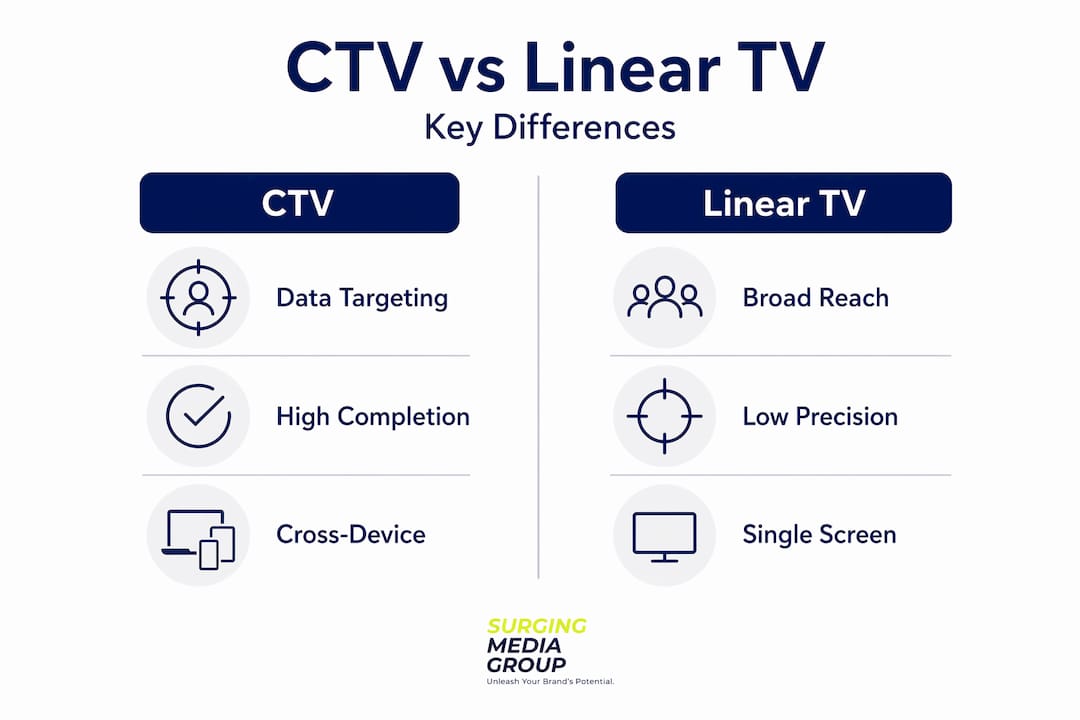
Here is how CTV compares to other channels at a glance:
| Feature | Linear TV | Social Video | CTV |
|---|---|---|---|
| Targeting precision | Broad demographics | Individual-level | Household-level |
| Ad completion rate | N/A (live broadcast) | 20-40% | 95%+ completion rate |
| Skippable | No | Often yes | Rarely |
| Measurement | GRP-based | Click/view-based | Impression + completion |
That completion rate is not a minor footnote. It fundamentally changes how you think about message design and creative investment.
Targeting capabilities and audience strategy
This is where CTV advertising separates itself from both linear TV and digital display, and where most marketers need to recalibrate their expectations. CTV targeting operates at the household level using IP addresses and device IDs matched inside privacy-safe data clean rooms, not individual-level cookies like browser-based digital channels. The distinction shapes every audience decision you make.
The types of targeting available on CTV include:
- Geographic targeting: Down to the zip code level, which makes CTV powerful for local market campaigns. Geo-targeted TV ads let regional brands reach specific neighborhoods without paying for irrelevant national inventory.
- Demographic targeting: Age, gender, household income, education level, applied at the household.
- Behavioral targeting: Modeled from browsing history, purchase signals, and app usage matched to household IDs.
- Contextual targeting: Matching ads to the genre or content category of the show being watched.
- First-party data targeting: Uploading your CRM or customer list to match against connected TV households.
- Lookalike audiences: Expanding reach to households that mirror your best existing customers.
The most common mistake I see is marketers assuming they can apply digital granularity to CTV. You cannot isolate one individual in a household of four. A campaign targeting 35-year-old women might serve the ad to the family television watched by multiple people. That is not a flaw to fight. It is a behavior to plan around when designing creative and setting frequency caps.
Pro Tip: Start with first-party data segments matched to your CRM before layering in third-party behavioral data. Your own customer data produces the sharpest targeting signal and the most defensible ROI story.
Audience fragmentation across platforms also complicates reach and frequency management. A viewer might use Hulu, Peacock, and Tubi in the same week, each measured separately. Integrating audience targeting strategies across platforms is the practical answer to this challenge.
Creative requirements for CTV campaigns
Here is a truth that brands discover the hard way: bad creative is painfully obvious on a 65-inch screen with the sound on. The full-screen, lean-back CTV environment exposes every production shortcoming. Low-resolution footage, flat audio, and copy written for a six-second Instagram swipe will not survive a 30-second non-skippable slot in front of a viewer who is deliberately settled in.

Successful CTV campaigns require 3 to 4 creative variants with refreshes every 6 to 8 weeks. Ad fatigue in a non-skippable environment is real and measurable. When the same household sees the same ad repeatedly, brand sentiment erodes faster than recall builds. You need to cycle stories, not just swap end cards.
Key production specifications to hit:
- Resolution: Minimum 1920x1080 (HD); 4K preferred for premium inventory
- Ad length: 15 seconds for awareness or retargeting, 30 seconds for story-driven conversion
- Audio: Mixed for 5.1 surround or stereo; sound plays at full volume by default
- File format: MP4 or MOV, H.264 or H.265 encoding; VAST 4.0 tag compliance for programmatic
- Safe zones: Keep text and logos away from screen edges, accounting for TV overscan
The creative itself needs emotional architecture from the first frame. Unlike YouTube where you have five seconds before a skip, CTV gives you the full spot if your opening five seconds earns attention. That opening must hook visually and contextually. Narrative-driven video ads consistently outperform straightforward product demos in CTV environments because the lean-back mindset rewards storytelling.
Interactive elements like QR codes embedded in the lower third of the frame have become a genuine bridge between passive viewing and immediate purchase behavior. Interactive CTV ads boost unaided recall by 36% and drive measurable foot traffic lift. If your campaign has a direct-response objective, that overlay belongs in your production plan from day one, not added as an afterthought in post.
Pro Tip: Commission your CTV creative separately from your social assets. Brief your production team on the sound-on, non-skippable, large-screen context from the start. Creative built for CTV can be adapted down to social. The reverse almost never works well.
Launching a CTV campaign: a 30-day plan
Running your first CTV campaign without a structured launch plan is how brands burn budget on inconclusive data. Here is a week-by-week framework:
- Week 1: Strategy and setup. Lock your KPIs before anything else. Are you measuring brand lift, video completion rate, branded search volume, or direct conversions? Define it now. Identify your targeting segments, set frequency caps (three to five impressions per household per week is a reasonable starting point), and select your buying method.
- Week 2: Production and trafficking. Finalize at least two creative variants per audience segment. Traffic your ads through a VAST tag tested across your target platforms. Confirm your measurement setup, whether that is a pixel, a brand lift study, or a third-party attribution tool.
- Week 3: Test launch. Deploy at 20 to 30 percent of your planned budget. This is not the time to optimize aggressively. Let the campaign run to gather statistically meaningful completion and reach data.
- Week 4: Review and scale. Analyze performance by segment, creative, and platform. Pause underperforming placements, increase spend on segments showing strong completion and low frequency waste, and finalize your full-scale creative refresh calendar.
CTV pricing is a critical planning input. Here is what you should expect:
| Inventory type | CPM range | Best for |
|---|---|---|
| FAST channels (free ad-supported) | $15 to $25 CPM | Broad reach, awareness campaigns |
| Premium AVOD (programmatic) | $25 to $45 CPM | Balanced reach and targeting |
| Audience-targeted premium buys | $45 to $85 CPM | High-value segment focus |
At $25 CPM, a $5,000 budget delivers 200,000 impressions on a household's primary screen. That math looks very different from social video buying, which is part of why CTV's attention-optimized campaigns deliver nearly three times the impact compared to viewability-only optimizations.
Challenges and what is coming next
No honest CTV advertising guide skips the hard parts. The channel has real limitations, and understanding them protects your budget and your credibility with leadership.
The most pressing challenges right now:
- Measurement fragmentation: 86% of media planners demand show-level reporting, but most platforms still deliver only aggregate impression data. You often cannot see which specific programs your ads ran in.
- Walled gardens: Platforms like Netflix, Disney+, and Amazon control their own data and measurement, making cross-platform attribution genuinely difficult.
- Budget inertia: Measurement problems reduce ad budgets shifting from linear TV to CTV, because CFOs want proof before committing. This is a structural industry challenge, not a brand-level failure.
- Cost versus reach trade-offs: Premium inventory carries premium CPMs. Smaller brands must make clear choices between reach and targeting precision.
On the optimistic side, the trends moving toward you are significant. 82% of marketers are not yet using AI in CTV campaigns, which means early adopters have a real advantage as platforms build AI-assisted targeting, contextual understanding, and creative production tools. Market consolidation among streaming services is also beginning to simplify measurement and targeting access for buyers.
"CTV's biggest opportunity lies in combining premium content environments with data-driven targeting and measurement not possible with linear TV." — Equativ, 2026
Retail data integration is another frontier worth watching. Brands that can connect CTV exposure data to in-store or e-commerce purchase data will have attribution clarity that was impossible even three years ago.
My honest take on where most marketers go wrong
I've watched brands invest real money into CTV and walk away underwhelmed, not because the channel failed them, but because they brought the wrong expectations and the wrong creative. What I've learned from working on campaigns across DRTV, streaming, and social is that CTV demands a specific kind of respect as a channel. You cannot phone it in.
The biggest misconception I encounter is that digital targeting translates wholesale to CTV. It does not. Marketers accustomed to Facebook's individual-level granularity often feel limited by household targeting. What they miss is that the tradeoff is premium: you are reaching that household on their primary screen, in a non-skippable format, with sound on. That is not a lesser context. It is a richer one.
What I've found actually works is treating creative investment as non-negotiable from the start. The brands that see strong CTV ROI are the ones that commission purpose-built spots, not the ones recycling their social assets. I've also found that brand storytelling strategy and direct-response principles are not opposites in CTV. The best-performing ads I've been part of blend emotional narrative in the first 20 seconds with a clear response mechanism in the final ten.
If you are new to CTV, run a 30-day test with real creative and real targeting, measure completion rates and branded search lift, and commit to the refresh cycle before you call it a verdict.
— Sergio
Ready to build CTV creative that performs?
At Surgingmedia, we produce CTV and streaming ads built for the large-screen, sound-on environment from the ground up. Our process covers every stage, from concept and scripting to final delivery in VAST-compliant formats ready for programmatic trafficking. We specialize in direct-response video that blends narrative engagement with measurable outcomes, the combination CTV audiences reward. If you are serious about building high-converting CTV video that drives both brand lift and immediate response, we should talk. Explore what our video assets for ad performance approach means in practice, and see how purpose-built creative changes campaign outcomes.
FAQ
What is CTV advertising?
CTV advertising delivers video ads on internet-connected television screens, including smart TVs, streaming sticks, and gaming consoles. Ads run inside streaming content from platforms like Hulu, Peacock, or Tubi, typically in non-skippable formats with 95%+ completion rates.
How is CTV different from traditional TV advertising?
CTV uses data-driven audience targeting at the household level, delivers measurable impression and completion data, and allows for programmatic buying. Traditional linear TV relies on broad demographic GRP models with no individual impression tracking.
What does CTV advertising cost?
CPMs range from $15 to $25 on free ad-supported FAST channels, $25 to $45 on premium programmatic inventory, and $45 to $85 for audience-targeted premium buys, depending on platform and targeting complexity.
How do you measure CTV ad performance?
Key metrics include video completion rate, reach and frequency by household, branded search lift, and third-party attribution studies. CTV measurement relies on playback confirmation signals rather than traditional viewability metrics, making completion rate the most reliable primary indicator.
How many creative variants do CTV campaigns need?
Most successful campaigns run 3 to 4 variants per audience segment and refresh creative every 6 to 8 weeks to prevent ad fatigue. The full-screen, non-skippable format makes creative wear-out more acute than in standard digital placements.