

Most marketing teams treat video as a deliverable. They produce a brand film, post it, and wait. What they're actually missing is a video content strategy, the industry term for a structured plan that connects every video you make to a specific business outcome. Without it, you're spending production budget on content that looks good but drives little. With it, every video has a purpose, a platform, an audience, and a measurable result. This guide breaks down what that strategy looks like in practice, and how to build one that actually moves the needle.
Table of Contents
- Key Takeaways
- What video content strategy really means
- Building a video content calendar that actually works
- Choosing the right formats and distribution channels
- Measuring what actually matters
- My honest take on what most teams get wrong
- Ready to build video content that converts?
- FAQ
Key Takeaways
| Point | Details |
|---|---|
| Strategy over production | A video content strategy ties every piece of video to a business goal, not just a creative brief. |
| Planning is an operating system | Effective video content planning treats the calendar as a production workflow, not a publish schedule. |
| Format and placement drive conversions | The right video format on the right platform can produce dramatically different conversion results. |
| Measure beyond views | Social shares, retention rates, and conversions tell you more about video success than raw view counts. |
| Repurposing extends ROI | A single event or shoot can generate a year's worth of content when planned with a repurposing framework. |
What video content strategy really means
A video content strategy defines the video types, topics, goals, distribution channels, and measurable results that connect your production efforts to real business objectives. It's not a posting schedule. It's not a creative brief. It's the framework that answers: why are we making this, who is it for, where will it live, and how will we know it worked?
The importance of video strategy becomes obvious once you understand what it prevents. Without one, teams chase trending formats, produce content in silos, and measure success by view counts that have no bearing on revenue. With a strategy in place, every video decision, from format to length to distribution channel, connects back to either awareness, engagement, or conversion goals. Those three objectives form the spine of every well-built video plan.
Here's what a functioning strategy actually contains:
- Business objectives: Awareness, lead generation, or direct sales, each requiring different formats and metrics
- Audience definition: Who you're talking to at each stage of the funnel, and what they need to see to move forward
- Content types: Educational videos, testimonials, explainers, product demos, and brand films, each serving a distinct purpose
- Distribution plan: Which platforms carry which formats, and when
- Measurement framework: What you track to prove performance and inform the next round of production
Emerging forces are reshaping this framework, too. AI personalization now allows brands to serve different video variations to different audience segments at scale. Interactive and shoppable videos let viewers take action without leaving the content entirely. These aren't future trends. They're live tools that forward-thinking teams are already weaving into their strategies. Effective video marketing in 2026 means your strategy accounts for both the content and the technology serving it.
Building a video content calendar that actually works
Most teams confuse a publishing schedule with a real plan. A publishing schedule tells you when content goes live. A true video content calendar is a production operating system that tracks date, platform, topic, format, goal, production status, assigned owner, asset links, and performance metrics, all in one place.

That distinction matters more than it sounds. When a calendar only tracks publish dates, production falls apart the moment two shoots land in the same week or a key team member is unavailable. A production-grade calendar prevents those collisions before they happen.
Here's how to build one that holds up under real workload:
- Define your content pillars first. Every video on the calendar should map to one of two or three core themes that reflect your brand's expertise. This creates coherence across episodes, formats, and platforms.
- Assign a primary goal to every video. Not a vague intention, a specific outcome. "Awareness for cold audiences on YouTube" is a goal. "Brand video" is not.
- Include production milestones, not just go-live dates. Script approval, shoot day, rough cut review, and final delivery should all appear on the calendar.
- Track repurposing opportunities from the start. A long-form interview can become three short clips, a blog post, a podcast episode, and a paid social ad. Note that potential at the planning stage, not after the fact.
- Review performance data weekly. The calendar should pull in retention rates, completion rates, and conversion data so you can course-correct before the next production cycle begins.
Audience feedback and analytics should actively shape your calendar, not just validate it after the fact. If short-form educational videos consistently outperform your brand films on Instagram, that's a signal to adjust the ratio, not something to note and ignore. Repurposing event content through clips, transcripts, and ads can extend a single production's lifespan by a year or more, which is one of the most underused efficiencies in video content planning.
Pro Tip: Build your calendar in 90-day blocks but review it every two weeks. Long-term planning gives you production stability; short-cycle reviews give you the agility to respond to audience behavior without scrapping everything.
Choosing the right formats and distribution channels
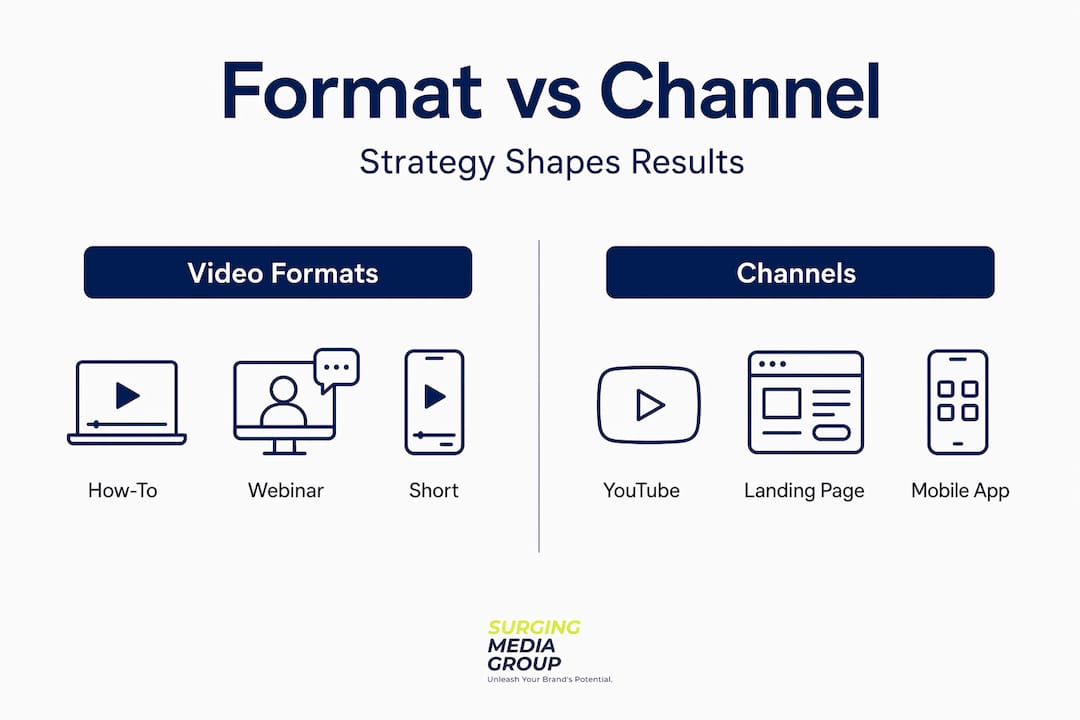
Format is not a creative preference. It's a strategic decision. The format you choose determines how long viewers stay, whether they take action, and where the content can realistically live.
| Video Format | Best Platform | Ideal Length | Primary Goal |
|---|---|---|---|
| Educational how-to | YouTube, LinkedIn | 3 to 8 minutes | Awareness, SEO |
| Testimonial or case study | Landing pages, paid social | 60 to 90 seconds | Conversion, trust |
| Explainer video | Website homepage | 90 seconds or less | Lead generation |
| Webinar or live session | LinkedIn, owned channels | 30 to 60 minutes | Engagement, retention |
| Short-form reel | Instagram, TikTok | 15 to 30 seconds | Reach, brand recall |
Educational videos under 5 minutes retain viewers roughly halfway through, while webinars maintain attention far longer among high-intent audiences. That retention gap matters when you're deciding where to invest production resources. A five-figure brand film that no one finishes is a weaker asset than a straightforward screen-recorded tutorial that drives 40% completion.
Placement is just as consequential as format. Landing page video placement shows a dramatic difference depending on how the video is embedded. A lightbox modal produces a 100% conversion lift on average, compared to 69% for standard inline embedding. That's a meaningful gap you can close without changing a single frame of footage, just by reconsidering where and how the video appears on the page. Pairing thoughtful audience targeting with the right placement multiplies that effect further.
On mobile, vertical video performs consistently stronger than horizontal across short-form platforms. If your team is still shooting everything in 16:9 and cropping for social, you're leaving performance on the table. Shoot for vertical first when the platform calls for it, then adapt for horizontal distribution, not the reverse.
Pro Tip: Use AI tools to generate platform-specific cuts from a single master file. The production investment stays fixed while your distribution reach expands significantly.
Measuring what actually matters
Views are a vanity metric. They tell you reach, not resonance. The teams that get real results from video shift their measurement focus to what happens after someone watches.
Social media engagement is now the fastest-rising top metric for video success, preferred by 22% of marketing teams as of 2026. That preference reflects a broader shift: teams are increasingly tracking meaningful interactions, click-throughs, and conversions rather than raw impressions. Here's where to focus your measurement attention:
- Retention rate: What percentage of viewers reach the halfway point? The 75% mark? The end?
- Click-through rate: Are viewers taking the intended next step after watching?
- Conversion rate: For landing page or product videos, how many viewers complete a purchase or fill out a form?
- Social shares: Organic sharing signals genuine resonance, not just algorithmic reach.
- Asset-level performance: Which specific video drives the most pipeline? Track at the individual asset level, not just the campaign level.
Video completion rates drop sharply after 120 seconds for most audiences, with the notable exception of high-intent B2B viewers watching a product demo. This benchmark should directly inform how you script and edit content for different contexts.
Iterative learning cycles built into your production calendar mean you're reviewing performance data at the asset level and using it to adjust your content mix. A video that underperforms on completion but drives strong click-throughs might need a tighter edit, not a complete rethink. Multi-touch attribution shows you how video fits across the full buyer journey, not just at the moment of conversion.
My honest take on what most teams get wrong
In my experience, the biggest failure point in video strategy isn't production quality. It's the disconnect between creative output and distribution discipline. I've watched teams spend weeks on a beautiful brand film, then post it once on LinkedIn and call it done. The film was excellent. The strategy behind its distribution was nearly nonexistent.
What I've learned over years of production work is that video asset performance scales with how deliberately you deploy it, not just how well you made it. I've seen modest, straightforward testimonial videos outperform polished hero films because they were placed correctly, targeted precisely, and tied to a clear conversion goal. High production cost only pays back when matched with sufficient traffic and a smart distribution plan.
The other thing most marketers miss is repurposing. Not as an afterthought, but as a production mandate. I've seen a single three-day event generate content that fed paid ads, organic social, email sequences, and blog posts for nearly a year, because someone planned the capture brief six weeks out and defined the hero moments before the cameras even rolled.
My advice: build your repurposing workflow before production begins, not after. And stop measuring your video success by views. Engagement and conversion are the numbers that connect your creative investment to real business outcomes.
— Sergio
Ready to build video content that converts?
At Surgingmedia, we work with brands that are done guessing. Every project starts with a strategy conversation, connecting your video goals to measurable outcomes before a single frame is captured. From direct-response infomercials to shoppable social content, our team handles concept, production, distribution, and performance tracking end to end.

Whether you're scaling a single product launch or building a full multi-platform video program, Surgingmedia brings the production depth and marketing precision to make it work. Brands like Copper Compression and Black & Decker have seen what purpose-built video content does for sales visibility. If your current video output isn't tied to a clear strategy, that's exactly where we start.
FAQ
What is a video content strategy?
A video content strategy is a structured plan that defines what video types you create, who they're for, where they're distributed, and how performance is measured. It connects production decisions directly to business goals like awareness, engagement, or conversions.
How is video strategy different from a content calendar?
A content calendar is one component of a video strategy, focused on planning and scheduling production. The strategy itself encompasses the full system: goals, audience, formats, distribution channels, and measurement frameworks.
What makes a successful video strategy?
A successful video strategy links every video to a specific business goal, uses the right format for each platform and audience, tracks engagement and conversion metrics rather than views alone, and builds repurposing workflows that extend each asset's value over time.
How long should marketing videos be?
It depends on format and intent. Short-form social content performs best under 30 seconds, while educational videos retain viewers well under 5 minutes. Most viewers drop off after 120 seconds unless they're in a high-intent B2B context like a product demo.
How do you measure video marketing success?
Move beyond view counts and track retention rate, click-through rate, conversion rate, and social shares. Engagement metrics like these, combined with asset-level attribution, give you a clear picture of which videos actually drive business results.