
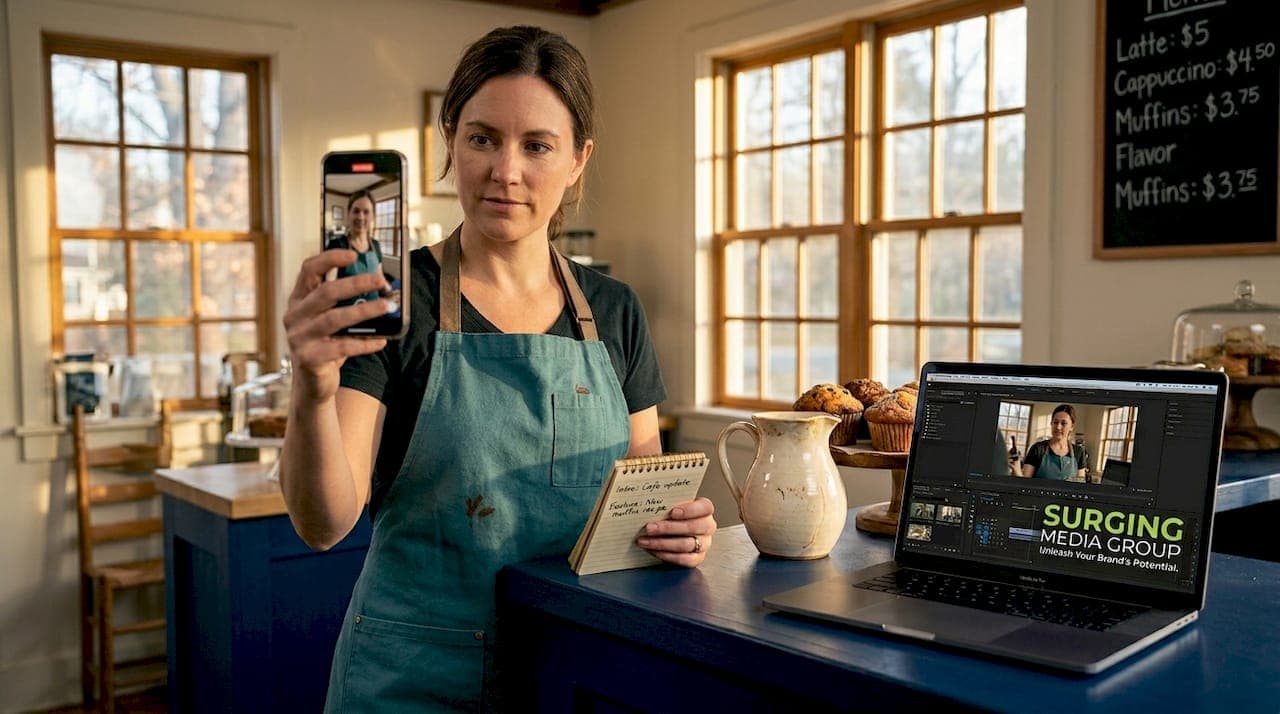
Video is no longer a nice-to-have for local businesses. It's the difference between a brand that gets found and one that gets overlooked. The role of video in local business marketing has grown from a supplementary tactic into a foundational driver of search rankings, customer trust, and revenue. Businesses using video grow revenue nearly 50% faster and rank 53 times more often on Google's first page. If you've been holding off because video feels complicated or expensive, this guide will show you exactly why that hesitation is costing you customers.
Table of Contents
- Key Takeaways
- The role of video in local business marketing today
- How video strengthens local SEO
- Video content types for every stage of the customer journey
- Implementing and measuring your video strategy
- My perspective on what actually moves the needle
- Ready to put your local video strategy to work
- FAQ
Key Takeaways
| Point | Details |
|---|---|
| Video accelerates revenue growth | Businesses using video consistently report faster revenue growth and significantly higher search rankings. |
| Authentic local content wins SEO | Location-specific videos and real customer reviews help Google verify your business and boost local rankings. |
| Match video type to customer journey | Different formats serve awareness, consideration, and conversion. Use the right one at each stage. |
| Consistency beats volume | Posting twice a month with purpose outperforms sporadic bursts of content with no strategy behind them. |
| Measure what actually matters | Track engagement rate, conversions, and traffic quality. Views alone tell you almost nothing useful. |
The role of video in local business marketing today
The local business playing field has changed. Customers now research businesses on their phones before they ever walk through your door. They watch videos, read reviews, and make decisions fast. Video is the format that captures attention and builds trust in the shortest time.
72% of consumers prefer video to learn about new products or services. That preference is not a trend. It reflects something deeper: people trust what they can see. A plumber who shows up on camera explaining a common pipe problem earns more trust than a plumber with just a logo and a phone number.
Here is what video does for local businesses specifically:
- Builds brand recognition in your community. A thirty-second clip showing your team, your shop, or your neighborhood signals to local viewers that you're real, present, and worth calling.
- Simplifies complex services. A two-minute walkthrough of how your HVAC maintenance works tells the story better than three pages of text ever could.
- Drives conversions on landing pages. Landing pages with video convert up to 86% better than those without.
- Increases email click-through rates. Emails with video see 200 to 300% higher CTR compared to text-only campaigns.
The importance of video marketing becomes clearest when you see it working against you. A competitor with a Google Business Profile full of customer video reviews and a YouTube channel showing real work will consistently outrank you, even if your actual service is better.
Pro Tip: Don't wait until your production looks perfect. A steady phone camera held by a confident team member is more persuasive than a polished corporate video that feels staged.
Video drives emotional connections through real people and stories. That emotional connection is what turns a first-time viewer into a loyal customer. It's the engine behind local brand storytelling that separates memorable brands from forgettable ones.
How video strengthens local SEO
Most local business owners think about video as a social media play. The smarter play is recognizing what video does for your search rankings.
Google's algorithm has evolved. It no longer just counts keywords. It evaluates behavioral signals, time on page, and evidence that a business is genuinely active and physically present. Video is woven into all three.
| SEO Signal | Without Video | With Video |
|---|---|---|
| Average session duration | Short | 88% longer with embedded video |
| Google first page ranking | Standard | 53x more likely |
| Google Business Profile strength | Moderate | Elevated by real video reviews |
| Local search trust signal | Weak | Confirmed via video metadata |
Authentic, location-specific video content proves what Google calls "proof of life." A video filmed at your shop, featuring a real customer in your service area, sends geographic and behavioral data that stock footage simply cannot replicate. Google's algorithms now verify business locations via video metadata, and stock footage actively works against you by producing weak or contradictory signals.

Customer video reviews are particularly powerful. When a customer films a review from their home or neighborhood and posts it tagged to your business location, that creates a spatial data point. Service area businesses can use location-tagged video reviews to map their geographic service territory in Google's local index.
Pro Tip: Ask satisfied customers to record a short video review from their home or yard and upload it directly to your Google Business Profile. Offer a small incentive, like a discount on their next visit, to increase participation.
This is how video advertising impact on local markets extends beyond awareness. It compounds into lasting SEO authority that pays dividends for months.
Video content types for every stage of the customer journey
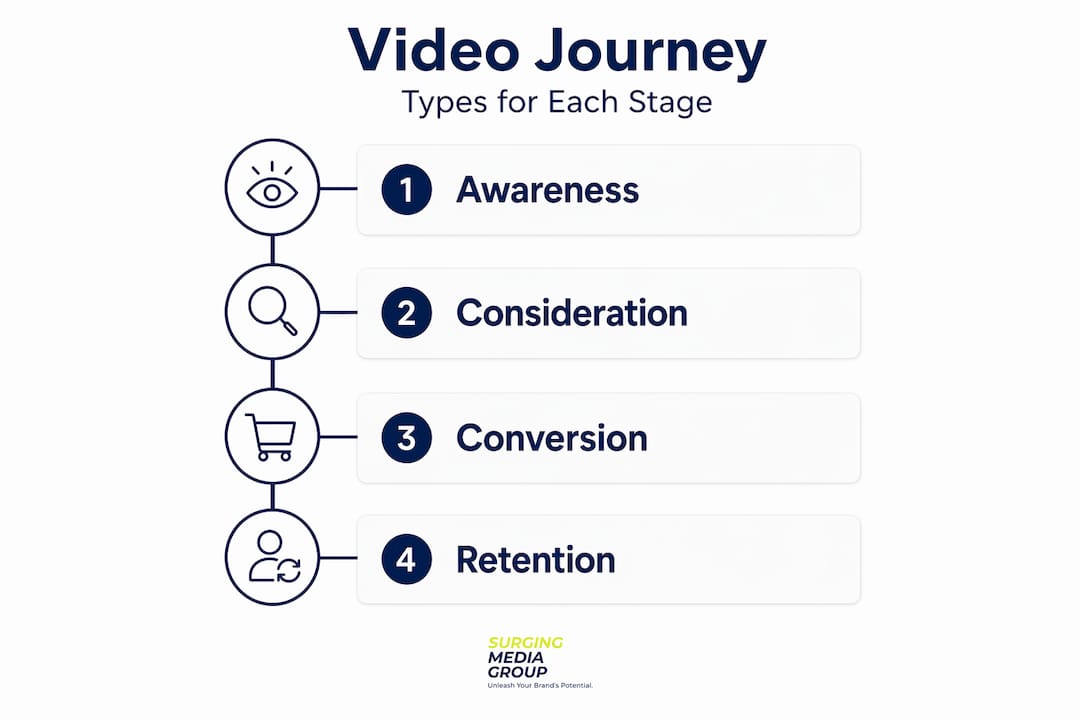
Not all video serves the same purpose. The businesses that get the most out of local business video content are the ones who match format to function. Think of it like a conversation with a potential customer: you wouldn't open with a sales pitch. You'd start by making yourself interesting.
Awareness: get found and recognized
At the top of the funnel, your goal is visibility. Quick brand introduction videos, neighborhood event highlights, and short "why we exist" stories work well here. Keep these under 60 seconds. Film them where your customers live: at local markets, community events, or right in front of your storefront.
YouTube videos also appear in organic search results, which means a short video titled "Best HVAC Service in [Your City]" can show up when someone searches that exact phrase. That's video working as a search asset, not just a social one.
Consideration: show your expertise
When someone is comparing you to a competitor, they want evidence. This is where how-to videos, behind-the-scenes content, and product or service demos earn their keep. A salon that posts a 90-second video of a full color treatment process tells potential clients exactly what to expect. That clarity reduces friction and builds confidence.
Short videos with captions maximize completion rates because most people watch without sound. Every video you publish should have captions, regardless of platform.
Conversion: turn viewers into buyers
Testimonials close deals. A real customer from your city, describing a specific problem you solved for them, is the most persuasive content you can produce. Video engagement for small businesses spikes when the people on screen look and sound like the viewer's own community.
Keep testimonials under two minutes. Lead with the problem, not the praise. The most effective format is: "Here's what I was dealing with, here's what they did, and here's my life now."
Retention: keep customers coming back
Post-purchase video content deepens loyalty. Think maintenance tips, product care guides, or community spotlights that feature your existing customers. Authentic community storytelling in video builds relationships that outlast social media algorithm shifts. That's a longer-term asset than any paid ad.
Implementing and measuring your video strategy
Knowing what to produce is one thing. Executing it without burning out is another. The businesses that sustain video marketing success treat it like any other operational process: planned, scheduled, and measured.
Here's how to build a video marketing system that actually sticks:
-
Build a content calendar tied to local events. Map your content to seasons, local holidays, and community happenings. A landscaping company posting lawn care tips in March will capture search traffic at exactly the right time.
-
Crowdsource from your customers and team. Your employees know your business intimately. Let them talk on camera. User-generated content from happy customers carries enormous credibility and costs almost nothing to collect.
-
Choose your platforms based on where your audience already spends time. YouTube for search visibility. Instagram Reels and TikTok for discovery. Facebook for community-focused content and local ads. Your Google Business Profile for reviews and presence.
-
Post twice a month at minimum. Consistent video content twice a month outperforms sporadic bursts every time. Frequency builds algorithm familiarity and audience expectation.
-
Repurpose aggressively. A single 3-minute service walkthrough can become five Instagram clips, a YouTube video, an email campaign asset, and a landing page embed. Understanding video content repurposing multiplies your output without multiplying your effort.
Pro Tip: End every video with a specific prompt. Ask viewers to comment with their question, tag a friend who needs your service, or click the link in your bio. Treating video as conversation and inviting responses boosts both engagement signals and search visibility.
On the measurement side, move past views. The metrics that actually tell you whether your video marketing strategy is working are engagement rate, time watched, website traffic quality from video referrals, and downstream conversions. Effective video measurement tracks pipeline contribution and customer acquisition cost reduction. Those numbers reveal whether video is earning its place in your budget or just filling your feed.
My perspective on what actually moves the needle
I've watched local businesses approach video in two very different ways. Some treat it like a broadcast: produce a video, publish it, wait for results. Others treat it like a conversation: produce something honest, invite a response, build on what they hear back. The second group consistently wins.
What I've found after working across dozens of local market campaigns is that authenticity travels further than production polish. A family-owned hardware store filming a thirty-second "staff pick of the week" with a phone gets more organic reach than a competitor who spent $5,000 on a corporate-style ad that feels generic. The reason is simple. People can feel when content is made for them versus made at them.
The other insight I keep coming back to is the compounding nature of local video SEO. The businesses that started uploading real customer videos to their Google Business Profiles in 2024 are sitting on a meaningful ranking advantage right now that competitors cannot quickly reverse. That's not a coincidence. It's the result of video as a behavioral signal that Google tracks over time.
My honest advice: forget trying to go viral. Focus on being consistently visible to the people within 10 miles of your front door. Show up regularly, be real, and ask your best customers to say something on camera. That combination, done for six months, will do more for your local business than most paid advertising strategies.
— Sergio
Ready to put your local video strategy to work
Local business owners who commit to video marketing gain a real and lasting advantage in their communities. Building that momentum is easier when you have a production partner who understands both storytelling and strategy.
Surgingmedia specializes in purpose-built video production for businesses that need content to perform, not just impress. From community-centered brand stories to conversion-focused testimonials, every video is designed to drive measurable results in your local market. Whether you're just starting out or ready to scale, Surgingmedia brings the creative craft and direct-response discipline to make your video investment count. Reach out today and see how the right video content can transform your local marketing presence.
FAQ
How does video help local businesses get found on Google?
Embedding video on your website increases session duration by up to 88%, which improves SEO. Authentic customer video reviews on your Google Business Profile also send location and engagement signals that Google uses to rank local results.
What video types work best for small business marketing?
Short brand introduction videos work for awareness, how-to and behind-the-scenes videos support consideration, and customer testimonial videos drive conversions. Each format serves a different stage of the customer decision process.
How often should a local business post video content?
Posting video at least twice a month consistently outperforms sporadic high-volume publishing. A steady cadence builds audience expectations and keeps your business visible in both social feeds and search results.
Do local businesses really need professional video production?
Not always, but quality matters more as you scale. Starting with honest, phone-shot content is fine. As your strategy matures, working with professionals who understand direct-response principles helps maximize the return on each video you produce.
What metrics should I track for local video marketing?
Track engagement rate, video completion rate, website traffic from video referrals, and downstream conversions rather than just view counts. These metrics reveal whether your video content is actually influencing purchase decisions in your local market.