

Amazon video advertising cost is defined as the CPM-based price brands pay to place video ads across Amazon's streaming platforms, including Prime Video, Freevee, and Fire TV. Rates typically range from $15 to $50 or more depending on the ad format, targeting depth, and whether you run a self-service or managed campaign. The two primary platforms are Amazon DSP and Sponsored TV, each with distinct pricing structures and minimum spend requirements. For brand marketers and business owners building an Amazon video ad budget, understanding these cost variables is the difference between a campaign that generates data and one that generates revenue.
What is Amazon video advertising cost by format?
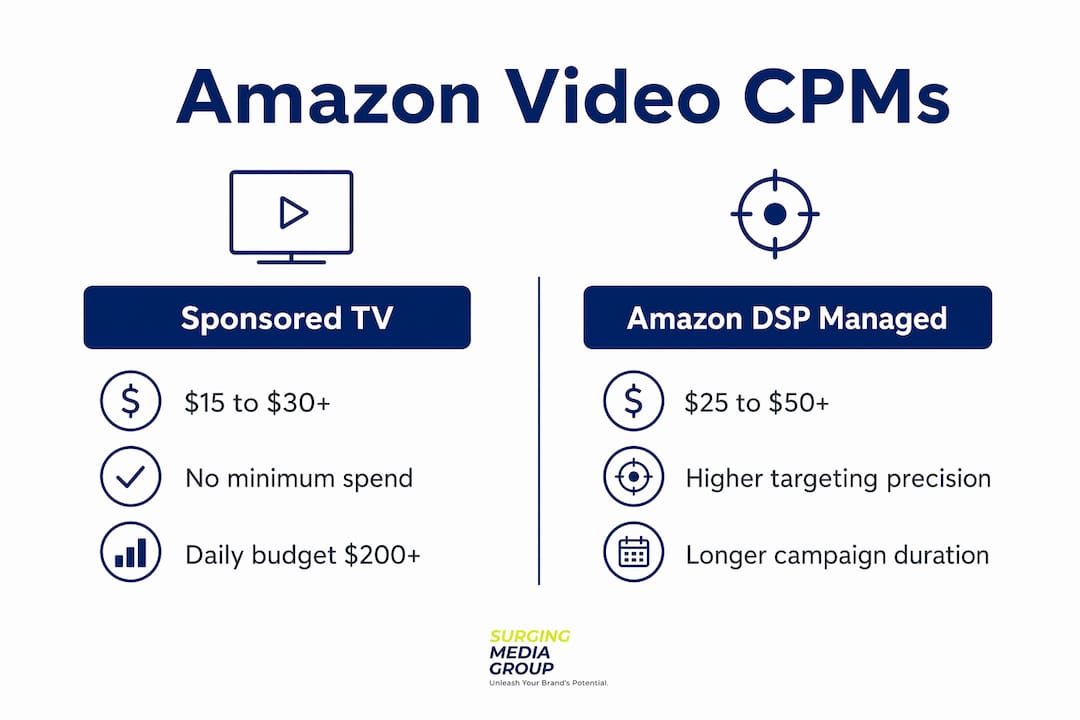
Amazon video advertising cost splits cleanly into two tiers based on how you access the inventory. Sponsored TV is the self-service option, and Amazon DSP managed service is the premium, full-support tier. Each carries a different pricing floor, CPM range, and minimum commitment.
Sponsored TV CPMs run $15 to $30+ with no formal minimum spend requirement. Amazon DSP managed service campaigns, by contrast, carry a $50,000 minimum spend and CPMs from $25 to $50+. That gap reflects the difference in audience access, reporting depth, and hands-on campaign management you receive from Amazon's own team.
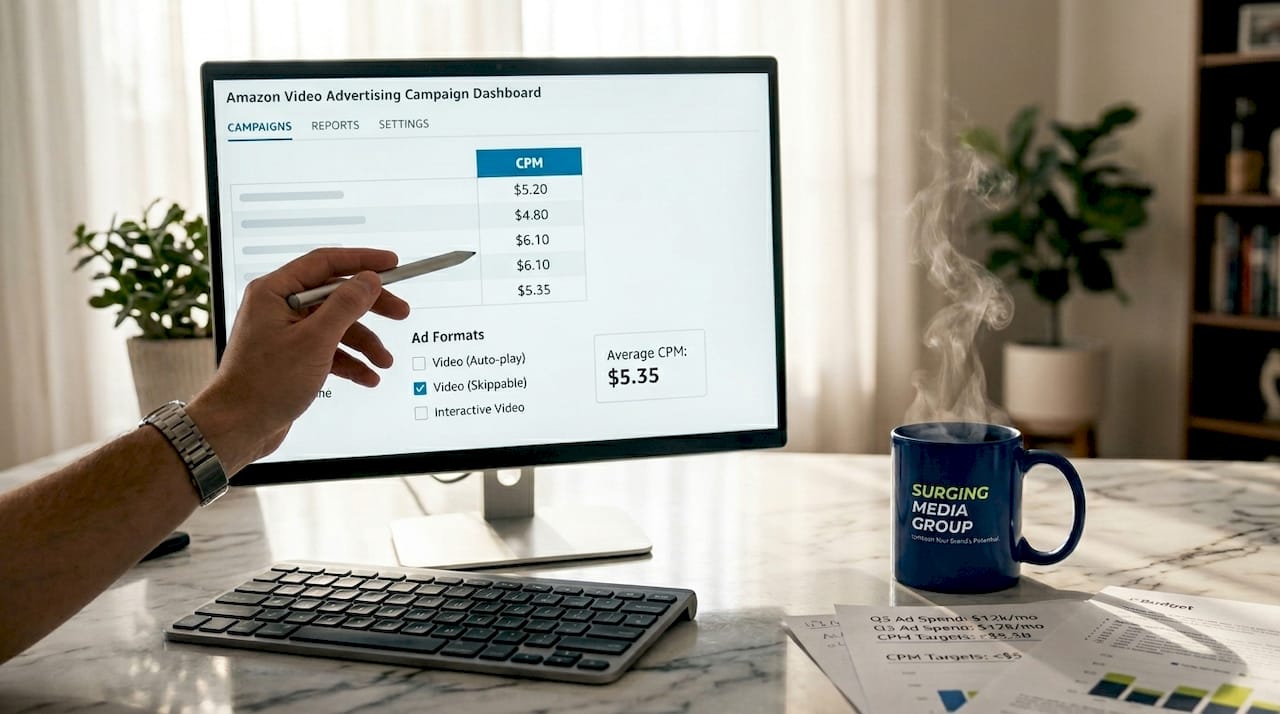
Here is a direct comparison of the main Amazon video ad formats and their cost structures:
| Format | CPM Range | Minimum Spend | Targeting Depth | Best For |
|---|---|---|---|---|
| Sponsored TV (self-service) | $15 to $30+ | No formal minimum | In-market, lifestyle, contextual | Brands testing video at scale |
| Amazon DSP (managed service) | $25 to $50+ | $50,000 | Custom audiences, behavioral, lookalike | Established brands with larger budgets |
| Prime Video Ads (programmatic) | $29 to $33 | Varies by deal | Broad to custom | Brand awareness campaigns |
The CPM pricing for streaming TV ads is higher than standard display ads because the inventory is premium and the formats are largely non-skippable. That premium translates directly into better completion rates and stronger view-through performance, which matters when you are measuring brand recall rather than just clicks.
- Sponsored TV reaches audiences on Prime Video, Freevee, Twitch, and Fire TV apps
- Amazon DSP managed service includes dedicated account support and deeper attribution reporting
- Prime Video programmatic placements offer broad reach at competitive CPMs
Pro Tip: If you are new to Amazon video advertising, start with Sponsored TV at a daily budget of $200 to $500. This lets you gather real CPM and completion rate data before committing to a managed service contract.
For a deeper look at how Sponsored Brand video fits into this picture, the Sponsored Brand video guide from Surgingmedia covers format specs and creative requirements in detail.
How does targeting precision influence Amazon video ad pricing?
Targeting is the single biggest variable in your Amazon video campaign cost after the format itself. Amazon's audience data is built on actual purchase behavior, not just browsing signals, which makes it unusually precise. That precision, however, comes with a cost premium.
Amazon offers several audience segment types that directly affect CPM:
- In-market audiences: Shoppers actively researching or purchasing in a specific category. These segments carry higher CPMs because the purchase intent is immediate.
- Lifestyle audiences: Broader behavioral profiles based on long-term shopping patterns. CPMs are lower, but conversion rates tend to follow.
- Custom audiences: Built from your own customer data or Amazon's matched segments. These are the most targeted and typically the most expensive per impression.
Narrow targeting raises CPM because you are competing for a smaller, higher-value pool of impressions. A campaign targeting "women aged 35 to 54 who purchased athletic apparel in the last 90 days" will cost more per thousand impressions than a campaign targeting all Prime Video viewers. The tradeoff is efficiency: a higher CPM with a tighter audience often delivers better return on ad spend than a lower CPM spread across a broad, unqualified audience.
Broader targeting lowers CPM but increases the risk of wasted impressions. For brand awareness campaigns with large budgets, that tradeoff can make sense. For performance-focused campaigns where every dollar needs to work, precision targeting is worth the premium. The audience targeting strategies that consistently outperform are those built around purchase intent signals, not just demographic filters.
Pro Tip: Allocate 70% of your Amazon video ad budget to your highest-intent audience segment and 30% to a broader awareness layer. This structure lets you capture near-term buyers while building brand recognition with future customers simultaneously.
What budget and campaign duration should you expect?
Setting a realistic Amazon video ad budget requires thinking in two phases: the test phase and the scale phase. Skipping the test phase is the most common and most expensive mistake brands make.
-
Set a test budget of at least $5,000. Practitioners consider $5,000 the practical minimum for Sponsored TV campaigns to generate enough impression and completion data for meaningful analysis. Below that threshold, the data set is too small to draw reliable conclusions about creative performance or audience response.
-
Plan daily budgets between $200 and $500 for Sponsored TV. The recommended daily range of $200 to $500 for self-service campaigns keeps delivery consistent without exhausting your budget before the algorithm has time to optimize. Erratic daily spend creates erratic delivery, which distorts your performance data.
-
Run campaigns for a minimum of 4 weeks. Running ads for at least 4 weeks builds the frequency needed for brand recall. Viewers typically need multiple exposures before a brand registers in memory, and cutting a campaign short at two weeks means you are paying for awareness you never fully delivered.
-
Extend to 6 to 8 weeks for brand lift measurement. Amazon DSP campaigns require 6 to 8 weeks to accumulate enough data for statistically valid brand lift studies. If measuring upper-funnel impact is part of your brief, budget for the full duration from the start. A recommended DSP minimum of $10,000 applies when you want access to those deeper attribution metrics.
-
Scale based on CPM efficiency, not just total spend. Once your test campaign establishes a baseline CPM and completion rate, use those numbers to project the cost of reaching your target audience at scale. A $15 CPM with a 90% completion rate is worth more than a $10 CPM with a 60% completion rate.
Budget and duration are inseparable in Amazon video advertising. A well-funded campaign cut short at three weeks will underperform a modestly funded campaign run for eight weeks with consistent daily delivery.
How do Amazon video ad CPMs compare to other streaming platforms?
Amazon's pricing position in the streaming ad market is one of the most strategically significant stories in digital advertising right now. Amazon Prime Video CPMs ranged between $29 and $33 in 2024, placing Amazon squarely in the mid-range of premium streaming inventory.
| Platform | Estimated CPM Range | Ad Format | Minimum Spend |
|---|---|---|---|
| Amazon Prime Video | $29 to $33 | Non-skippable, interactive | Varies |
| Netflix | $39 to $45+ | Non-skippable | $20M+ annually |
| Disney+ | $35 to $50+ | Non-skippable | High minimums |
| Hulu | $25 to $40 | Non-skippable, pause ads | $500K+ |
Netflix and Disney+ carry higher CPMs and significantly steeper access requirements, making them realistic only for enterprise-level advertisers. Amazon's self-service entry point through Sponsored TV changes that equation entirely for mid-market brands.
"Amazon's ability to maintain CPMs around $29 to $33 forced other streaming services to reduce their ad prices, increasing Amazon DSP spending substantially." — Digiday
That competitive CPM pressure has reshaped how media buyers allocate streaming budgets. Brands that previously allocated the majority of their connected TV spend to Hulu are now splitting budgets more evenly, drawn by Amazon's purchase-intent data and its lower cost of entry. The rise of personalized streaming ad formats on Amazon, where Dynamic TV Creative adapts ads in real time to viewer shopping behavior, adds measurable performance value that justifies the CPM premium over standard display. For a broader view of how connected TV fits into your media mix, the CTV advertising guide from Surgingmedia covers platform comparisons and budget allocation frameworks.
Key takeaways
Amazon video advertising cost is primarily CPM-based, ranging from $15 to $50 or more depending on format, targeting depth, and whether you use self-service Sponsored TV or Amazon DSP managed service.
| Point | Details |
|---|---|
| CPM range by format | Sponsored TV runs $15 to $30+; Amazon DSP managed service runs $25 to $50+. |
| Minimum viable budget | Plan at least $5,000 for Sponsored TV test campaigns to generate usable performance data. |
| Campaign duration | Run at least 4 weeks for brand recall; extend to 6 to 8 weeks for valid brand lift measurement. |
| Targeting and CPM | Narrow, intent-based targeting raises CPM but typically delivers stronger return on ad spend. |
| Competitive positioning | Amazon Prime Video CPMs of $29 to $33 undercut Netflix and Disney+, making it the most accessible premium streaming platform for mid-market brands. |
Why I think most brands are budgeting Amazon video ads wrong
I have watched brands approach Amazon video advertising the same way they approach paid search: set a modest budget, run for two weeks, see no measurable lift, and conclude that video does not work. That conclusion is almost always wrong. The problem is the budget structure, not the channel.
Amazon's advertising business reached $56 billion in 2024, and the platform's scale means your ads are competing for attention in a genuinely crowded environment. Underfunded campaigns do not just underperform. They generate misleading data that leads to bad decisions downstream. A $3,000 test campaign with a two-week window tells you almost nothing about whether your creative resonates or whether your audience targeting is calibrated correctly.
The brands I have seen succeed on Amazon video treat the first campaign as a learning investment, not a revenue event. They commit to the 4 to 8 week window, hold daily budgets steady, and resist the urge to optimize mid-flight based on incomplete data. The creative also matters more than most brands expect. Non-skippable formats mean your first five seconds carry the entire weight of the brand impression. Weak creative at a correct budget still fails. Strong creative at a correct budget compounds.
My honest advice: pair your Amazon video ad budget planning with a production partner who understands direct-response principles, not just brand storytelling. The two disciplines are not the same, and the gap between them shows up directly in your completion rates and conversion data.
— Sergio
How Surgingmedia helps brands get more from Amazon video
Surgingmedia specializes in producing video content built specifically for performance on Amazon and connected TV platforms. Every production is grounded in direct-response principles, which means the creative is designed to convert viewers into buyers, not just generate impressions. From concept and scripting through to distribution and analytics, Surgingmedia manages the full production cycle. Brands like Copper Compression and Black & Decker have used Surgingmedia's approach to drive measurable sales lift through purpose-built video content. If you are planning an Amazon video campaign and want creative that earns its CPM, explore Surgingmedia's video production services to see how the process works.
FAQ
What is the average CPM for Amazon video ads?
Amazon video ad CPMs typically range from $15 to $30+ for self-service Sponsored TV campaigns and $25 to $50+ for Amazon DSP managed service. Prime Video placements specifically averaged $29 to $33 in 2024.
Is there a minimum budget for Amazon video advertising?
Sponsored TV has no formal minimum spend, but practitioners recommend at least $5,000 to generate statistically useful campaign data. Amazon DSP managed service requires a $50,000 minimum spend commitment.
How long should an Amazon video ad campaign run?
Run Sponsored TV campaigns for at least 4 weeks to build brand recall frequency. Amazon DSP campaigns need 6 to 8 weeks to produce valid brand lift measurement data.
How does Amazon video advertising cost compare to Netflix or Disney+?
Amazon Prime Video CPMs of $29 to $33 are meaningfully lower than Netflix ($39 to $45+) and Disney+ ($35 to $50+), and Amazon's self-service entry point makes it accessible to mid-market brands that cannot meet the high minimums of those platforms.
Does targeting affect how much Amazon video ads cost?
Targeting directly affects CPM. Narrow, intent-based audience segments such as in-market shoppers carry higher CPMs than broad lifestyle audiences, but they typically deliver stronger return on ad spend because the impressions reach buyers with active purchase intent.