

Social commerce video is the practice of embedding shoppable, engagement-driven video content directly within social media platforms so consumers can discover and purchase products without ever leaving the app. The industry term for this broader practice is shoppable video, and it sits at the intersection of content marketing and direct-response commerce. Platforms like TikTok, Instagram, and Facebook have built native checkout infrastructure around this format, compressing the traditional sales funnel into a single scroll. 89% of consumers report that watching a video convinced them to buy a product, which means video is no longer a support channel. It is the channel.
What is social commerce video and why does it matter in 2026?
Social commerce video is defined as video content published on social platforms that combines product discovery, demonstration, and a direct purchase path within one native experience. Unlike a traditional product page or even a YouTube ad that redirects to a website, social commerce video keeps the buyer inside the platform. TikTok Shop, Instagram Shopping, and Facebook Shops all enable this frictionless path from content to cart.
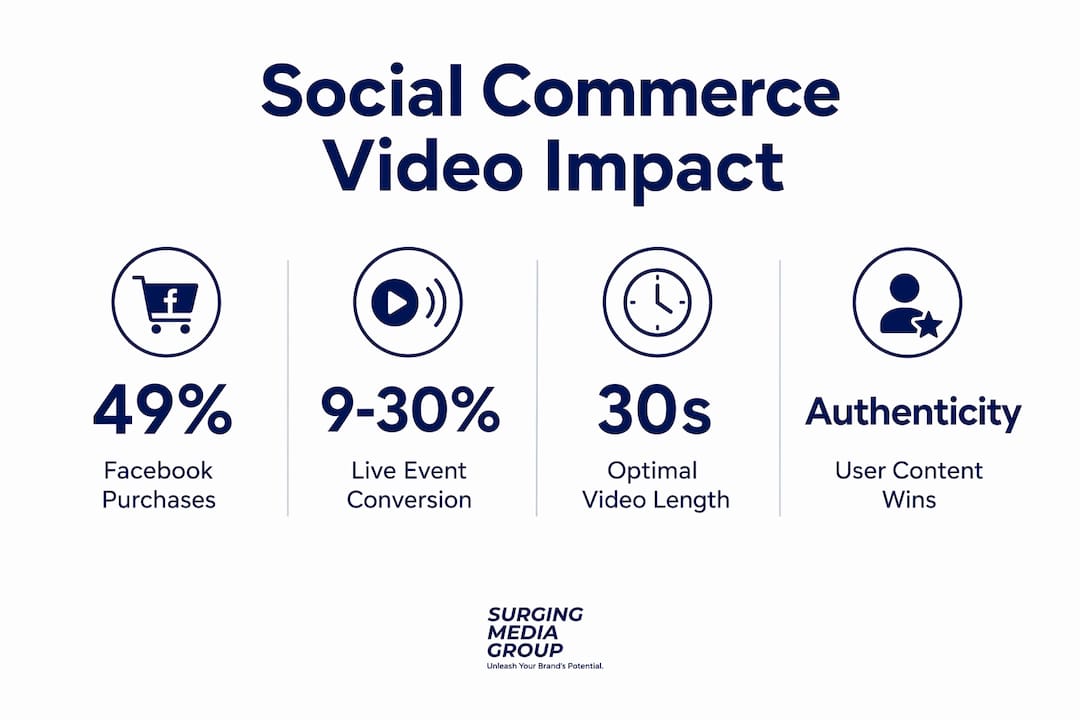
The strategic importance of understanding social commerce in 2026 cannot be overstated. Social commerce will account for over 17% of online retail sales, with Facebook leading in-app purchase usage at 49%. That share represents billions of dollars flowing through video-driven discovery moments, not search queries or email campaigns. Brands that treat social commerce video as a dedicated revenue channel, rather than a content marketing add-on, are capturing that spend.

What separates social commerce video from general social media marketing is intent architecture. A brand awareness post builds recognition. A social commerce video builds recognition and closes the sale in the same moment. That compression of the funnel is the defining feature, and it is why marketers and business owners need a clear framework for how to create social commerce videos that actually convert.
How does social commerce video influence consumer behavior and sales?
Social commerce video works by collapsing the gap between inspiration and action. When a viewer watches a 30-second TikTok demonstrating a skincare product, sees 40,000 likes, and spots a "Buy Now" tag in the corner, three psychological triggers fire simultaneously: product education, social proof, and purchase accessibility. The result is impulse buying behavior that standard ecommerce pages rarely produce.
The mechanics behind this are well documented. Social commerce eliminates friction by enabling discovery and purchase mid-scroll, making it particularly powerful for visually driven, trend-based products. Apparel, beauty, fitness accessories, and home goods all perform strongly in this format. Complex, high-consideration purchases like enterprise software or medical devices are less suited to the impulse dynamic.
Several forces drive the conversion lift that video marketing in social commerce consistently delivers:
- Social proof at scale. Creator content and user-generated clips signal real-world validation before the buyer even reads a description.
- Objection handling in real time. A 45-second demo answers "Does this actually work?" faster than any product copy.
- Frictionless checkout. One-tap purchase paths inside TikTok Shop or Instagram Checkout remove the abandonment risk of a redirect.
- Shoppable product tags that provide one-click checkout increase conversion by reducing the gap between watching and buying.
Pro Tip: Tag products early in the video, within the first five seconds, not at the end. Viewers who drop off before the final frame never see a late-placed tag, and that is a conversion you never recover.
User-generated content and creator clips consistently outperform brand-produced content because authenticity reduces purchaser hesitation more effectively than polished production. This does not mean production quality is irrelevant. It means the feel of authenticity matters as much as the technical execution.
What are the main types of social commerce video content?
The format you choose shapes the conversion outcome as much as the product itself. Each type serves a distinct role in the buyer's journey, and the most effective social media commerce strategies deploy several in combination.
- Short-form video clips. The backbone of TikTok and Instagram Reels commerce. These run 15 to 60 seconds, lead with a visual hook, and carry a product tag or link in bio. They are built for discovery and impulse response.
- Live shopping events. Real-time broadcasts where hosts demonstrate products, answer viewer questions, and offer time-limited deals. This format creates urgency that pre-recorded content cannot replicate.
- Shoppable videos with clickable product tags. Pre-recorded content with embedded purchase links, available across Instagram, Facebook, and YouTube. These work well for tutorials and product comparisons where the viewer needs a moment to decide.
- User-generated content (UGC) and customer testimonials. Organic or lightly produced clips from real buyers. Brands like Copper Compression have used authentic customer video to build trust at scale, and the results consistently outperform scripted brand content.
- Behind-the-scenes and process videos. These build brand affinity and are particularly effective for artisan, food, and lifestyle categories where the story of how something is made is part of the product's appeal.
- Tutorial and how-to videos. Answer purchase-related questions directly. A "how to style this jacket three ways" video on Instagram Reels serves both content and commerce simultaneously.
Each platform rewards different formats. TikTok favors raw, fast-paced clips with trending audio. Instagram Reels performs best with polished visuals and strong opening frames. Facebook Live shopping connects well with older demographics who prefer longer, conversational formats. Replicating the exact same video across all three without adjustment reduces effectiveness because each platform's algorithm and audience behavior are distinct.
How does social commerce video differ from video commerce?
These two terms are often used interchangeably, and that confusion costs brands real money. Social commerce video and video commerce are related but serve fundamentally different roles in the sales funnel.
| Dimension | Social commerce video | Video commerce |
|---|---|---|
| Where it lives | TikTok, Instagram, Facebook, YouTube | Brand website, retailer product pages |
| Primary role | Discovery and impulse purchase | Conversion and consideration |
| Shopper intent | Passive, browsing, mid-scroll | Active, in purchase mode |
| Data ownership | Platform-controlled | Brand-owned first-party data |
| Typical conversion rate | 2 to 3% (standard ecommerce baseline) | 9 to 30% on brand sites during live events |
Live shopping events convert at 9% to 30% on brand sites compared to 2 to 3% for standard ecommerce, driven by the higher purchase intent of visitors who arrive on a brand's own page. That gap is not a flaw in social commerce video. It reflects the different job each format is doing.
Successful strategies separate discovery from conversion. Social commerce video ignites the impulse. Video commerce on owned pages converts the demand with deeper content, richer product detail, and a checkout environment the brand fully controls. Video commerce on brand-owned pages also delivers richer first-party data, including watch time, add-to-cart clicks, and FAQ engagement, all of which are more predictive of purchase intent than social platform metrics.
Pro Tip: Think of social commerce video as the spark and your brand website as the engine. Use platform content to create desire, then build a video commerce experience on your own pages that captures buyers who want more before committing.
Understanding social commerce as a discovery channel rather than a full-funnel solution is the strategic shift that separates high-performing brands from those burning budget on misaligned expectations.
What are best practices for creating effective social commerce videos?
The benefits of social commerce videos only materialize when the content is built with conversion in mind from the first frame. Here is what the evidence and experience consistently support:
- Focus on one product per video. Multi-product videos dilute attention and reduce click-through on product tags. A single, clearly featured item gives the viewer one decision to make.
- Open with the product in use, not a logo. The first two seconds determine whether a viewer scrolls past. Show the product solving a real problem before anything else.
- Include frequent calls to action within the video itself. Reminders that indicate shoppability, such as "tap the tag to shop," set viewer expectations and improve conversion.
- Leverage creator and UGC content. Partnering with micro-influencers in your category produces content that feels native to the platform and builds trust faster than brand-produced clips.
- Use live shopping to create urgency. Limited-time offers and real-time Q&A during live events drive immediate purchase decisions that asynchronous video cannot replicate.
- Tailor format to platform norms. A vertical 9:16 video with trending audio works on TikTok. A square or landscape format with clean visuals performs better on Facebook. Treat each platform as its own production brief.
- Track SKU-level sales from specific creator content to connect video investment to actual revenue. Brands that measure at this granularity optimize spend far more effectively than those tracking only impressions or engagement.
Pro Tip: When working with creators, brief them on the product's single most compelling benefit rather than a full feature list. The best social commerce videos feel like a friend sharing a discovery, not a brand reciting specifications.
You can explore social media video formats that drive results to see which content structures align with your platform mix and audience behavior.
Which platforms lead in social commerce video features?
Platform selection shapes the entire production and distribution strategy. Each major platform has built distinct social commerce video infrastructure, and the features available in 2026 reward brands that understand the differences.
| Platform | Key social commerce video features | Best content type |
|---|---|---|
| In-app checkout, Facebook Shops, Live Shopping, 49% in-app purchase share | Long-form live events, product demos | |
| TikTok | TikTok Shop, creator affiliate program, short-form shoppable clips | Raw, trend-driven 15 to 60 second clips |
| Shopping tags, Reels, Instagram Shops, Checkout | Polished Reels, UGC reposts, Stories | |
| YouTube | Shoppable ads and AI-driven product showcases | Long-form tutorials, product reviews |
Facebook's dominance in in-app purchase behavior makes it the highest-volume platform for direct social commerce conversion today. TikTok's creator ecosystem and TikTok Shop integration make it the fastest-growing channel for discovery-driven impulse purchases, particularly among audiences under 35. Instagram's Shopping tags woven into Reels create a natural content-to-commerce path that works across both organic and paid distribution. YouTube's shoppable ads and AI-driven product recommendations support longer consideration cycles, making it well suited for products that benefit from detailed demonstration. For deeper guidance on shoppable video integration, the technical and creative requirements vary meaningfully by platform.
Key takeaways
Social commerce video is a dedicated revenue channel that requires platform-specific content, SKU-level measurement, and a clear separation between discovery and conversion roles to deliver consistent sales results.
| Point | Details |
|---|---|
| Definition is precise | Social commerce video is shoppable video content embedded within social platforms enabling in-app purchase. |
| Discovery vs. conversion | Social platforms ignite impulse buying; owned-site video commerce converts higher-intent buyers at 9 to 30%. |
| Platform fit matters | TikTok, Instagram, Facebook, and YouTube each require distinct formats and content strategies. |
| UGC outperforms brand content | Authentic creator and customer videos build trust and reduce purchase hesitation more effectively. |
| Measure at SKU level | Connecting specific videos to product-level revenue is the only way to optimize video investment accurately. |
Why most brands are still treating social commerce video like a marketing expense
I have watched brands pour significant production budgets into TikTok and Instagram content, then measure success by follower growth and video views. That is the wrong scorecard entirely. Social commerce video is a revenue channel. The moment you start measuring it like one, the entire strategy sharpens.
The mistake I see most often is conflating discovery and conversion in the same video. A brand tries to build awareness, demonstrate the product, establish credibility, and close the sale in 30 seconds on a platform where the viewer's thumb is already moving. That is too much weight for one piece of content. The smarter approach is to let social commerce video do what it does best: create desire and trigger the first click. Then build a video commerce experience on your own site that captures the buyer who wants more before committing. Brands that invest in both form more complete strategies and capture broader revenue than those who rely on one channel alone.
The other pattern worth calling out is platform laziness. Reposting the same video across TikTok, Instagram, and Facebook without adaptation is a signal that the content was not built for any of them. Each platform has its own rhythm, its own audience behavior, and its own algorithm logic. Respecting that takes more production effort, but the conversion difference is real and measurable.
Data discipline is what separates the brands winning at social commerce video from those guessing. Demand SKU-level attribution from your platform partners. Know which creator, which format, and which product combination is actually driving revenue. Without that, you are optimizing for the wrong signals.
— Sergio
How Surgingmedia helps brands win with social commerce video
If you are ready to treat social commerce video as the revenue channel it is, Surgingmedia builds the content that makes that possible.

Surgingmedia specializes in producing high-converting video content built specifically for social commerce environments. From short-form TikTok and Instagram Reels to shoppable product clips and live shopping support, every production is grounded in direct-response principles that compel viewers to act. The team handles concept development, scripting, platform-specific formatting, and performance tracking so your video investment connects directly to measurable sales. Brands like Copper Compression and Black & Decker have used Surgingmedia's production expertise to drive visibility and revenue across major platforms. If your social commerce video strategy needs a production partner who measures success in sales, not views, Surgingmedia is built for that work.
FAQ
What is social commerce video in simple terms?
Social commerce video is shoppable video content published on platforms like TikTok, Instagram, and Facebook that lets viewers purchase products directly within the app without visiting an external website.
How does social commerce video differ from a regular product video?
A regular product video drives awareness or redirects viewers to a website. A social commerce video includes native product tags, in-app checkout, or direct purchase links that complete the sale inside the platform.
Which platform is best for social commerce video?
Facebook leads in in-app purchase usage at 49%, making it the highest-volume platform for direct social commerce conversion, while TikTok Shop is the fastest-growing channel for discovery-driven impulse purchases.
Does user-generated content really outperform brand video in social commerce?
Yes. Authentic creator and customer clips build trust and reduce purchase hesitation more effectively than polished brand-produced content, which is why UGC is a core element of high-performing social commerce strategies.
How should I measure the success of social commerce video campaigns?
Track SKU-level sales tied to specific creator content and video formats, not just impressions or engagement. Connecting individual videos to product-level revenue is the only measurement approach that supports accurate budget optimization.