

Most marketers assume they understand social media advertising. Then they run a static image campaign, watch the results flatline, and wonder what went wrong. The answer is almost always format. A social media video ad — the industry term is paid social video — is a targeted, paid placement that delivers moving content directly to specific audiences on platforms like Facebook, Instagram, TikTok, LinkedIn, and YouTube. With digital video on pace to capture nearly 60% of all TV and video ad spend in the US in 2025, this format has moved from experimental to non-negotiable.
Table of Contents
- Key Takeaways
- What a social media video ad actually is
- Technical specs that determine performance
- Why video ads outperform other formats
- Using AI to scale creative and lift ROAS
- Putting it all together: a practical strategy
- My take on where video ads are heading
- How Surgingmedia helps brands build high-converting video ads
- FAQ
Key Takeaways
| Point | Details |
|---|---|
| Video ads are paid placements | They use platform targeting to reach specific demographics, interests, and behaviors beyond organic reach. |
| Format specifications matter | Aspect ratio, duration, and safe zones differ by placement and directly affect performance. |
| AI multiplies creative output | Tools like Meta Advantage+ generate variations automatically, lifting ROAS by an average of 22%. |
| Video outperforms static | Platforms distribute video more widely because engagement signals like watch time are richer than image clicks. |
| Measurement drives improvement | Tracking CTR, watch time, and CPA reveals what to scale and what to cut. |
What a social media video ad actually is
At its core, a social media video ad is a paid digital marketing format that delivers video content to specific audience segments using demographic, interest, and behavioral data collected by the platform. Unlike organic posts that surface based on follower relationships or algorithmic goodwill, paid social video is guaranteed placement. You define who sees it, when, and in what context.
The placements vary significantly across platforms, and that variation shapes everything from production choices to pacing decisions. Here is where paid social video shows up most consistently:
- In-feed videos scroll naturally through Facebook, Instagram, LinkedIn, and TikTok timelines, blending with organic content
- Stories and Reels ads appear in vertical, full-screen formats designed for mobile-first consumption with a swipe-up or tap interaction
- Pre-roll and mid-roll clips run before or during YouTube and streaming content, often with skip options after five seconds
- Sponsored content on LinkedIn carries video directly into professional feeds, optimized for B2B audiences with job title and company targeting
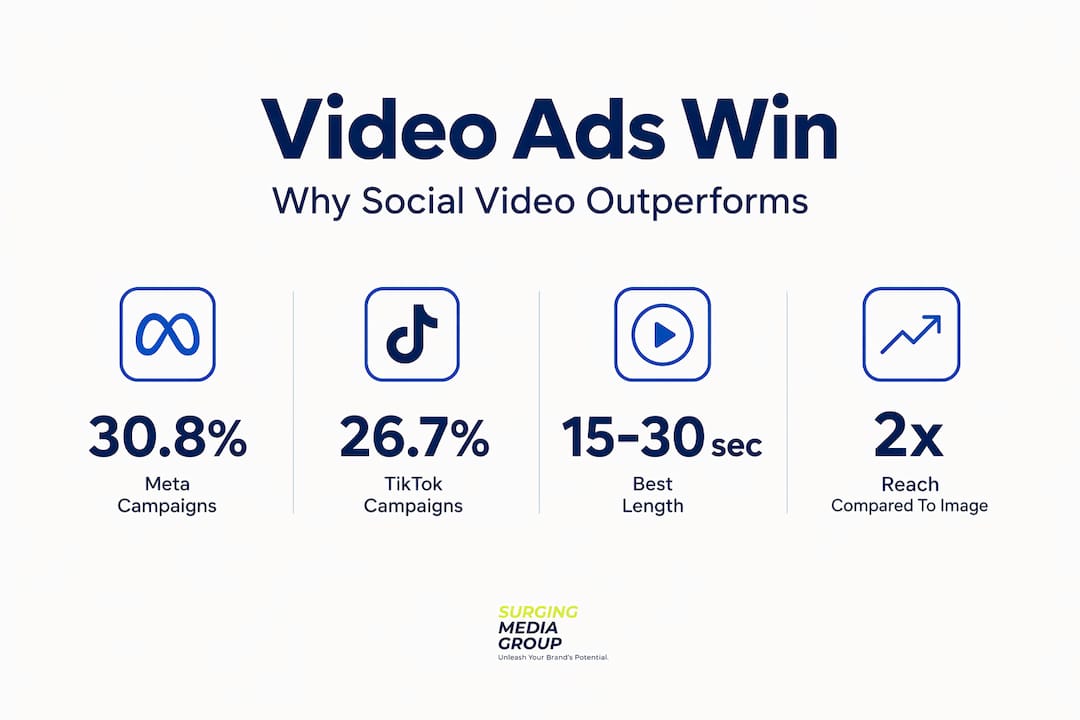
The reason video typically achieves higher engagement over static images is structural. Platforms reward content that holds attention. A video with strong watch time signals sends the algorithm a clear message: keep distributing this. A static image, no matter how well designed, cannot generate that same depth of signal. That gap in engagement data is why video ads receive preferential distribution on almost every major platform.
Technical specs that determine performance

Understanding what a social media video ad is matters. Knowing how to build one that actually works requires getting into the specifications. This is where many brands lose performance before the campaign even launches.
For Instagram Reels ads, the recommended setup is a 9:16 vertical aspect ratio at 1080×1920 resolution, exported as MP4 or MOV using H.264 compression, with a maximum file size of 4GB and AAC stereo audio at 128kbps or higher. Feed ads on Instagram and Facebook use a 4:5 ratio instead, which means a different crop, different text placement, and potentially different opening shots.
| Placement | Aspect ratio | Recommended duration | Key consideration |
|---|---|---|---|
| Instagram Reels / Stories | 9:16 | 15 to 30 seconds | Full-screen safe zones for UI overlays |
| Instagram / Facebook Feed | 4:5 | 15 to 30 seconds | Centered composition for thumb-stop |
| YouTube Pre-roll | 16:9 | 15 to 30 seconds | Hook within first 5 seconds before skip |
| TikTok In-feed | 9:16 | 9 to 15 seconds | Native-style, fast-paced cuts |
The 9:16 versus 4:5 decision is not just an export setting. It changes shot composition, where faces are framed, and how much breathing room text has before it collides with platform UI elements like buttons and captions. Planning this at the production stage saves time, money, and clicks later.
Optimal video length for Reels and Stories sits at 15 to 30 seconds based on mobile user completion patterns. Shorter formats drive completion rates up. Completion rates feed the algorithm. The algorithm expands distribution. That chain reaction starts at the script level.
Pro Tip: Export every social video ad in at least two aspect ratios — 9:16 for Stories and Reels and 4:5 for Feed placements. Running the wrong ratio in the wrong placement cuts click-through rates noticeably, and the fix costs almost nothing at the editing stage.
Why video ads outperform other formats
The advantages of video ads reach well beyond aesthetics. They are structural, algorithmic, and measurable. Here is how they stack up against other formats in practice.
Video combines visuals, sound, and storytelling to create brand experiences that drive stronger recall, sharing behavior, and conversion than images or text-only formats. A product demo that shows a compression sleeve in motion communicates in three seconds what a paragraph of copy cannot. That sensory combination also makes the memory sticky. Viewers who watch a video ad through to the end are significantly more likely to recall the brand later.
"Platforms optimize video distribution based on richer engagement signals — views, watch time, and clicks — giving video ads a structural distribution advantage that static formats simply cannot match." — Brandwatch Social Media Glossary
The performance data reinforces this. Meta traffic campaigns achieve a 30.8% interaction rate, and TikTok traffic campaigns deliver a 4.93% CTR, both figures that reflect the engagement depth video creates compared to display or static placements. Sales campaigns on Meta can push cost per action down to $0.13, which reframes the conversation about video production ROI entirely.
The other benefit worth naming directly: precision targeting. Paid social video does not broadcast blindly. You reach specific age bands, income ranges, purchase behaviors, job titles, and interest clusters. A brand like Copper Compression can serve video ads to people who recently searched for joint support or follow athletic recovery accounts, rather than paying to reach anyone who scrolls past. That specificity, layered on top of video's inherent engagement power, is what separates effective social media video ads from campaigns that burn budget without results.
Using AI to scale creative and lift ROAS
This is where the conversation shifts from understanding video ads to winning with them. AI has changed the production and optimization workflow in ways that matter for your budget and your output.
Meta's Advantage+ Creative delivers 22% higher ROAS on average compared to traditional campaigns by automating creative variations and letting the platform's algorithm select the best-performing combinations. Instead of running one video ad and hoping it connects, you feed the system multiple variations and let performance data decide.
Here is a practical workflow for scaling with AI:
- Produce a core video asset at full quality, following technical specs for your primary placement (typically 9:16 for Reels)
- Generate format variations by exporting 4:5 and 16:9 versions from the same edit to cover Feed and YouTube placements without a full reshoot
- Create messaging variations by swapping headline cards, opening hooks, or calls to action within the same base video to test different angles
- Upload all variations into Advantage+ and allow the AI to allocate budget toward whichever combination generates the strongest signals
- Review performance weekly, pause underperformers, and use the winning angles to inform your next production brief
AI-assisted creative iteration reduces manual workload and accelerates the feedback loop. What used to require multiple production cycles now happens within a single well-planned shoot. The video assets driving performance are rarely singular masterpieces. They are systems of variations that the platform continuously refines.
Pro Tip: Do not treat your video ad as a finished product. Treat it as a starting point. Plan shoots with swap-able elements — different hooks, different closing lines — so you can generate five to ten creative variations from a single production day.
Putting it all together: a practical strategy
Knowing what a social media video ad is and how it performs means little without a clear plan for execution. Here is how to approach video advertising on social media in a way that connects strategy to results.
- Match format to objective. Brand awareness campaigns favor longer storytelling formats in Feed placements. Direct response and sales campaigns perform better in Reels and Stories with tight hooks and clear calls to action within the first three seconds.
- Write for sound-off viewing. Over 85% of social videos are watched without audio on first play. Captions, text overlays, and visual storytelling carry your message when the viewer has not yet tapped for sound.
- Build your hook around the viewer's problem, not your product. The most effective social media ad strategies open with a tension or recognition moment that stops the scroll. Your product is the resolution, not the introduction.
- Use platform targeting features to layer context. Retargeting video viewers who watched 50% or more of your ad with a direct response offer is one of the highest-converting sequences in paid social.
- Measure watch time alongside CTR. Watch time tells you whether your creative is compelling. CTR tells you whether your offer is relevant. A high watch time with low CTR means you need a stronger call to action, not a better video.
- Keep cost-per-acquisition central. Creative decisions should connect to CPA, not just engagement rates. Beautiful videos that do not convert are content, not advertising.
A good starting point for understanding audience-level targeting is mapping your customer data to platform audience tools before you build a single frame of video.
My take on where video ads are heading
I have watched this space evolve from the early days of grainy Facebook video posts to AI-generated creative systems that optimize in real time. What strikes me most is not how much the technology has changed. It is how many marketers still treat video as a production exercise rather than a performance discipline.
In my experience, the brands that win with paid social video are the ones who obsess over the first three seconds, not the last thirty. They know that brand storytelling matters deeply, but the story has to earn its audience in the opening frame before it earns attention for the narrative.
I have also seen the convergence of social video and CTV accelerate faster than most marketing teams are prepared for. The skills and assets you build for Instagram Reels today translate directly to streaming and connected TV placements tomorrow. That is not a future-state observation. It is already happening in media plans I see right now.
My honest advice: stop treating video ads as a line item you occasionally activate. Build a creative system, plan for AI-assisted iteration from the start, and measure beyond surface metrics. The marketers who figure this out early are building durable advantages that are genuinely hard for competitors to replicate.
— Sergio
How Surgingmedia helps brands build high-converting video ads
If you are ready to move from understanding paid social video to producing content that actually performs, the production quality and strategic clarity of your creative will determine the outcome.
Surgingmedia specializes in performance-driven video production built specifically for brands that need results, not just reach. From scripting and production to format optimization and distribution, every asset is built with direct-response principles woven into each frame. Surgingmedia has helped brands like Copper Compression and Black & Decker produce social video content that connects creative storytelling with measurable sales impact. Whether you need Reels built for Meta Advantage+, multi-format assets ready for cross-platform deployment, or authentic testimonial content that builds trust at scale, Surgingmedia delivers production tailored to your campaign goals.
FAQ
What is a social media video ad?
A social media video ad is a paid digital placement that delivers video content to targeted audiences on platforms like Facebook, Instagram, TikTok, LinkedIn, and YouTube. It uses platform advertising systems to reach specific demographics, interests, and behaviors beyond organic reach.
How long should a social media video ad be?
For Reels and Stories on Meta platforms, 15 to 30 seconds is the recommended duration based on mobile completion patterns. Shorter videos drive higher completion rates, which feeds the algorithm and expands distribution.
Why do video ads perform better than static image ads?
Platforms distribute video ads more widely because watch time and view data give algorithms richer signals than image impressions. Video also combines audio, visuals, and storytelling, creating stronger brand recall and higher conversion rates than static formats.
What aspect ratio should I use for social media video ads?
Use 9:16 for full-screen placements like Stories and Reels, and 4:5 for in-feed placements on Instagram and Facebook. Aspect ratio choices affect composition, UI overlay placement, and click-through rates, so plan this during production rather than at the export stage.
How does AI improve social media video ad performance?
Meta's Advantage+ Creative uses AI to test multiple video creative variations automatically, delivering an average 22% higher ROAS compared to traditional campaigns. Producing several variations from a single shoot and uploading them together allows the platform to optimize delivery toward the best-performing combination.