

Social video ad creative briefs are structured documents that align your production team, media buyers, and creators around a single, testable creative strategy before a single frame is shot. Without one, you get subjective creative decisions, off-brief work, and wasted budget. The best-performing campaigns on Meta, TikTok, and YouTube share one common foundation: a brief that specifies the hook hypothesis, audience profile, platform specs, and success metrics with zero ambiguity. If you want video ads that drive results, the brief is where the work actually begins.
What goes into an effective social video ad creative brief
A well-structured creative brief includes eight non-negotiable fields: campaign objective, audience profile, hook hypothesis, offer and value proposition, format and placement specs, copy guidelines with annotated reference ads, success metric, and a capped revision protocol. Omitting any of these fields produces off-brief work and forces creatives to make subjective decisions that should have been made strategically. Think of the brief as the engine of the entire production. Every creative choice downstream runs on what you put into it.

The hook hypothesis: the most misunderstood field
The hook hypothesis is not a tagline or a vague creative direction. A strong hook hypothesis predicts the viewer's emotional or behavioral response within the first three seconds and is measurable via a metric like the three-second view rate. That specificity transforms your brief from a creative suggestion into a testable strategy. Instead of writing "open with something attention-grabbing," you write: "Opening with a close-up of the product solving the problem will trigger curiosity in our 35-to-54 female audience, measurable by a 3-second view rate above 35%."
Format, placement, and technical specifications
Every brief must include placement-specific contracts with precise safe zones and character limits. Safe zone rules for Meta prevent call-to-action text from being hidden behind UI overlays, and vertical 9:16 is mandatory for Reels and Stories to deliver the full-screen experience. Specify video length ranges, aspect ratios, and whether audio is required or the ad must survive audio-off viewing. These details look administrative, but they are the difference between a creative that looks polished in an editor and one that actually performs on platform.
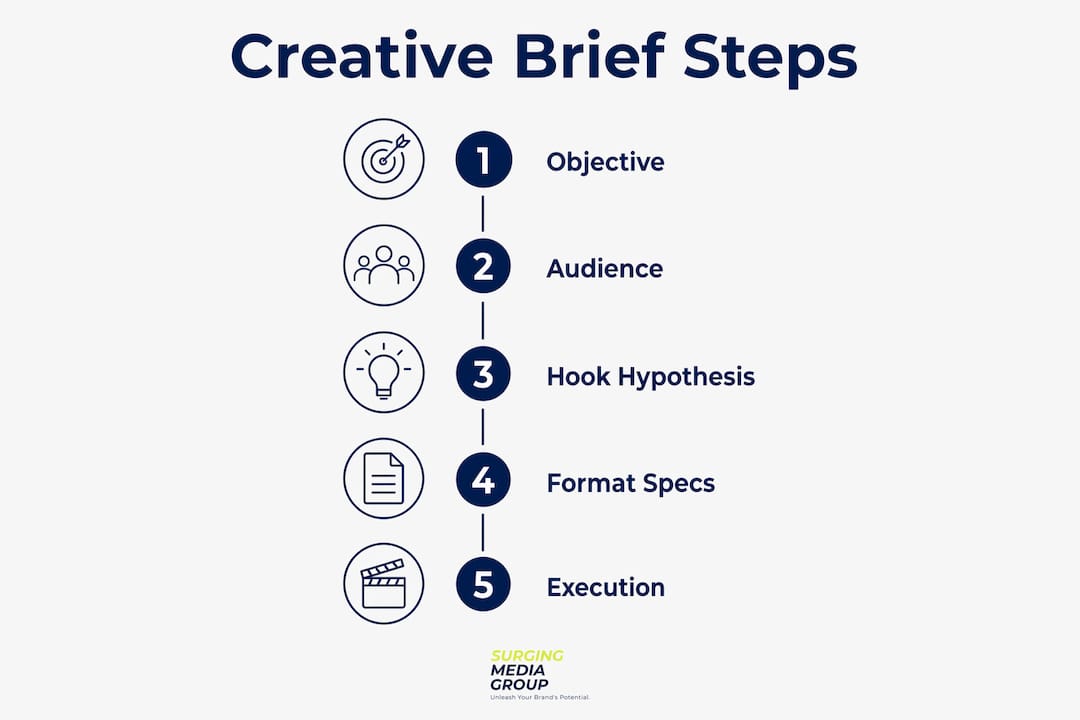
Here is a reference table for the core fields every brief should contain:
| Brief Field | What to specify |
|---|---|
| Campaign objective | Single conversion goal (purchase, lead, install) |
| Audience profile | Demographics, psychographics, pain point |
| Hook hypothesis | Predicted response + measurable metric |
| Format and specs | Aspect ratio, safe zone, length, audio requirements |
| Annotated reference ads | 2-3 examples with notes on what to replicate |
| Success metric | Primary KPI and threshold for scaling |
| Revision protocol | Maximum number of revision rounds |
Pro Tip: Keep the brief to one page. Anything longer signals that you have not made the strategic decisions yet. Creatives read one-page briefs. They skim everything else.
How to research before writing your brief
Preparation separates a brief built on instinct from one built on evidence. Before writing a single word, you need a competitive audit, a swipe file of annotated reference ads, and a clear picture of what formats are winning on each platform. This research phase typically takes two to three hours, but it saves days of revision cycles.
Follow this sequence before drafting any brief:
- Run a competitive audit using Meta Ad Library. Search your category, filter by active ads running longer than 30 days, and identify the hook patterns that appear repeatedly. Longevity signals performance. Screenshot and annotate what each ad does in the first two seconds.
- Build a swipe file organized by hook type. Categorize your collected ads into pattern-interrupt hooks, demonstration cuts, and social proof narratives. These are the three winning archetypes on Meta Reels, and they translate well across platforms with minor adjustments.
- Identify format gaps in your category. If every competitor runs talking-head UGC, a product demonstration in native vertical format becomes a differentiator. Your brief should explicitly call out the gap you are exploiting.
- Pull platform-specific performance benchmarks. TikTok, Meta, and YouTube each publish creative best practices that include engagement benchmarks. Use these to set realistic success metric thresholds in your brief rather than guessing.
- Document your audience targeting assumptions. Cross-reference your audience targeting strategy with the creative direction. A brief written for a cold audience needs a different hook than one retargeting warm visitors.
Pro Tip: When annotating reference ads in your swipe file, write one sentence explaining why each element works, not just what it is. That interpretation is what makes the reference useful to a creator who was not in your strategy meeting.
Platform-specific specs and best practices for 2026
Platform specifications are not suggestions. They are the physical constraints of the environment your ad lives in, and a brief that ignores them produces creative that fails before the audience even judges it. Meta, TikTok, and YouTube Shorts each have distinct technical requirements and audience behavior patterns that must be woven into every brief you write.
| Platform | Format | Hook window | Audio behavior | Key constraint |
|---|---|---|---|---|
| Meta Reels | 9:16 vertical | First 3 seconds | Audio-on preferred | Safe zone: avoid UI overlay areas |
| TikTok | 9:16 vertical | Full hook within 2 seconds | Trending audio boosts reach 22% | No brand intros; cuts every 2-4 seconds |
| YouTube Shorts | 9:16 vertical, under 60 seconds | 0-2 second hook window | Design for audio-off survivability | Avoid top 10% and bottom 25% of frame |
Meta Reels ads demand native vertical 9:16 content with fast hook resolution and audio-on storytelling. The three archetypes that consistently win are the pattern-interrupt, the demonstration cut, and the social proof narrative. Your brief should specify which archetype you are testing and why it fits the audience and offer. Effective briefs specify audio design explicitly, because platform viewer behavior varies by placement and a creator who defaults to silence will underperform on Reels.
TikTok operates on a different cognitive clock. Users decide to stay or scroll within approximately 0.3 seconds, and the full hook, meaning the combined visual, audio, and text stimulus, must complete within two seconds. Using trending sounds is not optional decoration. It boosts reach by 22% and signals to the algorithm that the content belongs in the feed. TikTok ads applying proper hook techniques and native formats achieve 40-65% lower CPA compared to platform averages. That is a performance gap wide enough to determine whether a campaign is profitable.
YouTube Shorts briefs require a 0-to-2-second hook window and must account for audio-off survivability through captions and text overlays. Place all critical visual information outside the top 10% and bottom 25% of the frame, where YouTube's UI elements obstruct the view. Pacing on Shorts rewards faster cuts than standard YouTube content, but not as aggressive as TikTok. Brief your creators with explicit frame-safe guidelines and sample caption placements.
Pro Tip: Never reuse a Meta brief for TikTok without rewriting the hook hypothesis and audio direction. The platforms share a format but not an audience mindset. What reads as authentic on TikTok often reads as low-effort on Meta, and vice versa.
Step-by-step process to write and execute your brief
Writing a brief is a discipline, not a template exercise. The sequence matters because each field informs the next. Here is the process that produces briefs worth executing.
- Define the single campaign objective. One ad, one goal. Purchase, lead capture, or app install. Multiple objectives produce creative that serves none of them.
- Write the audience profile. Include demographics, the specific pain point the ad addresses, and the emotional state the viewer is in when they encounter the ad in their feed.
- Craft the hook hypothesis. State the predicted emotional or behavioral response, the creative mechanism that triggers it, and the metric you will use to validate it. This is the most important sentence in the brief.
- Specify all technical requirements. Aspect ratio, video length range, safe zone dimensions, audio requirements, and caption guidelines. For short-form social video, these constraints are tighter than most marketers expect.
- Include two to three annotated reference ads. Pull from your swipe file. Write one sentence per annotation explaining what the reference demonstrates, not just what it shows.
- Define the success metric and threshold. Specify the primary KPI and the number that triggers scaling. "A 3-second view rate above 30% and a CPA below $45" is a success metric. "Good engagement" is not.
- Set the revision protocol. Cap revisions at two rounds. More than two rounds signals a brief that was not specific enough, not a creative team that needs more feedback.
Once the brief is written, communicate it in a live walkthrough with your creative team, not just as a document drop. Walk through the hook hypothesis, the reference ads, and the success metric together. Questions that surface in that conversation reveal ambiguities in the brief that would otherwise surface as off-brief work in post-production.
Testing follows execution. Start with hook variants, then test body structure, then CTA variations, isolating each variable for reliable optimization. Hook testing yields the highest performance uplift of any variable. For TikTok specifically, test a minimum of three hook variations per ad concept using trending sound hooks and native formats like green-screen or split-screen.
Common pitfalls in creative briefing and how to avoid them
Even experienced teams fall into predictable traps when briefing social video ads. Recognizing these patterns early saves budget and production time.
- Omitting the hook hypothesis. A brief without a testable hook hypothesis is a mood board with a budget attached. Every brief must predict viewer response and name the metric that confirms it.
- Ignoring platform UI restrictions. Creatives that look perfect in editing software often have key text or CTAs buried under platform overlays. Always include safe zone diagrams specific to each placement.
- Overloading the brief with storyboards. For TikTok UGC creators especially, excessively detailed storyboards hamper authenticity. Separate your brief into "Musts" (technical specs, claims, CTA, dos and don'ts) and "Maybes" (hook ideas, angles, references) to protect brand requirements while enabling genuine creator expression.
- Testing only one hook. One hook is a guess. Three hooks is a test. Brief your team to produce multiple hook variations from the start, not as an afterthought when the first version underperforms.
- Skipping competitive research. A brief written without a competitive audit will likely replicate what is already saturating the feed. The research phase is not optional preparation. It is the source of your differentiation.
- Leaving success metrics undefined. Without a clear threshold, creative review becomes subjective and revision cycles multiply. Define the KPI and the number before production begins.
Pro Tip: The "Musts vs. Maybes" framework from TikTok UGC briefing applies to every platform. Brand requirements belong in Musts. Creative latitude belongs in Maybes. When everything is a Must, nothing gets made with conviction.
Key takeaways
Effective social video ad creative briefs require a testable hook hypothesis, platform-specific technical specs, annotated reference ads, and defined success metrics to produce video ads that convert.
| Point | Details |
|---|---|
| Hook hypothesis is non-negotiable | Predict viewer response within 3 seconds and name the metric that validates it. |
| Platform specs belong in every brief | Meta, TikTok, and YouTube Shorts each require distinct safe zones, audio direction, and hook timing. |
| Research before you write | A competitive audit and swipe file turn instinct into evidence-backed creative direction. |
| Test hooks first, always | Hook variants yield the highest performance uplift; test at least three per concept before scaling. |
| Cap revisions at two rounds | More than two revision rounds signals a brief that lacked specificity, not a creative problem. |
Why the hook hypothesis changed how I write every brief
I have reviewed hundreds of creative briefs over the years, and the single most common failure is not missing specs or wrong formats. It is the absence of a real hook hypothesis. Most briefs say something like "open with something that grabs attention." That is not a hypothesis. That is a hope. The shift that changed everything for me was treating the hook as a pre-cognitive stimulus, a combined visual, audio, and text signal that fires before the viewer consciously decides to watch. When you write a brief that way, you stop asking "does this look good?" and start asking "does this trigger the right response in the right person in the right half-second?"
I have also watched teams waste significant budget by reusing the same brief across Meta and TikTok, changing only the aspect ratio. The platforms share a format but not a psychology. TikTok audiences reward rawness and speed. Meta Reels audiences respond to narrative momentum and audio-on storytelling. A brief that does not account for that distinction is not a platform-tailored strategy. It is a copy-paste that costs you performance.
The other lesson I keep coming back to is the value of the revision cap. Two rounds. That is it. When a brief is specific enough, two rounds are sufficient. When a team keeps asking for a third and fourth round, the brief failed, not the creative. That discipline forces better upfront thinking, and it respects the time of every person in the production chain.
The types of video formats you choose matter, but they matter less than the quality of the brief that guides their production. Get the brief right, and the format becomes a vehicle for a strategy that was already sound.
— Sergio
How Surgingmedia helps you produce briefs that perform
At Surgingmedia, we build video content from the brief outward. Every production we deliver for brands like Copper Compression and Black & Decker starts with a platform-tailored creative brief that specifies hook hypotheses, safe zone requirements, and testable success metrics before a camera turns on. If you are running social video campaigns on Meta, TikTok, or YouTube Shorts and your briefs are not producing the creative alignment you need, we can help. Our team handles end-to-end production, from brief development and scripting to distribution and performance analytics. Explore high-converting video production built for direct-response results and see what a brief-first approach does for your ROI.
FAQ
What is a social video ad creative brief?
A social video ad creative brief is a structured document that communicates campaign objectives, audience profiles, hook hypotheses, platform specifications, and success metrics to align creative teams before production begins. It replaces subjective creative decisions with testable strategy.
How long should a creative brief be?
A creative brief for social video ads should fit on one page. Longer briefs signal unresolved strategic decisions and reduce the likelihood that creators will read and apply the guidance.
What is a hook hypothesis in a creative brief?
A hook hypothesis predicts the viewer's emotional or behavioral response within the first three seconds and names the metric used to validate it, such as a three-second view rate above a defined threshold. It transforms the brief from vague direction into a measurable creative test.
How many hook variations should I test per ad concept?
Test a minimum of three hook variations per ad concept. On TikTok, this means three distinct visual and audio combinations. Hook testing consistently yields the highest performance uplift compared to testing body copy or CTA variations.
Do I need a separate brief for each platform?
Yes. Meta, TikTok, and YouTube Shorts each have distinct hook timing windows, audio behavior norms, safe zone requirements, and audience psychology. A single brief adapted only for aspect ratio will underperform on at least two of the three platforms.