

Most marketers assume that a great product video starts with great visuals. The camera, the lighting, the editing. But the teams who consistently produce videos that actually convert know the truth: it all starts with the script. Understanding what is product video script means recognizing it as the strategic backbone of your entire production, not a formality you fill out before the shoot. This guide breaks down the components, the proven structure, the writing best practices, and the templates you need to produce scripts that move people from curious viewer to committed buyer.
Table of Contents
- Key takeaways
- What a product video script actually is
- The proven timing structure for product scripts
- Best practices for writing compelling scripts
- Script examples and templates that work
- Common scripting challenges and how to solve them
- My honest take on what the script really does
- Bring your script to life with expert production
- FAQ
Key takeaways
| Point | Details |
|---|---|
| Script is the foundation | A product video script combines dialogue, visual cues, and a CTA to guide both production and viewer action. |
| Timed structure drives conversions | Effective scripts follow proven timing beats from hook to CTA, keeping each section tight and purposeful. |
| One workflow beats feature lists | Demonstrating a single end-to-end workflow creates more clarity and impact than listing multiple features. |
| Measurable proof outperforms vague praise | Specific, time-bounded social proof builds far more trust than generic testimonials. |
| Format affects production quality | Using an audio/visual side-by-side format reduces on-set confusion and aligns the entire team. |
What a product video script actually is
A product video script is more than talking points on a page. According to Teleprompter.com, a video script maps out pacing, tone, dialogue, visual cues, and call to action to ensure message clarity and engagement. That definition matters because it means the script controls the viewer's entire experience, from the first frame to the final ask.
Where a brand story video or a training video might prioritize atmosphere or instruction, a product video script exists specifically to drive a viewer toward a purchase decision. Every sentence earns its place by either building desire, overcoming doubt, or advancing the viewer one step closer to action.
The core components of any strong product video script include:
- Hook: The first 8 seconds that stop the scroll and earn the next 60
- Problem: A clear, emotionally resonant articulation of the viewer's pain
- Solution and product demo: Where your product is shown resolving that pain, not just described
- Proof: Measurable results, testimonials, or social validation that confirm the product works
- Call to action: A single, specific instruction telling the viewer exactly what to do next
The script also functions as the command center for your production crew. Structured scripts lock in filming decisions and enhance teamwork, reducing the kind of on-set improvisation that inflates budgets and dilutes messages.
Pro Tip: Never hand a script to a production team that separates dialogue from visual instructions. A script that integrates both cuts confusion in half.
The proven timing structure for product scripts
Knowing what a product video script contains is one thing. Knowing how to sequence it within a specific time window is where most scripts either win or lose. There is a conversion-oriented timed structure that top-performing product videos follow consistently:
- Hook (0–8 seconds): Open with a bold statement, a provocative question, or a visual that immediately signals relevance to the viewer's problem.
- Problem agitation (8–25 seconds): Name the pain directly and make the viewer feel understood. This is not about drama; it is about precision.
- Value proposition (25–35 seconds): Introduce your product as the answer. Keep it concise. One sentence of setup is enough.
- Core demo (35–75 seconds): Show the product solving the problem in real time. Focus on a single, clear workflow.
- Social proof (75–85 seconds): Drop a specific, measurable result that confirms the product delivers. "Reduced cart abandonment by 34% in three weeks" beats "Customers love it."
- Call to action (final 8–12 seconds): One ask. One URL or button. No alternatives.
This is not a rigid template so much as a proven rhythm. The hook earns attention. The problem creates identification. The demo provides evidence. The proof removes doubt. The CTA captures intent.
Pro Tip: If your script runs longer than 90 seconds for a direct-response product video, cut the demo section first. Show one "aha moment" end-to-end rather than three moments at surface level.
Here is how a product demo script compares to a training video script:
| Element | Product demo script | Training video script |
|---|---|---|
| Primary goal | Drive purchase decision | Teach procedure or skill |
| Tone | Persuasive and emotionally resonant | Instructional and neutral |
| Focus | Value and outcome | Navigation and steps |
| Social proof | Central and specific | Rarely included |
| Call to action | Always present | Usually absent |
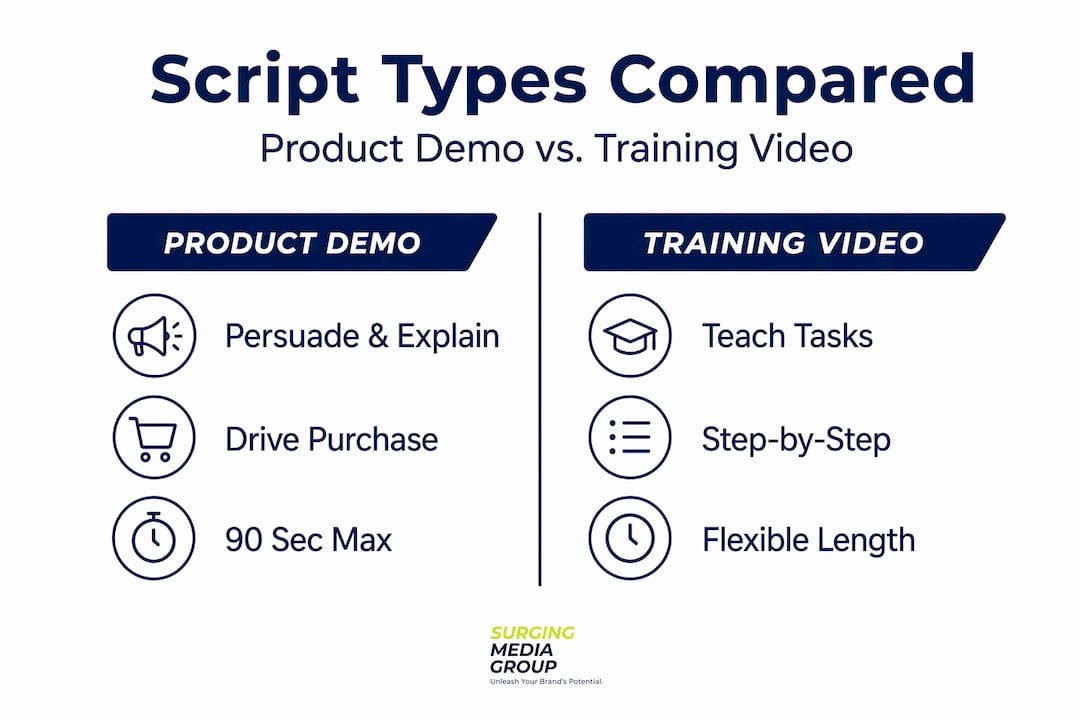
Demo scripts explain AND persuade, while training scripts focus on tasks. Blending the two produces something that does neither job well.
Best practices for writing compelling scripts
The best product video scripts are not the result of raw creative talent. They come from a disciplined process. Here is what that process looks like when applied consistently.

Start with a clear brief. Before writing a single word, define the viewer, the platform, the one action you want them to take, and the one problem your product solves. Ambiguity at the brief stage produces bloat at the script stage.
Use the audio/visual format. A production-ready product script uses an A/V format with dialogue and visual instructions side-by-side. The left column carries what the viewer hears. The right column describes exactly what they see. This is the professional standard for good reason.
Write for the ear, not the eye. Spoken dialogue reads differently than written prose. Read every line out loud. If you stumble, the talent will too.
Anchor every claim in specificity. Vague language destroys credibility. "Saves time" means nothing. "Cuts your reporting workflow from 45 minutes to 8" creates desire. Measurable, time-bounded proof improves conversion rates because it answers the viewer's skepticism with verifiable evidence.
Show one thing well. Focusing on a single key workflow end-to-end maintains viewer attention and communicates value more clearly than rapid feature showcases. This is the single most underused principle in product video scripting.
Here is a quick reference for common script lengths by platform and format:
| Platform/format | Recommended script length | Max screen time |
|---|---|---|
| Amazon product video | 60–90 seconds | 90 seconds |
| Social media reel/ad | 15–30 seconds | 30 seconds |
| DRTV/long-form infomercial | 2–28 minutes | 28 minutes |
| CTV/streaming pre-roll | 15–30 seconds | 30 seconds |
| Landing page demo | 90–120 seconds | 2 minutes |
For Amazon product video sellers especially, sticking to the 90-second window with a tight script structure directly correlates with conversion lift.
Pro Tip: After you finish your draft, read it aloud with a timer. If you exceed your target time by more than 10%, cut dialogue before cutting visual sequences. Visuals carry more persuasive weight than narration in most formats.
Script examples and templates that work
Seeing a product video script template in action makes the abstract concrete. Here is a stripped-down example framework with timing annotations that you can adapt for almost any physical or digital product.
Scene 1 (0–8s): Audio: "Still spending three hours a week manually updating your inventory?" Visual: Close shot of frustrated person staring at a spreadsheet.
Scene 2 (8–25s): Audio: "Manual tracking eats your time, causes costly errors, and keeps you reactive instead of strategic." Visual: Quick montage of common inventory pain points. Error messages. Delayed shipments.
Scene 3 (25–35s): Audio: "There is a better way. Introducing [Product Name], built specifically for growing e-commerce brands." Visual: Clean product logo reveal. Interface overview shot.
Scene 4 (35–75s): Audio: "Watch how it syncs your inventory across every channel in real time, with zero manual input." Visual: Screen recording of one complete sync workflow. No extra features. No detours.
Scene 5 (75–85s): Audio: "Brands using [Product Name] report a 40% reduction in fulfillment errors within 30 days." Visual: Customer quote card with name, company, and result. Real. Specific. Attributed.
Scene 6 (final 10s): Audio: "Get started free at [URL]." Visual: CTA screen with URL and product visual.
What makes this template effective comes down to a few consistent choices:
- Every scene has a single job, and the scene ends when that job is done
- The demo never detours into secondary features or menu navigation
- The social proof uses a number, a timeframe, and a category of result
- The CTA appears both in audio and visually, reinforcing the ask
You can find deeper inspiration for brand storytelling structure when crafting scripts for more narrative-driven product videos.
Common scripting challenges and how to solve them
Even experienced marketers run into the same recurring obstacles when writing product video scripts. Knowing them ahead of time prevents the rewrites.
- The script reads like a user manual. This happens when writers default to explaining features rather than demonstrating value. Scripts that focus solely on procedural navigation dilute persuasive power. Ask yourself for every line: "Does this move the viewer toward buying, or does it just explain how the product works?"
- The script tries to show everything. Feature overload is the most common kill shot for product video scripts. Narrow to one workflow before you write a word.
- The timing feels off in production. Scripts that look short on paper often run long on camera. Read dialogue at speaking pace, not reading pace, during your timing review.
- The social proof sounds forced. Integrate proof organically by tying it to the exact moment in the demo where the viewer would naturally ask "but does it actually work?"
- The production team goes off-script. This is a coordination failure, not a talent failure. A well-structured A/V script gives directors and talent fewer reasons to improvise because every decision is already made on the page.
Pro Tip: Schedule a script read-through with your production lead before the shoot day. When the director and the writer are aligned on what every visual instruction means, the shoot runs faster and the edit is cleaner.
Understanding how scripted video assets drive better ad account performance can also help you build the internal case for investing in scripting before production.
My honest take on what the script really does
I have watched a lot of product videos fall short. Not because the production quality was poor, not because the product was weak. They failed because the script was treated as a checkbox instead of a strategic document.
In my experience, the scripts that consistently convert share one counterintuitive quality: restraint. The teams that resist the urge to show everything, explain everything, and impress everyone tend to produce videos that move people. The ones that pack every feature into 90 seconds produce videos that confuse people.
I have also seen what happens when vague testimonials replace specific proof. "This changed my business" is practically useless on screen. "We cut our return rate by 28% in the first month" is a reason to buy. That distinction alone is worth more to your conversion rate than any production upgrade.
The other thing I want marketers to really sit with: the script is where your media spend either compounds or leaks. A well-scripted video, repurposed thoughtfully across platforms using a solid content repurposing strategy, multiplies your return on every dollar spent in production. Treat scripting as the strategic work it actually is.
— Sergio
Bring your script to life with expert production
Writing a strong product video script is the first step. Executing it with the production quality that commands attention on every platform is where the real work happens.
Surgingmedia specializes in high-converting video production for brands that need results, not just content. From concept and scripting through distribution and performance analytics, the team at Surgingmedia brings direct-response discipline to every production. Whether you are creating an Amazon product video, a social media ad, or a full DRTV campaign, their process is built to turn a great script into measurable sales. Explore how Surgingmedia's video production services can amplify what you have already built on the page.
FAQ
What is a product video script?
A product video script is a structured document that combines dialogue, visual instructions, and a call to action to guide production and drive viewer behavior. It maps pacing, tone, and messaging to move the viewer from problem awareness to purchase decision.
How is a product demo script different from a training video script?
A product demo script is designed to persuade and explain, focusing on the value the product creates. A training video script focuses on procedures and navigation, with no expectation that the viewer will make a purchase.
What should a product video script include?
An effective product video script includes a hook, problem statement, value proposition, product demo focused on one key workflow, specific social proof with measurable results, and a single clear call to action.
How long should a product video script be?
Script length depends on platform and format. Social ads typically run 15 to 30 seconds, Amazon product videos run 60 to 90 seconds, and landing page demos can extend to two minutes. Every section should earn its time.
What makes a good video script for product marketing?
A good product video script is specific, persuasive, and disciplined. It focuses on one workflow, uses measurable proof over generic praise, writes dialogue for the ear, and gives every scene a single clear job to do.