

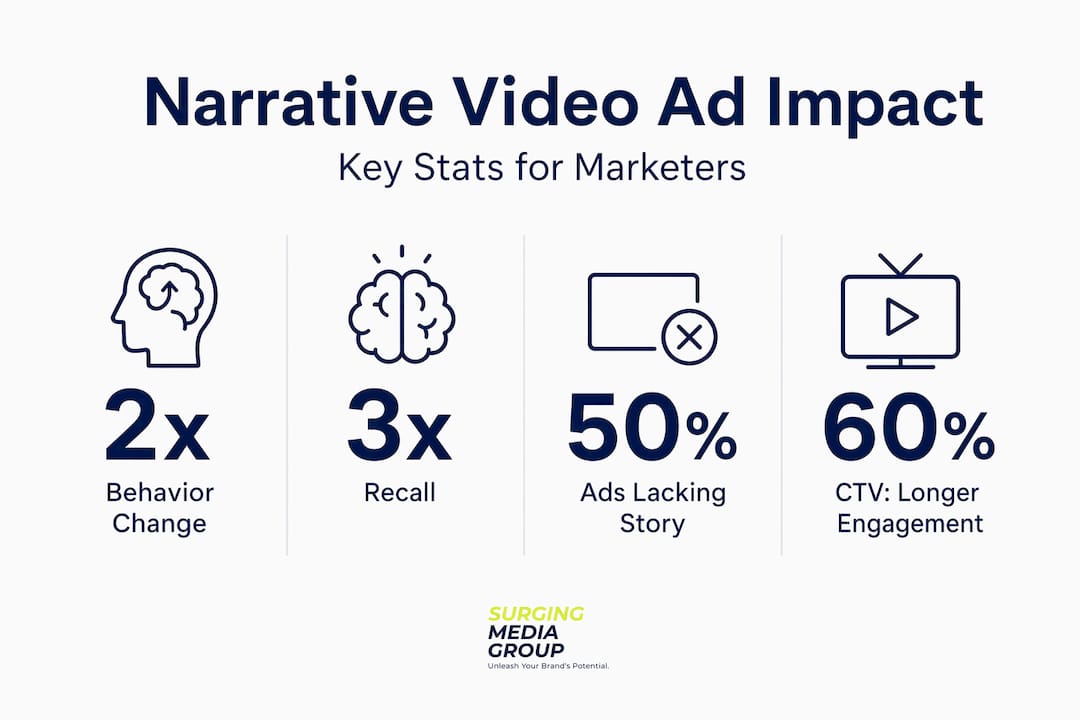
Most video ads still sell features. They list specs, show product close-ups, and wrap with a logo. And most of them are forgotten within hours. Narrative driven video ads explained clearly: they work differently, reaching viewers not as consumers but as human beings with emotions, goals, and stories of their own. Research published in 2026 shows that ads using storytelling are twice as effective at changing consumer behavior compared to feature-focused campaigns. If you're a brand marketer or advertising professional looking to close the gap between creative effort and real business results, this guide gives you the frameworks, structures, and platform strategies to make it happen.
Table of Contents
- Key takeaways
- Narrative driven video ads: definition and why they matter
- Anatomy of an effective narrative video ad
- How to create narrative video ads that actually perform
- Platform considerations for narrative video ads in 2026
- Measuring the impact of narrative ad campaigns
- My take on why narrative ads are non-negotiable
- How Surgingmedia helps brands tell stories that sell
- FAQ
Key takeaways
| Point | Details |
|---|---|
| Narrative ads outperform feature ads | Storytelling doubles behavior change effectiveness compared to product-feature-led campaigns. |
| Emotional arc comes before production | Define your value, voice trait, and target emotion before a single frame is shot. |
| Short narratives beat padded ones | Tight 15-second story arcs consistently outperform longer, less focused 30-second formats. |
| Platform shape determines story structure | TikTok, streaming, and social each demand different narrative formats and pacing decisions. |
| Measure beyond clicks | Engagement depth, recall lift, and sentiment analysis reveal true narrative ad performance. |
Narrative driven video ads: definition and why they matter
A narrative-driven video ad is any ad built around a storytelling arc. It has characters, a situation with some kind of tension, and a resolution that connects emotionally to a brand's promise. What it is not is a product demo with background music. The distinction matters more than most marketers realize.
Traditional ads operate on a logic-first model. They present a product, state its benefits, and ask viewers to act. Narrative ads operate on an experience-first model. They pull viewers into a scene, attach them to a character, and let the brand's value emerge through the story rather than being declared outright.
The psychological mechanism driving this is called narrative transportation. When viewers mentally inhabit a story, they project their own goals and struggles onto the protagonist, which deepens engagement and lowers the psychological resistance to persuasion. That's not a soft benefit. It's the engine of why narrative ads convert.
"The most compelling ads don't tell viewers what to think. They make viewers feel something, and that feeling does the persuading."
Despite decades of evidence, nearly 50% of video ads still lack any narrative structure. That gap represents a real competitive opportunity. Brands willing to shift from listing features to telling stories are working with a structural advantage, not just a creative preference. The benefits of storytelling in ads extend from immediate recall all the way through to long-term brand equity.
Anatomy of an effective narrative video ad
The core storytelling arc in advertising follows the same structure that has worked in fiction for centuries: setup, conflict, resolution. What makes video advertising unique is the ruthless compression required. You have 15 to 60 seconds to make that arc land. Here is what goes into each stage.
- Setup: Establish a relatable character in a recognizable situation. The viewer needs to see themselves within the first three seconds. A parent rushing out the door, an athlete who keeps getting injured, a small business owner drowning in paperwork. Specificity here is not a risk. It's the hook.
- Conflict or tension: Introduce friction. Something is not working, something is missing, or something threatens what the character values. This is the emotional core of the ad. Without tension, there is no story, only a demonstration.
- Resolution: The brand product or service resolves the tension. The resolution should feel earned, not inserted. If the setup and conflict are strong, the brand becomes the natural answer rather than an interruption.
- Call to action: This is the fourth beat many marketers underestimate. The CTA should feel like the next logical step in the character's story, not a hard pivot to sales language.
Beyond structure, the creative devices you layer in determine whether the ad is remembered or skipped. Research shows that humor combined with unexpected elements boosts memorability nearly threefold compared to ads that play it straight. Surprise is a neurological signal. It forces the brain to pay attention and encode the moment more deeply.
For short-form formats, the concept of narrative efficiency matters enormously. Tight narrative arcs in 15-second spots consistently outperform padded 30-second versions, especially with cold audiences who have no prior brand relationship. Every second you spend without advancing the emotional arc is a second working against you.

Pro Tip: Build your conflict around the audience's internal frustration, not the product's external limitation. "I feel invisible at the gym" lands harder than "conventional compression gear doesn't work."
How to create narrative video ads that actually perform
The most common failure in narrative advertising is what practitioners call a failure in the architecture of persuasion. Focusing on product features over human experience is the single most common reason narrative ads underperform. The solution begins before the camera turns on.
Here are the core pre-production disciplines that separate high-performing narrative ads from well-intentioned ones:
- Narrative mapping sessions: Bring your creative, strategy, and production teams together before scripting starts. These cross-team workshops align everyone on emotional arc and messaging direction. They prevent the costly situation where a beautifully shot ad fails because the story logic was never properly stress-tested.
- Define three pre-production pillars: Before filming, every narrative ad should have three things locked in. First, the specific value you're featuring. Second, the voice trait of the brand in this moment (warm, irreverent, confident). Third, the target emotion to elicit for attention and sharing. These three pillars shape everything from casting to color grading.
- Persona-aligned protagonists: Your lead character should mirror your audience's specific identity, not a generic everyman. Viewers project themselves onto protagonists when the character's context matches their own, which is what makes narrative transportation possible. Generic characters produce generic engagement.
- Batch production for consistency: Plan multiple narrative ad variations simultaneously rather than producing one at a time. Shooting in batches maintains a consistent emotional journey across your funnel and makes retargeting sequences feel cohesive rather than fragmented.
- Creative testing beyond CTR: Click-through rate tells you if the CTA worked. It does not tell you if the story worked. Track engagement depth (how much of the video was watched), repeat view rates, and recall lift scores to understand where your narrative is holding attention and where it's losing viewers.
Pro Tip: Create at least three narrative variations per campaign: one that leads with empathy, one that leads with humor, and one that leads with aspiration. The audience will tell you which emotional entry point converts best for your category.
The video ad performance advantage compounds when these disciplines work together. Strong pre-production alignment, persona-specific characters, and batch production give you a library of narrative assets that can be tested, refined, and deployed across every stage of the funnel.
Platform considerations for narrative video ads in 2026
Not all platforms receive story the same way. Format, length, and viewer expectations vary significantly, and narrative strategies built for one platform often fail on another. The table below maps the key differences.
| Platform | Ideal format | Narrative structure | Length |
|---|---|---|---|
| TikTok | Multi-part sequential ads | Hook, story, CTA across three videos | 15 seconds per part |
| Instagram Reels | Single-arc micro-stories | Tight setup-conflict-resolution | 15 to 30 seconds |
| YouTube pre-roll | Extended narrative | Full arc with emotional payoff | 30 to 60 seconds |
| CTV/Streaming | Episodic storytelling | Character-led, serialized arcs | 30 to 90 seconds |
| Amazon | Problem-solution testimonial | Real person, real result | 30 to 60 seconds |
TikTok's approach is worth unpacking because it represents the most structurally different format in current advertising. TikTok's own insights show that the most effective narrative ad formats don't interrupt user experience. They contribute to it. The three-part format, where the first video hooks, the second develops the story, and the third delivers the CTA, uses sequential targeting to tell a complete story across a 15-minute window. Viewers who engage with part one are served part two, and so on. It's episodic storytelling scaled to paid media.
Streaming and CTV platforms reward longer narrative investments. Audiences watching connected TV are in a lean-back, high-attention mindset. Episodic ad campaigns where the same characters appear across multiple spots across a season can build genuine brand affinity. The power of storytelling in this context mirrors how audiences bond with TV characters, which is a level of engagement no product demo can replicate.
The underlying trend shaping all platforms right now is that attention spans are not actually shrinking. What has shrunk is tolerance for irrelevance. A compelling narrative holds attention at any length. A mediocre product pitch loses the viewer at three seconds regardless of format.
Measuring the impact of narrative ad campaigns
Measurement is where many marketers default back to feature-ad thinking. They optimize for conversions and ignore the signals that reveal how the story is actually landing with audiences. These are the metrics that matter most for narrative video campaigns.
- Engagement depth: What percentage of viewers watched 75% or more of the video? A high engagement depth score indicates the story held attention through the critical middle section where many ads lose viewers.
- Repeat view rate: Viewers who watch a video more than once are telling you the story resonated. This metric is a strong leading indicator of recall and brand preference.
- Sentiment analysis in comments: Qualitative signals from social comments reveal emotional reactions that quantitative metrics miss entirely.
- Recall lift studies: These measure whether exposed audiences actually remember the brand and message after viewing. They are the clearest proxy for how effectively the narrative transported viewers into the story.
- Multi-touch attribution for upper funnel: Narrative ads often do their best work at the awareness and consideration stages, which means last-click attribution will consistently undervalue them. Multi-touch models give a truer picture of their contribution to conversion.
Run systematic A/B tests pitting narrative creative against product-feature creative for the same product in the same market. The results from these tests are almost always the most persuasive internal case you can make for investing further in storytelling as a creative video marketing strategy.
My take on why narrative ads are non-negotiable
I've seen brands with genuinely great products create video ads that no one remembers. And I've seen scrappy brands with modest production budgets create campaigns that audiences share, talk about, and return to. The difference is almost never budget. It's almost always whether the ad treated the viewer as someone with a life worth caring about.
What I've learned from years working at the intersection of storytelling and performance marketing is this: the instinct to feature your product is a fear response. Marketers worry that if they don't explain what the product does, the viewer won't understand. But viewers aren't confused about what products do. They're uncertain whether the product understands them.
The most honest thing I can say is that narrative ads are harder to make than feature ads. They require more creative courage, more pre-production discipline, and more patience with testing. The temptation to pivot back to a product shot and a voiceover is real, especially when results are slow in the early testing phase.
But the long-term payoff is brand equity that compounds. I've watched brands that committed to authentic story-led video build the kind of audience relationship that makes every subsequent launch easier and every ad dollar work harder. That's not sentiment. That's how the storytelling advantage plays out in real campaign data over time.
— Sergio
How Surgingmedia helps brands tell stories that sell
At Surgingmedia, we've built our entire practice around the belief that great video doesn't just capture attention. It captures people. Our end-to-end narrative video production services are designed specifically for brand marketers who need storytelling and direct-response performance working together, not pulling in opposite directions.

From narrative mapping sessions and scripting through to production, testing, and distribution across DRTV, CTV, Amazon, and social platforms, our team aligns every creative decision with your conversion goals. Brands like Copper Compression and Black & Decker have trusted us to translate their product value into stories audiences act on. Whether you're building your first narrative ad campaign or scaling creative that's already working, we'd love to show you what's possible when story meets strategy.
FAQ
What are narrative driven video ads?
Narrative driven video ads are ads structured around a storytelling arc with characters, tension, and resolution rather than product features. They engage viewers emotionally and are twice as effective at changing consumer behavior compared to feature-focused formats.
How long should a narrative video ad be?
Tight 15-second narrative ads with complete story arcs consistently outperform padded 30-second versions for cold audiences. Streaming and CTV platforms support longer 30-to-90-second formats where episodic storytelling builds deeper brand affinity.
What makes a narrative video ad memorable?
Ads that combine humor with unexpected or illogical elements boost memorability nearly threefold compared to straightforward ads. Relatable protagonists who reflect the audience's real experiences also significantly increase recall and emotional resonance.
How do you measure narrative video ad performance?
Beyond click-through rate, track engagement depth, repeat view rate, sentiment from comments, and recall lift studies. Use multi-touch attribution to capture the upper-funnel value narrative ads deliver before a viewer converts.
What platforms work best for narrative video ads?
Every major platform supports narrative formats, but structure varies. TikTok's sequential three-part format works well for multi-part stories. YouTube and CTV reward longer arcs. Instagram Reels favors tight 15-to-30-second micro-stories with strong opening hooks.