

Finding the right video production company means securing a partner who combines marketing savvy, technical skill, and transparent deliverables to create video content that drives real sales. The vendor selection process, known in the industry as a video production RFP and partner evaluation, is where most brand marketers either win or waste their budget. 55% of customers purchase products after watching high-quality product videos. That single number explains why the partner you choose matters as much as the script they write. This guide covers every stage of the decision, from evaluating marketing alignment and building a strong RFP, to locking down contract essentials and comparing proposals with a clear head.
What key factors should you evaluate when choosing a video production company?
The best video production companies share one trait that separates them from capable-but-generic shops: they think like marketers first and cinematographers second. A vendor who asks about your conversion goals before discussing camera specs is the one worth your time.
When choosing a video production service, evaluate these core dimensions:
- Marketing alignment. Does the company understand direct-response principles, audience segmentation, and platform-specific formats? Ask how they approach scripting for a paid social ad versus a CTV spot. The answer reveals whether they treat video as art or as a sales tool.
- Service range. Top production partners cover the full arc: concept development, scripting, shooting, editing, and distribution support. Vendors who hand you a finished file and disappear leave you without the performance data that informs your next campaign.
- Portfolio relevance. Watch work made for brands in your category or with your audience profile. A stunning automotive reel tells you nothing about how they handle a direct-response product video for Amazon or a shoppable social ad.
- Company size and specialization. Boutique firms often move faster and assign senior talent to every project. Larger agencies offer deeper bench strength but can route your work to junior teams. Match company size to your project complexity and timeline.
- Budget and value. Subscription-based video services can cut production costs roughly 70% and turnaround time roughly 40% compared to traditional agencies. That benchmark helps you calibrate whether a quote reflects genuine efficiency or corner-cutting.
Pro Tip: Ask every shortlisted vendor to show you a video that underperformed and explain what they learned. Vendors who answer confidently are the ones who treat production as a performance discipline, not just a creative exercise.
Understanding brand storytelling fundamentals before you enter vendor conversations gives you a sharper filter for assessing creative vision. You will spot the difference between a vendor who tells stories and one who just shoots footage.

How to craft and use a strong video production RFP
A request for proposal (RFP) is the document that separates serious vendors from those who submit generic decks. A well-structured RFP takes four to eight weeks from issuance to final vendor selection, so build that window into your campaign calendar.
Here is how to build an RFP that attracts the right partners and filters out the wrong ones:
- Define your project goals and audience. State the campaign objective (awareness, lead generation, direct purchase), the target viewer profile, and the platforms where the video will run. Vague briefs produce vague bids.
- Specify deliverables and timelines. List every asset you need: hero video, cut-downs, vertical formats, subtitled versions. Include your go-live date and work backward to set production milestones.
- State your budget range. Withholding budget invites inflated proposals and wastes everyone's time. A range signals seriousness and lets vendors propose the best work within real constraints.
- Invite creative input. Leave a section where vendors can propose a concept or suggest a format you have not considered. A well-scripted RFP signals respect for vendor expertise and often surfaces ideas that sharpen your brief.
- Define evaluation criteria. Tell vendors how you will score proposals: creative approach, relevant experience, timeline feasibility, and price. Quantitative scoring minimizes bias and makes apples-to-apples comparison possible.
- Set a response deadline and selection date. Vendors plan their capacity around these dates. Giving them two to three weeks to respond shows professionalism and attracts more thoughtful submissions.
Pro Tip: Include two or three examples of videos you admire in the RFP, even if they are from outside your industry. Visual references communicate tone and quality faster than any written description.
What contract essentials protect your investment?
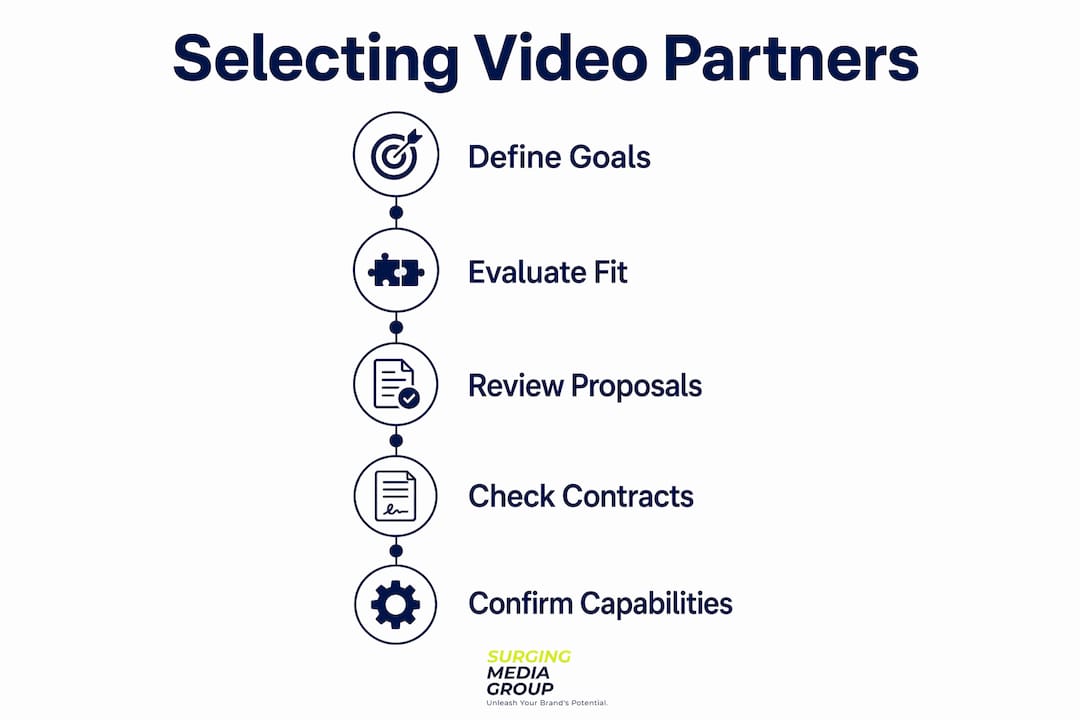
A video production contract is not a formality. It is the document that determines who owns what, who pays for what, and what happens when something goes wrong. Contracts missing termination rights, usage clarity, or liability caps often lead to costly breakdowns that no amount of goodwill can fix.
Every contract you sign should address these points:
- Scope of work. List every deliverable with format, length, and resolution specifications. Ambiguity here is the root cause of most production disputes.
- Revision rounds. Limiting revision rounds via contract clauses prevents scope creep and project delays. Specify how many rounds are included, how feedback must be submitted (consolidated, not piecemeal), and what additional rounds cost.
- Usage rights. Usage rights must be explicitly defined and scoped by channel, territory, and term. A video licensed for organic social use is not automatically licensed for paid media or broadcast. Discovering this after launch is expensive.
- Payment terms. Structure payments around milestones: a deposit at signing, a payment at rough-cut approval, and a final payment at delivery. Avoid paying in full upfront.
- IP ownership. Confirm that you own the final deliverables and all raw footage, or negotiate clearly if the vendor retains any rights. Raw footage ownership matters when you need to repurpose content later.
"A balanced, clear contract protects both the client and the video producer, reducing legal risks and disputes before they surface." — alexberman.com
Contracts also function as professional signals. A well-drafted agreement reassures clients and improves the producer-client relationship from day one. Vendors who resist detailed contracts are telling you something important about how they operate.
How do AI tools and human expertise work together in video production?
AI-assisted video production is not a replacement for human creative leadership. It is a force multiplier for teams who know how to use it. Hybrid AI-human workflows enable scaling volume without sacrificing the authentic emotional connection that makes brand content memorable.
The practical split works like this. AI handles rapid concept generation, script variations, voiceover drafts, and performance testing across multiple ad formats. Human creatives provide the strategic judgment, emotional nuance, and brand authenticity that AI cannot replicate. Hybrid strategies reduce cost-per-lead by 15 to 30%, which is a meaningful efficiency gain for brands running high-volume paid media campaigns.
Competitor intelligence combined with AI production tools helps teams avoid wasted creative testing. Analyzing what formats and messaging structures competitors are running tells you where the market has already validated an approach, so your human creative energy goes toward differentiation rather than reinvention.
When evaluating vendors, ask directly how they integrate AI into their workflow. Vendors who use AI for pre-production research and rapid iteration while keeping human directors and editors in control of final output represent the most capable model available today. You can explore how video assets drive performance when AI and human creativity are properly aligned.
Pro Tip: Request a sample of a vendor's AI-assisted concept deck alongside the final produced video. The gap between the two reveals how much human craft they actually bring to the process.
What are the best practices to compare proposals and select your partner?
Proposal comparison is where most marketers make their biggest mistake: they default to price as the primary filter. Price matters, but it is the last variable you should weight, not the first.
Use a structured scoring approach across these dimensions:
| Evaluation Criterion | What to Look For |
|---|---|
| Creative fit | Does their concept reflect your brand voice and campaign goals? |
| Relevant experience | Have they produced work in your category or for your distribution channels? |
| Communication style | Are they responsive, specific, and collaborative in their proposal? |
| Revision and support policy | Do they define revision rounds and post-delivery support clearly? |
| Price and timeline | Does the quote reflect realistic scope and a feasible production schedule? |
Beyond the scorecard, check references and watch full case studies, not just highlight reels. A highlight reel shows a vendor's best thirty seconds. A full case study shows how they handled a real brief, a real client, and real constraints. Ask references specifically about how the vendor managed scope changes and whether the final product matched the original proposal.
Avoid these common selection mistakes:
- Choosing based on a demo reel that features work from a different industry or budget tier
- Ignoring usage rights until after the contract is signed
- Selecting the lowest bid without understanding what was removed to reach that price
- Skipping the reference check because the portfolio looks impressive
Cultural fit matters more than most marketers admit. A vendor who communicates clearly, respects your timeline, and treats your feedback as collaboration rather than criticism will produce better work than a technically superior team that treats clients as obstacles. For deeper guidance on aligning vendor selection with your content goals, the audience targeting strategies framework from Surgingmedia offers a practical lens for evaluating creative alignment.
Key takeaways
Selecting the right video production partner requires evaluating marketing alignment, contract clarity, and creative fit before price ever enters the conversation.
| Point | Details |
|---|---|
| Marketing alignment comes first | Choose vendors who ask about conversion goals before discussing camera specs or visual style. |
| RFPs filter and attract | A structured RFP with budget ranges and evaluation criteria produces comparable, honest bids from qualified vendors. |
| Contracts define ownership | Specify usage rights by channel, territory, and term to avoid costly renegotiations after delivery. |
| AI amplifies, humans lead | Hybrid workflows cut cost-per-lead by 15 to 30% while human oversight preserves brand authenticity. |
| Score proposals beyond price | Weight creative fit, relevant experience, and communication style before comparing final costs. |
What I have learned from years of watching these decisions go right and wrong
After working across dozens of video production engagements, the pattern I keep seeing is this: the brands that get the best results are not the ones with the biggest budgets. They are the ones who treated the selection process as seriously as the production itself.
The most expensive mistake I have witnessed is a brand signing a contract without defined usage rights, then discovering six months later that their broadcast campaign required a separate licensing negotiation with the production company. The video was excellent. The legal bill erased the ROI. A single clause would have prevented it.
I am also skeptical of the instinct to hire the flashiest portfolio. The vendors who have impressed me most are the ones who ask uncomfortable questions early: "What does success look like in 90 days?" and "What has not worked in your previous video campaigns?" Those questions signal a partner who is invested in your outcome, not just their reel.
On AI, my honest view is that vendors who dismiss it entirely are falling behind, and vendors who lead with it as a cost-cutting pitch are missing the point. The right answer is a team that uses AI to move faster and test smarter, then applies human judgment to everything that touches the audience's emotions. That combination is where the real performance gains live.
Long-term vendor relationships consistently outperform one-off engagements. A production partner who has made three campaigns with you understands your brand voice, your approval process, and your audience in ways that no brief can fully communicate. Build toward that, even if you start with a single project.
— Sergio
Ready to produce video that actually sells?
Surgingmedia specializes in high-converting video content built for direct-response marketing, from DRTV infomercials and Amazon product videos to social media reels and CTV ads. Every project starts with a clear scope, defined deliverables, and a contract that protects your investment from day one. Brands like Copper Compression and Black & Decker have used Surgingmedia's end-to-end production model to drive measurable sales growth across multiple platforms.
If you are ready to work with a team that treats your video budget as a performance asset, explore Surgingmedia's production services and see how purpose-built video content can move your numbers.
FAQ
What makes a video production company right for marketing?
The right production partner understands direct-response principles and asks about conversion goals before discussing creative style. 55% of customers purchase after watching high-quality product videos, so marketing alignment is the defining factor.
How long does a video production RFP process take?
A structured RFP process takes four to eight weeks from issuance to vendor selection. Build that window into your campaign calendar to avoid rushing a decision that affects your entire production budget.
What usage rights should my video contract include?
Your contract must specify every channel, territory, and term for which you are licensed to use the video. Contracts that define exact channels prevent licensing conflicts and the surprise fees that follow when you expand distribution without renegotiating.
How do I compare video production proposals fairly?
Score each proposal across creative fit, relevant experience, communication style, revision policy, and price using a weighted rubric. Watch full case studies rather than highlight reels, and call at least two references before making a final decision.
Should I choose a local or nationwide video production company?
Local videography services offer on-site flexibility and faster logistics for location-based shoots. Nationwide firms like Surgingmedia bring specialized expertise in performance-driven formats and can manage multi-market campaigns from a single production team.