

Testimonial videos are the single most persuasive sales asset a brand can deploy, converting skeptical prospects into buyers by showing real customers telling real stories. Unlike written reviews, which anyone can fabricate in seconds, video captures facial expressions, vocal tone, and genuine emotion in ways that are nearly impossible to fake. That combination is precisely why testimonial videos drive sales at a measurably higher rate than any other form of social proof. Landing pages using video testimonials report conversion lifts between 20% and 80%, and the gap between brands using them strategically and those ignoring them is only widening in 2026.
Why testimonial videos drive sales better than written reviews
The psychology behind video's persuasive power comes down to one word: presence. When a real customer appears on screen, speaks naturally, and describes a specific result they achieved, the viewer's brain processes it the same way it processes a recommendation from a trusted friend. Written text, no matter how well crafted, cannot replicate that neurological shortcut.
Shopify's research on testimonial videos confirms that facial expressions and voice are the two primary drivers of brand affinity in video format. A customer who leans forward, smiles, and says "I went from zero sales to $40,000 in three months" communicates credibility that a five-star text review simply cannot match. The personality comes through, and personality is what transfers trust from the customer to the brand.

This trust transfer is the engine behind video testimonials' sales impact. Buyers at the consideration stage are not looking for more information. They already have information. What they need is permission to believe the brand's claims, and a real human being delivering that permission on camera is the most direct path to a purchase decision.
Video testimonials also engage audiences 2.7x more than written reviews on social platforms. That engagement gap translates directly into more purchase decisions, more shares, and more organic reach without additional ad spend.
Pro Tip: Ask your happiest customers to record a 60-second video on their phone answering one specific question: "What result did you get, and would you recommend us?" That single constraint produces tighter, more credible testimonials than open-ended prompts.
What does the data say about conversion and ROI?
The numbers behind video testimonials are not marginal. They are transformative, and they hold up across industries and funnel stages.
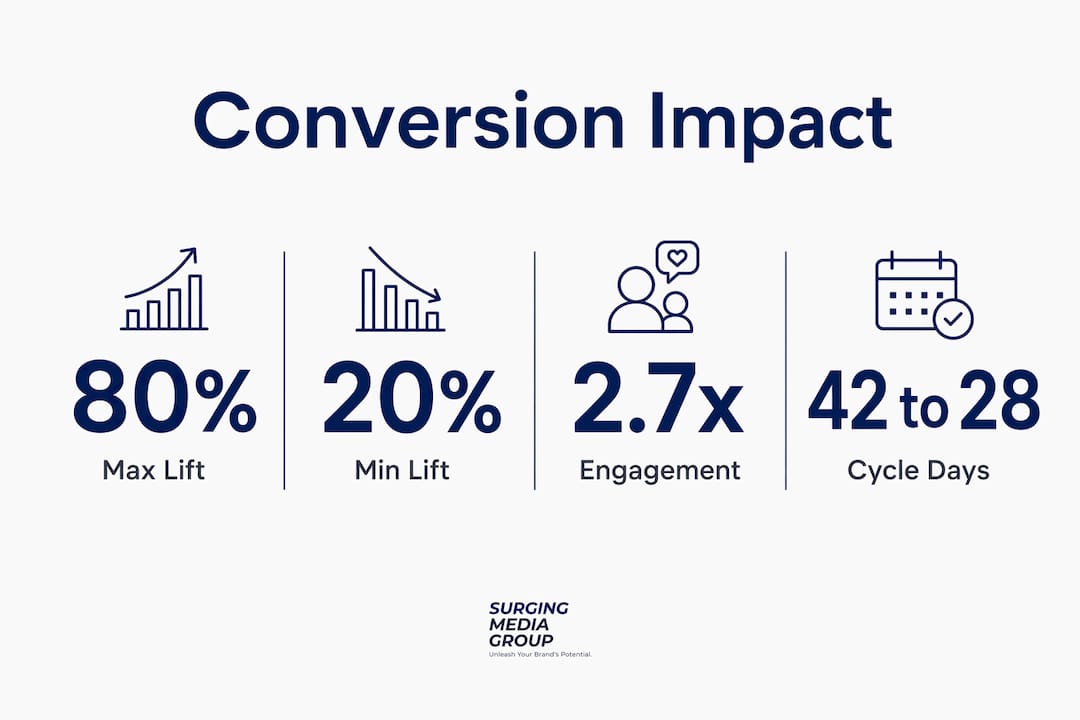
A/B tests consistently show that video testimonials boost conversions 20% to 80% on landing pages, with the range depending on placement, industry, and how well the testimonial matches the buyer's specific concern. That is not a rounding error. An 80% conversion lift on a high-traffic page can represent millions of dollars in incremental revenue.
The ROI case becomes even clearer when you factor in cost per acquisition. Video testimonials lower CPA by roughly 20% to 40%, with one documented example showing a drop from $50 to $38.46 per acquisition, saving nearly $27,700 annually on a single campaign. Production costs for a well-executed testimonial video are typically recovered in under a month at those rates.
Perhaps the most striking case study in recent years involves a SaaS startup that deployed video testimonials throughout its entire funnel. The results were documented and specific:
"Trial-to-paid conversion increased from 8% to 19%, and the average sales cycle shortened from 42 days to 28 days. Overall, the company recorded a 340% conversion increase in six months."
That sales cycle compression matters as much as the conversion lift. Shortening the buying decision from 42 to 28 days means revenue arrives faster, cash flow improves, and sales teams spend less time nurturing deals that stall.
| Metric | Impact |
|---|---|
| Landing page conversion lift | 20% to 80% depending on placement and industry |
| Sales cycle compression | 20% to 35% shorter with strategic video placement |
| Cost per acquisition reduction | 20% to 40% lower versus non-video pages |
| SaaS trial-to-paid rate | Increased from 8% to 19% in one documented case |
| Social engagement vs. text | 2.7x higher engagement on social platforms |
These figures represent what is achievable when video testimonials are treated as performance assets rather than decorative content.
How to combine video and text testimonials for maximum impact
Here is a counterintuitive finding that most marketers miss: video testimonials used alone can actually increase bounce rates. The highest-converting pages pair 3 to 5 videos with 15 to 30 text testimonials organized by use case. Video without text creates an incomplete trust package, and incomplete trust packages lose conversions.
The reason is straightforward. Video delivers emotional resonance and credibility. Text delivers volume, skimmability, and SEO value. A prospect who watches a 90-second testimonial video and then wants to quickly scan 20 written reviews to confirm the pattern is not unusual. Removing that option forces them to make a decision with less confirmation than they want.
Text testimonials support search indexing in ways video cannot, which means they also drive organic traffic to the very pages where video testimonials close the deal. The two formats are not competing. They are complementary, each doing a job the other cannot.
SaaS brands like Slack and Notion execute this pairing well. Their pricing and feature pages typically lead with one or two high-impact video testimonials from recognizable customers, then support those videos with a grid of short text quotes filtered by company size, industry, or use case. That structure lets a prospect self-select the testimonial most relevant to their situation, which is exactly the kind of personalization that reduces friction at the decision stage.
Pro Tip: Organize your text testimonials by buyer persona or use case, not by star rating or recency. A CFO evaluating your software needs to see testimonials from other CFOs, not from marketing managers. Segmentation at this level can lift conversions on high-intent pages by double digits.
The role of testimonial video in e-commerce follows the same pairing logic. Product pages that lead with a customer video and support it with verified text reviews consistently outperform pages that rely on either format alone.
How to create testimonial videos that actually convert
Production quality matters far less than authenticity. Casual, self-recorded clips outperform polished studio productions when the customer speaks to concrete results and the story feels unscripted. Buyers are sophisticated enough to recognize when a testimonial has been coached, and coached testimonials erode the very trust they are meant to build.
The most effective testimonial videos share three structural elements:
- Who the customer is: Job title, company size, or specific situation that mirrors the prospect's own context. This creates immediate identification.
- What measurable result they achieved: Specific numbers, timelines, or before-and-after comparisons. Vague praise ("it's great!") does not move buyers. "We cut our onboarding time from three weeks to four days" does.
- A genuine, unprompted recommendation: The moment a customer says they would recommend a product without being asked directly is the moment trust transfers. Structure your questions to draw that out naturally.
Browser-based recording tools reduce the friction of collecting these videos significantly. Customers can record on their own schedule without scheduling a production call, which increases response rates and preserves the natural, unpolished quality that makes video testimonials credible.
Deploy these videos at the moments of highest buyer uncertainty. The homepage establishes credibility. The pricing page addresses the "is it worth it?" hesitation. The sales deck answers the "can I trust this company?" question before a live call. Each placement serves a different psychological function, and treating testimonials as funnel assets rather than homepage decorations is what separates brands that see 20% lifts from those that see 80%.
For brands selling on Amazon, the same principles apply. Amazon product video best practices consistently show that customer-facing video content placed near the buy button outperforms brand-produced content in driving add-to-cart rates.
Key takeaways
Testimonial videos drive sales because they transfer trust from real customers to your brand at the exact moment a prospect needs permission to buy.
| Point | Details |
|---|---|
| Video outperforms text on trust | Facial expressions and voice create credibility that written reviews cannot replicate. |
| Conversion lifts are measurable | Landing pages with video testimonials report 20% to 80% higher conversion rates. |
| Pair video with text | The highest-converting pages combine 3 to 5 videos with 15 to 30 organized text testimonials. |
| Authenticity beats production polish | Self-recorded, result-focused clips consistently outperform studio-produced testimonials. |
| Place videos at decision points | Pricing pages, sales decks, and checkout flows deliver the highest ROI from testimonial placement. |
What I've learned from years of watching testimonial videos work (and fail)
The most common mistake I see marketing teams make is treating testimonial videos as a one-time content project rather than a living sales system. They collect five videos, post them on the homepage, and call it done. Six months later, those videos feature customers who have churned, products that have changed, and results that no longer reflect current performance. The trust signal becomes a liability.
The brands that get the most from testimonials treat them the way a good sales team treats its best case studies: constantly updated, carefully tagged by industry and persona, and deployed at the specific moment in the funnel where doubt is highest. I have watched companies with modest production budgets outperform competitors spending ten times more on paid media, simply because their testimonial library was current, specific, and placed with intention.
There is also a subtler benefit that rarely gets measured: the effect on the customers who give the testimonials. When you ask a customer to go on record about their results, you are reinforcing their own decision to buy from you. That act of public commitment deepens loyalty in ways that no loyalty program can replicate. The testimonial video is not just a sales tool. It is a relationship asset.
The pitfall I see most often in e-commerce specifically is ignoring text support entirely. A brand will invest in a beautiful video testimonial and place it alone on a product page, then wonder why bounce rates climbed. The video plus text pairing is not optional if you want the full conversion benefit. Think of video as the emotional hook and text as the rational confirmation. Buyers need both, and giving them both is what closes the sale.
— Sergio
How Surgingmedia helps you build a testimonial video system that sells
Surgingmedia specializes in producing testimonial videos built for one purpose: driving measurable sales results. The team at Surgingmedia brings direct-response production principles to every shoot, which means every video is structured around buyer psychology, not just aesthetics. From scripting the right questions to placing finished videos at the highest-impact funnel touchpoints, Surgingmedia handles the full production process for brands ranging from e-commerce startups to established names like Copper Compression and Black & Decker. If you are ready to treat testimonial videos as the revenue-generating assets they are, Surgingmedia offers both local and nationwide production services built to scale with your growth.
FAQ
Why do testimonial videos drive sales more than written reviews?
Video captures facial expressions, vocal tone, and personality, making endorsements far harder to fake than text. Shopify's analysis confirms these elements are the primary drivers of brand affinity and buyer trust.
How much can testimonial videos increase conversion rates?
Conversion rate lifts of 20% to 80% are documented across A/B tests on landing pages, with the range depending on placement, industry, and how closely the testimonial matches the buyer's specific concern.
Should I use video testimonials alone or with text?
Pairing is always more effective. Pages combining 3 to 5 videos with 15 to 30 text testimonials organized by use case consistently outperform pages using either format alone, because video delivers emotional trust while text provides volume and SEO value.
Do high-production testimonial videos perform better than self-recorded ones?
No. Authentic, self-recorded clips that emphasize concrete customer results consistently outperform polished studio productions, because buyers recognize and respond to genuine, unscripted delivery.
Where should testimonial videos be placed for the highest impact?
Place them at moments of highest buyer uncertainty: the pricing page, the checkout flow, and inside sales decks. Treating testimonials as funnel-stage assets rather than homepage decorations is what drives the largest measurable conversion gains.